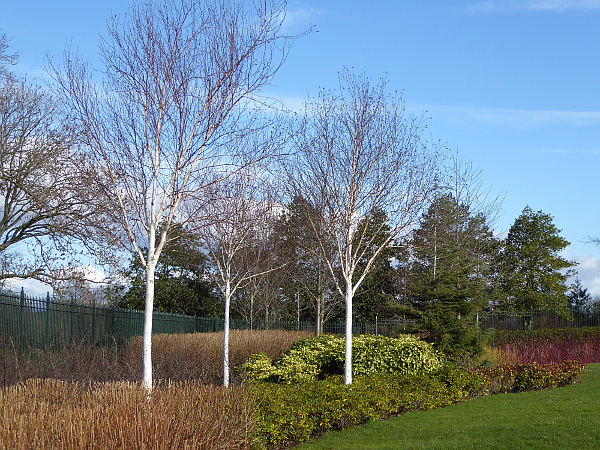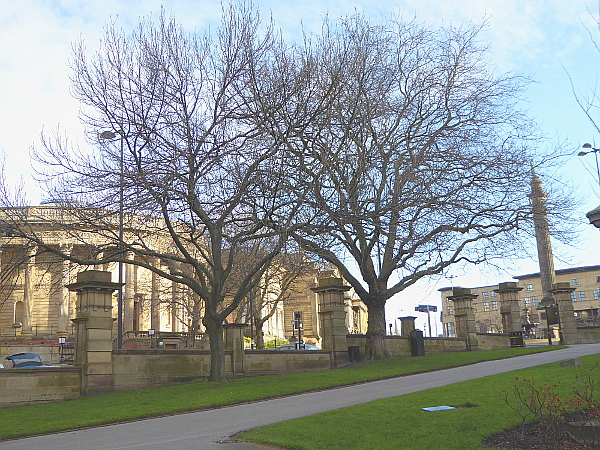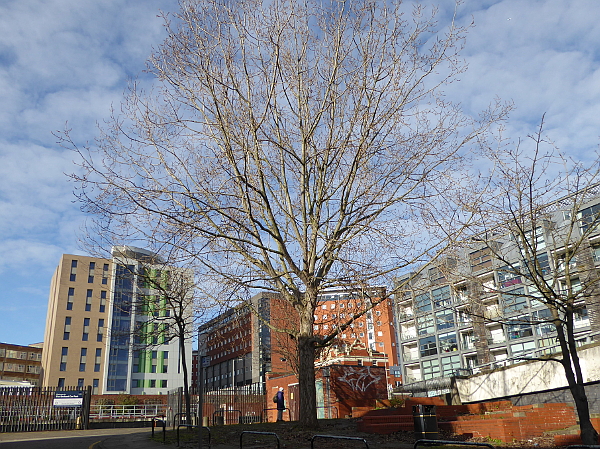
Waterloo Gardens, 10th January 2016

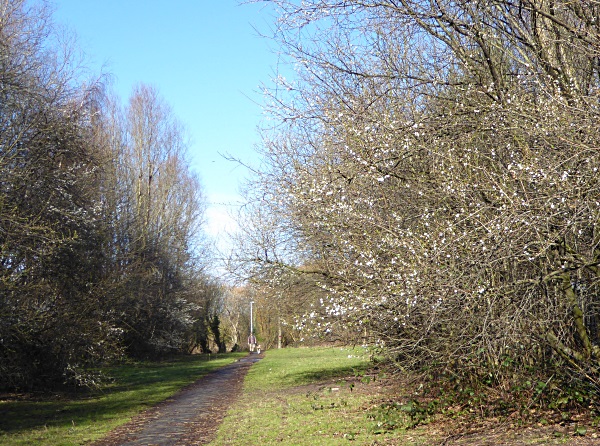
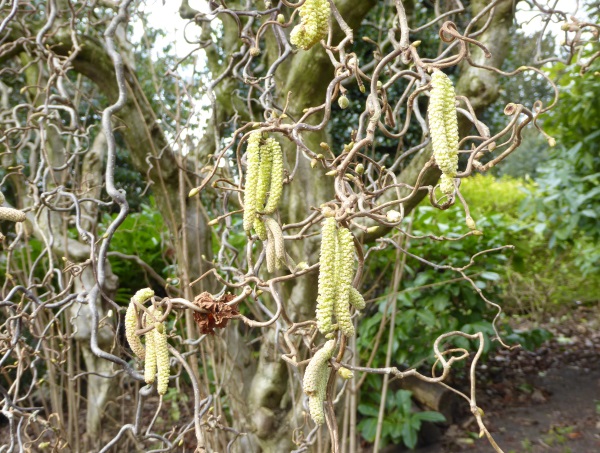
I know it’s only January, but I thought I’d go and look for any signs of spring – any flowers, Snowdrops or catkins. The official Sunday walks haven’t started yet, but it was a fine bright day, ideal for the Waterloo beachfront gardens. In the domestic gardens on the way I noted the hairy buds of Magnolia, one very early Camellia in flower and a Silk Tassel tree Garrya elliptica, which puts out long catkins or tassels in January.

01 Waterloo silk tassells

There were also several examples of the December-flowering shrub Laurustinus Viburnum tinus, which is one of the parents of the winter-flowering hybrid Viburnum x bodnantense.

01 Waterloo Laurustinus

At the north end of Beach Lawn Garden there was a flock of 200-ish Starlings, fluting and whistling on the rooftops then wheeling overhead. Just inside the gate was some kind of Mallow in flower. Is it a Hollyhock Mallow? A garden type, anyway, but a welcome splash of brightness on a brisk January day.

01 Waterloo Mallow

In Adelaide Garden, a Blackbird was chucking low down on a fence, then vanished into the shrubbery. There were lots of Herring Gulls aloft, hovering in the strong onshore breeze. Spears of Daffodils were shooting up.

01 Waterloo Daffs

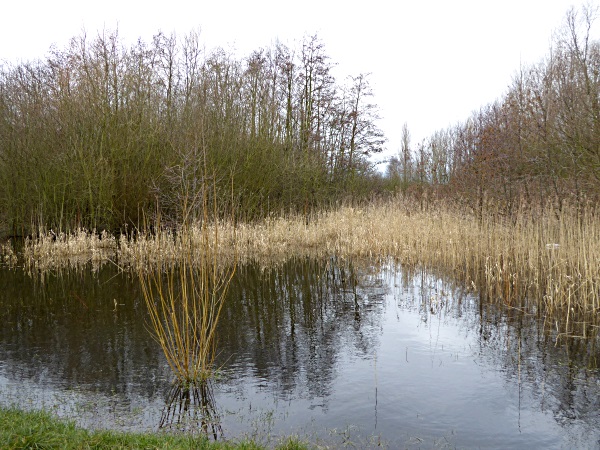
There were Feral Pigeons and Wood Pigeons in Crescent Garden, and also a Carrion Crow defending what looked like a meaty bone. There’s a colony of House Sparrows in the shrubbery. Around the disused raised pond the paths were flooded.

01 Waterloo flooded paths

I stopped for a pot of tea in the café called Waterloo Place, in what used to be the old shop and loo block at the end of South Road. They had lamb stew, hot soup, award-winning pies and home-baked cake. The smart new crockery all matched and I was given a tea strainer and stand. Very elegant! Strongly recommended.

01 Waterloo Christ Church

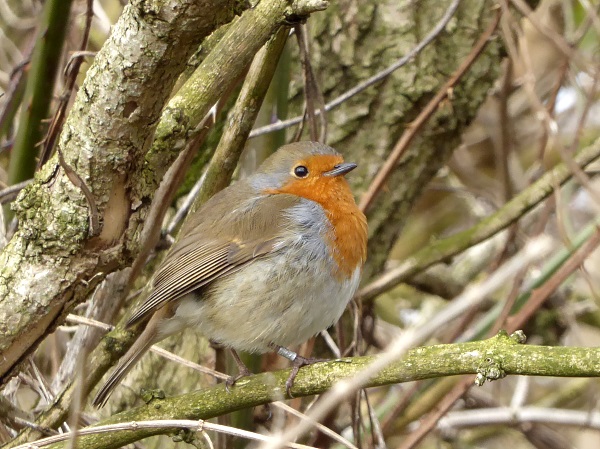
Then into the southernmost garden, Marine Garden, where there were Daisies and Shepherd’s Purse in flower, some Heathers and a cultivated Periwinkle. I spotted no catkins or Snowdrops today, but a Robin was proclaiming its territory from the top of a bush, which must be some kind of forerunner of spring.

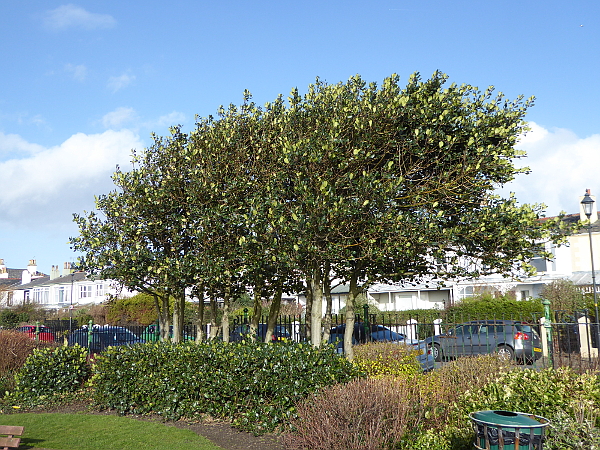
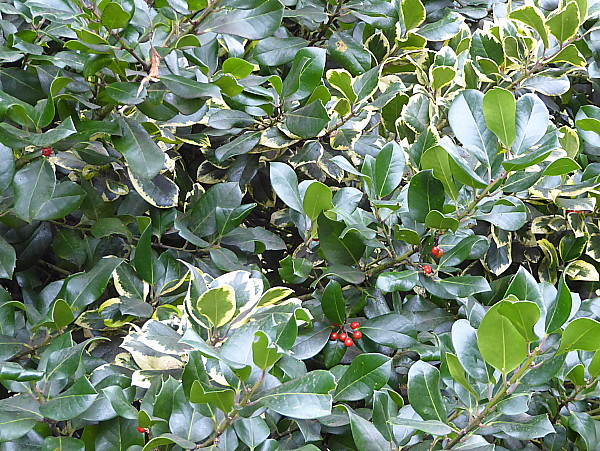
My Tree of the Day was a nicely-shaped Holm Oak, with plain glossy leaves, paler and slightly furry underneath. The bark was dark and finely cracked. I looked up into the crown for acorns to clinch the ID, but couldn’t see any. However the ground underneath was covered with tiny undeveloped acorns, 5-7mm across.  I wonder why they all failed? Is there no other Holm Oak in the vicinity to provide pollen?

01 Waterloo Holm Oak

01 Waterloo failed Holm acorns

My route home took me through Victoria Park, which is surrounded by rows of Lombardy Poplars. The trunks are massive, very gnarled and buttressed. I think they must be the original plantings of 1902, and now over 100 years old.

01 Waterloo Lombardy Poplars

01 Waterloo Lombardy trunks

Public transport details: The nearest station is Waterloo.


Posted in Sunday Group | Comments Off on Waterloo Gardens, 10th January 2016

Croxteth Hall Park, 13th December 2015

50 Croxteth long walk

It was a cold, wet morning, with a steady drizzle all day. On the long walk up to the Hall we noticed an old Hawthorn tree that had come down in storm Desmond, and also that the temporary pond in the wet grass on the left was now nearly encroaching on the path. The herd of Highland Cattle appears to be doing well, now a dozen or more strong, with some young ones. They were ankle deep in mud but didn’t seem to care.

50 Croxteth highland cow

On the lawn opposite the house is an interesting evergreen tree, a Lucombe Oak. It has green glossy leaves and corky bark. See some pictures of it on my post of 11 Dec 2011, where I said it was a hybrid of Holm Oak and Turkey Oak, but that’s wrong – it’s a cross between Turkey Oak and Cork Oak.

50 Croxteth Lucombe oak foliage

The Winter-flowering Cherry was in bloom, probably Prunus subhirtella ‘Autumnalis’.

50 Croxreth cherry blossom

Not a good day for birds it was far too wet. We heard a Great Tit calling tea-cher, tea-cher, and some Crows cawing. Magpies were about in abundance, and some Black-headed Gulls were far out on the fields. A few forlorn Mallards pootled about on the Long Pond, leaving clear trails in the green weed, and some Moorhens ventured out to peck at the wet grass. A clattering of over 50 Jackdaws congregated in a tree above the old stable block.

50 Croxteth Jackdaws

One of the old Beeches on the main lawn was showing off its exposed roots. They are very shallow-rooted trees, and sometimes come down in storms. This one had, luckily, shed all its leaves by the time storm Desmond came along.

50 Croxteth beech exposed roots

North of the Hall, there’s a tree with bark mulch all around it, and a ring of logs. Two strange devices were hanging in the branches, looking like wind chimes, but they weren’t. The tree had a straight bole and tiny acorns, and judging by the fallen leaves nearby, it could have been a Pin Oak or a Scarlet Oak. Is it undergoing some special study by the students at the outstation of Myerscough College nearby?

50 Croxteth tree with device

50 Croxteth device in tree

As we turned back to West Derby Village, we spotted our Tree of the Day. Next to the path at the end of the fountain lake was an otherwise undistinguished tree with delicate drooping bare branches, which we might have easily taken for a Birch, except that it had a lot of spiky seed balls hanging from the branches. They were far too spiky to be Plane fruits. I looked it up at home and it must be a Sweet Gum Liquidambar styraciflua. According to Mitchell’s tree book, the flowers and fruit are “not often seen” in the UK, so our warm summer must have suited them.  In the Southern USA they call it the most dangerous tree in the suburbs, and American gardeners often collect the spiky balls to ward off snails and slugs from their flower beds.

50 Croxteth spiky seed

Happy Christmas and New Year to everyone.

Public transport details: Bus 13 from Queen Square towards Stockbridge Village, getting off at West Derby Village at 10.25. Returned from West Derby Village at 1.45 on the 13 bus, arriving Liverpool city centre at 2.00.


Posted in Sunday Group | Comments Off on Croxteth Hall Park, 13th December 2015

Eric Hardy Memorial Prize 2016

MNA Eric Hardy Prize 2016

Catrin Watkin of the School Of Environmental Sciences, Liverpool University has been awarded the Eric Hardy Memorial Prize 2016 for her MRes thesis ‘Fine-scale habitat associations of bats: implications for conservation’.

Catrin (middle) is pictured along with Prof George Wolff (left) – Head of School and Prof Rob Marrs (right) – Project Supervisor.

Katrin has started a job with the Lancashire Wildlife Trust as a Trainee Ecological and Recording Officer. The MNA wish her well in her future career 🙂


Posted in MNA reports | Comments Off on Eric Hardy Memorial Prize 2016

New Brighton, 6th December 2015

There was a dead hedgehog in road this morning as I set out, outside SS Peter and Paul church in Crosby. It was only a small one, probably quite young, and it seemed to have been hit by a car only an hour or so before.  A bit gory, sorry.

49 New Brighton dead hedgehog

At Wallasey Grove Road Station there’s a sign saying that it is “tended and cared for by the Edible Wirral Partnership”. There was a raised bed, but no sign of any vegetables. More Ivy-leaved Toadflax was growing and flowering, though. What a tough little plant it is!  In light rain we threaded through Groveland Road, past St Nicholas Church and down Newport Avenue, and by the time we got to the prom the rain had stopped. We headed about a mile along the front to New Brighton. A Crow was hovering over the golf club dune heath in the stiff breeze and the Gorse was flowering profusely.

49 New Brighton gorse

There was a lot of sand on this side of the sea wall, probably thrown over in the tail end of Storm Desmond, which had brought flooding to Carlisle and Cumbria.  Several Black-headed Gulls were on the grass, one with its black head starting to show. That’s early!

49 New Brighton BHGs

Scattered on the beach were immature Gulls and a several groups of Oystercatchers, standing on their reflections in the wet sand and preening.

49 New Brighton Oyks

We had great views of the five new “mega-max” quayside cranes, which arrived last month at the new container terminal after an 18,000 sea voyage from Shanghai.

49 New Brighton megamax cranes

We had our Christmas dinner at Wetherspoons, joined there by Seema and Christine, who had been to West Kirby to see the young Red-throated Diver which has been hanging around there for the last week or so.

Public transport details: Train from Liverpool Central Station towards New Brighton at 10.20, arriving Grove Road at 10.40. Returned on 432 bus at 1.35, arriving Liverpool City centre at 2.05.


Posted in Sunday Group | Comments Off on New Brighton, 6th December 2015

Sefton Park, 29th November 2015

48 Sefton Park fountain

The Mute Swan family we saw in the middle of last week wasn’t at the south end of the lake, but there was another individual, standing hesitantly on the grass bank, with a BTO ring but no Darvic ring. Where had that one come from? The usual congregation of birds had gathered for food hand-outs: Canada Geese, Black-headed Gulls, Herring Gulls, a few Common Gulls further out, Mallards, Coots and Moorhens. The male Coots are starting to get aggressive and chasing each other around. A Pied Wagtail flitted around on the far bank, and we noticed two Little Grebes, where we’d seen only one last week. There were still Cormorants on the chain posts and about half a dozen Tufted Duck. I wonder why there always seem to be more males than females?

48 Sefton Park Tufted Duck

Near the grotto tunnel there were two Jays in a tree, and a Ring-necked Parakeet flew over the lake. Up on the higher bank we found this tree with amazing deeply ridged bark. I think it has to be Tree of the Day, although I have no idea what it was. Simply going by book descriptions I guess Black Poplar, Common Walnut or Locust but we need to see it in leaf at some other time of year.

48 Sefton Park ridged bark

The family of eight Mute Swans were by the stepping stones on the middle lake, clustering around some children who were stooping to feed them. There are only seven birds on this photo, but the father of the family (the cob) was a bit further out, keeping an eye cocked for any danger. John was able to take all their Darvic ring numbers again, and the only one missing from last week was now readable as 4BVP.

48 Sefton Park swan family

Both fountains on the upper lake were squirting intermittently, and it looks like there is something wrong with the pump. We had lunch by the aviary, where we were sheltered from the very strong winds. Just opposite was a young tree, probably planted in the last few years, which may have had a name marker on the post in front of it, but it was long gone. Is it  a Blue Atlas Cedar? The foliage matched, but it’s too young to have any cones.

48 Sefton Park Blue Atlas Cedar

Nearby is an astonishing tree trunk. Olive remembers having this pointed out to her by a ranger, possibly Ritchie in his park heyday, and he said something about it being unusual that it dropped its leaves, and that it came from the time of the dinosaurs. I think it must be a Dawn Redwood Metasequoia glyptostroboides, but what an unusually figured trunk!

48 Sefton Park Dawn Redwood trunk

But back to Cedars. There are only four true Cedars (genus Cedrus) and the Cyprus Cedar is small and very rare, so it can be ignored. That leaves just three to sort out, and there is a handy mnemonic about their branches. A = Atlas Cedar (with two colour forms) = ascending;  L= Cedar of Lebanon = level; D = Deodar = drooping. There was a definite Deodar Cedrus deodara in the Dell, with drooping tips to its branches and leaves of different lengths. It was in deep shadow and hard to photograph well. So we’ve seen a mature Atlas Cedar in its green form, a young Blue Atlas Cedar and a Deodar in Sefton Park. Is there a Cedar of Lebanon? I used to live nearby and walked here often, but don’t remember ever seeing one.
48 Sefton Park Deodar
It was a very wild blustery day, with gales up to 60 mph reported. We later heard that some trees were down in Liverpool, disrupting trains and roads, but we weren’t affected. The wind roared in the trees overhead, and over it we could hear Crows cawing, Magpies cackling and the occasional squawks of Ring-necked Parakeets as they flew between the sheltering Scots Pines. In open areas we were sometimes blown to a standstill. There were twigs and bigger broken branches scattered along the paths, some up to two inches across, but mostly already dead wood. In the Dell a large branch had broken off some kind of Willow.

48 Sefton Park broken willow

On the way back around the lake we saw the young Heron from last week, sheltering under the bank of the island.

48 SEfton Park Heron

Public transport details: Bus 82 from Liverpool ONE bus station at 10.07, arriving Aigburth Road / Ashbourne Road at 10.29. Returned on 82 bus from Aigburth Road / Jericho Lane at 1.55, arriving Renshaw Street 2.15


Posted in Sunday Group | Comments Off on Sefton Park, 29th November 2015

Birkenhead Park, 22nd November 2015

47 Birkenhead Park green and yellow

Before meeting the group I had a look at the trees in Williamson Square. The ones on the south side (Richmond Street) are Ginkgos, and one of the four on the other side, outside the football shop and near the Playhouse, has no leaves, so it will have to wait for Spring. The three others are small evergreens, but not conifers, and I think they are Holm Oaks.

47 Birkenhead Park town Holm acorns

The soil under the grid at the base of one of them had been excavated by some small animal, and there was a burrow. I swear I saw something’s nose just pulling back into the hole. A rat? While I waited to see if it would re-emerge two council fellows in yellow jackets came along, one with a white plastic bucket and the other with a large pick. They were sure it was rat diggings and they trowelled rat poison down the burrow.

47 Birkenhead Park town rat burrow

We were joined by two ex-MNA members, Joyce and David, who are also learning about trees. There was a Robin in the Lower Park, and many Grey Squirrels mooching for handouts. On the lake were Mallards, Canada Geese, Coots and a Moorhen. For a few years we have been noting a family of odd black ducks here.  They had been five when we first spotted them on 13th November 2011, but only two survived to 3rd March 2013 and 2nd Feb 2014. This must be the same two again, now coming to the end of their fourth summer.

47 Birkenhead Park black ducks

There were some very dark evergreens in the deep shaded shrubberies but they were far too droopy to be Yew. In retrospect, I suspect  they were Western Hemlocks and I should go back and look again.

47 Birkenhead Park droopy evergreen

The Swiss Bridge was blocked off and partly clothed in scaffolding. Vandalised by fire a few weeks ago, apparently. High up on some trees there were bat boxes, and we looked at an old-looking gnarled tree which probably belonged to the park’s Black Mulberry, of which they are quite proud. They advertise their Cucumber Tree, too, but we didn’t spot that one. Another small tree in a glade was probably a Persian Ironwood, perhaps only about ten years old. We had a good look at a Turkey Oak, noting the deeply indented leaves, the whiskery buds and the cracked bark with orange showing through.

47 Birkenhead Park Turkey Oak foliage

47 Birkenhead Park Turkey Oak bud

47 Birkenhead Park Turkey Oak bark

Christine spotted two Great Spotted Woodpeckers silhouetted high against the sky. They were pecking at the branches and making pieces of bark fly. Goldfinches and Greenfinches were also in distant trees. On the eastern edge of the lake was one of the trees I was hoping to spot, a Camperdown Elm Ulmus glabra ‘Camperdownii’, the weeping version of Wych Elm. The pendulous top is grafted onto a normal Wych Elm trunk. It’s the Cheshire county champion for girth, at 93cm. (There’s another one in Stanley Park in the “Druid’s circle” of London Planes.)

47 Birkenhead Park Camperdown Elm

There were about half a dozen Redwings in a Holly tree, gorging on red berries. They probably came down from Scandinavia on the sudden cold winds we had this week. After lunch at the Visitor’s Centre we headed off to the Upper Park, where a Mistle Thrush scolded us from high overhead. Nearby was the thickly burred stump of an old Sweet Chestnut.

47 Birkenhead Park Chestnut stump

As we approached the westernmost gate, at the junction of Park Road North and Park Road West we spotted two interesting trees over the wall in the garden of the Castellated Lodge. One was a very big Monkey Puzzle, with big brown globular spiky fruits on it, which take two years to mature.

47 Birkenhead Park Monkey Puzzle fruit

A few yards away was our Tree of the Day, a huge old Tulip Tree, with just one leaf left to clinch the identification, which was covered in pointed erect fruits, standing up against the sky like candle bulbs. They only produce fruit this prolifically in hot summers, according to Mitchell.

47 Birkenhead Park Tulip Tree fruit

Public transport details: Train from Central Station at 10.05 towards West Kirby, arriving Birkenhead Park station at 10.15. Returned on the train from Birkenhead Park station at 13.36, arriving Liverpool Central 13.50.

Posted in Sunday Group | Comments Off on Birkenhead Park, 22nd November 2015

Sefton Park, 18th November 2015

Despite the warnings of high winds and torrential rain, nine members met at the Lakeside café at the south end of the lake for this easy short walk (11am to 1pm) looking for water and woodland birds.

46 Sefton Park view

Sefton Park is once again a Green Flag Award winner for 2014/15 and a sign headed “Grassland management within Sefton Park – a site of nature conservation value” says “For the past four years there has been a programme of grassland diversification being carried out within the park as a means of providing increased resources for local wildlife. Most of the grassland in the park is managed for amenity and cut regularly. Other areas, however, are managed for wildlife. These areas are only cut once or twice a year or sometimes even less. This provides greater resources for mammals, birds and insects. The programme is part of the City Council’s effort to improve the biodiversity value of its parks for the benefit of wildlife and visitors.”

46 Sefton Park plan

There were over 40 Canada Geese grazing on the grass verge, unbothered by people walking by. But when a dog walker came along, they hurried back into the water, despite the dog being held on a very tight lead. They were clearly disturbed by all dogs. One sign on the railings asked for dog walkers to respect the Swans, while a more urgent one said, “Recent dog attacks on the family of swans here at Sefton Park have resulted in the female swan and one of her cygnets being injured and having to be taken from the lake by the RSPCA to be treated, thus leaving the male swan and remaining cygnets on their own and therefore in a vulnerable position.” Then followed a warning that CCTV was in operation, and the phone numbers of the RSPCA, the police, Liverpool Direct and the volunteer Swan and Wildlife Watch group. We were happy to see the full family of two parents and six cygnets come sailing along together, clearly recovered from their ordeal.

46 Sefton Park swan family

Other birds on the lake were Mallards, Moorhens, Coots, Black-headed Gulls, Herring Gulls, Lesser Black-backed Gulls, some Tufted Duck, some Cormorants, a Great Crested Grebe and a single Little Grebe.

46 Sefton Park Little Grebe

The warm autumn has confused many plants. We spotted late flowers of Herb Robert, Bramble and Wood Avens. Some things were meant to be flowering, of course. The winter-flowering shrub Viburnum bodnantense was blooming and a small but productive clump of Ivy was providing pollen and nectar for any lingering insects.

46 Sefton Park ivy clump

A sudden monsoon rain shower drove us under a sheltering tree, where we watched a young Heron tough it out.

46 Sefton Park wet Heron

Near the bandstand there is said to be a Black Walnut tree Juglans nigra which is the Lancashire county champion for girth and height (20m, about 65 feet). Now that most of the leaves have fallen, trees are harder to identify, but it must be one of this group. There were big hanging fruits above and many had fallen to the path below.

46 Sefton Park Black Walnut group

46 Sefton Park fallen walnut

The sun came out as we approached the Eros statue. Two Ring-necked Parakeets flew over and we tracked them to the Fairy Glen, where they screeched in the trees overhead. These were lifers for some of the group. All the bird feeders at the usual place seemed to be missing. Have they been nicked? It can’t have been long ago because the area is still full of birds. We saw Great Tit, Blue Tit, Coal Tit, Long-tailed Tits, Wood Pigeon, Jay, Magpies, Carrion Crows, a Treecreeper and a Nuthatch, as well as several fearless Grey Squirrels.

We returned along the other side of the lake. Another sign posted on the railings warned of the dangers of feeding bread to ducks and geese, with dramatic pictures of birds affected by angel wing. The poster made the novel recommendations of feeding oats, sweetcorn or defrosted frozen peas. We came across the family of Mute Swans again and were able to read most of the blue Darvic rings on their right legs: X46, 4MT, 4ANT, 4BVB, 4BVG, 4BVM, 4BVS, and one that was too dirty to read. Last year we recorded one of the adults as XZ6, which may be the same bird as the one read as X46 today.  A confused Coot appeared to be making a nest, and a Cormorant yawned silently on one of the chain barrier posts.

46 Sefton Park Coot on nest

46 Sefton Park cormorant yawning
A Buzzard flew over the trees just as we were breaking up.  I went to investigate my Tree of the Day, a Cedar on the bank.

46 Sefton Park Cedar

It wasn’t the right shape for a Cedar of Lebanon, and it wasn’t droopy-tipped enough to be a Deodar, but the cones were definitely from the Cedar family. I think it was the third member of the genus, the Atlas Cedar Cedrus atlantica. It is most commonly seen in the “blue” form, var ‘Glauca’, and the plain dark green one is rarer. The clincher for me was the description of the infant cones as having pale green scales tipped with lilac.

46 Sefton Park Cedar mature cones

46 Sefton Park cedar infant cones
On my way back to the station via Livingstone Drive I spotted a Blackbird, and also, judging by the fallen leaves, what appeared to be a Red Oak outside the Family Health Centre on the corner of Lark Lane.

46 Sefton Park Red Oak litter

Public transport details: Bus 82 leaves Liverpool ONE bus station or Lime Street stop GD (near the Vines pub) every three minutes or so on weekdays, arriving at the stop before Aigburth Vale about 25 minutes later. I travelled from Crosby on the train to St Michaels, with a 25 min walk to the south end of the park.

If you are interested in the wildlife of the north-west of England and would like to join the walks and coach trips run by the Merseyside Naturalists’ Association, see the main MNA website for details of our programme and how to join us.

Posted in MNA reports | Comments Off on Sefton Park, 18th November 2015

Hoylake and West Kirby, 15th November 2015

There was a high tide of 8.73m due at 12.40, and it was “Wirral Wader Weekend”. Two MNA members, Christine and Seema, joined us for the event. It was a very windy day with squally showers but still very warm: 15°C at 9.15 near North Park, Bootle.

45 West Kirby ranger van

This warm weather has the flowers confused. I saw a Dandelion blooming in town earlier in the week, and my Himalayan Poppies are sprouting new shoots like it’s spring. Near Hoylake Station this Ivy-leaved Toadflax was blooming happily on a garden wall.

45 West Kirby ivy leaved toadflax

Along Stanley Road, amongst the rustling fallen leaves, we came across our Corpse of the Day, a squashed hedgehog on the pavement.

45 West Kirby squashed hedgehog

Cormorants were flying by the Red Rocks, but it was so blowy we set off along the coastal path towards West Kirby. The kite surfers were getting their kit set up and a Kestrel took advantage of the same strong wind to hover over the dunes. In the salt marsh we spotted a Curlew, and further along, a Little Egret.

45 West Kirby Little Egret

A short squall of rain soon blew over, and didn’t disturb the WEBS counters out with their scopes.  The waders were lined up along the water’s edge; Oystercatchers, hundreds of pale grey Dunlin twinkling in the air as they took off, Knot, a few Sanderling and some Brent Geese. Christine was on the look-out for a leucistic Oyk which she had spotted here on the previous day, then she found it again. I think it’s on the first picture below. Count the back row of Oyks from right to left, then between the third and the fourth, drop down.  There is a white head at the back of the front group of Oyks.

45 West Kirby Oyks and Hilbre

45 West Kirby Oyks and Brents

Near West Kirby Margaret went beachcombing in her wellies. She picked up this strand of weed with may kinds of bivalve creatures clinging to it. There was also the test (empty skeleton) of a small Sea Potato, Echinocardium cordatum, only about 6cm across. They live buried in the sand, about 10-15cm down.

45 West Kirby shelly weed

We lunched in the shelter of Sandlea Park, where a Pied Wagtail strutted across the path. Above the roofs was an amusing weather vane in the shape of a fox.

45 West Kirby fox weathervane

There were leaf miners in the Holly. They are the larvae of the fly Phytomyza ilicis, and there is no problem identifying them, because there is only one species which lives on Holly in the UK. Up to three larvae will mine from a single deposit of eggs, and this leaf seems to have three, possibly even four. The tunnels aren’t very long, though. Apparently some larvae will hatch through a small round hole, some will be attacked by a parasitic wasp and some will be pecked out by Blue Tits, which leave triangular beak-shaped holes in the leaf. Must look more closely next time!

45 West Kirby holly leaf miner

Some of us went back to Dee Lane Slipway to join a ranger-led walk, but the less hardy made for home.

Public transport details: Train from Central Station towards West Kirby at 10.05, arriving Hoylake station at 10.30. Returned to Liverpool on the 13.31 train from West Kirby, arriving Liverpool central at 2.05.


Posted in Sunday Group | Comments Off on Hoylake and West Kirby, 15th November 2015

Remembrance Sunday, 8th November 2015

No nature walk today, because we attended the remembrance service at St George’s Hall, which was also an opportunity to see the newly-installed Weeping Window of ceramic poppies. Its formal name is Blood Swept Lands and Seas of Red, and is by artists Paul Cummins and Tom Piper.

44 Remembrance poppy cascade

Then we walked the “Liverpool Remembers” Poppy Trail, a series of 22 posters set up from William Brown Street, along Old Haymarket, Victoria Street, Stanley Street, Whitechapel, Paradise Street, Thomas Steers Way, Albert Dock and ending at the Pier Head. The one in the Museum is rather clever, as it shows a pressed Poppy flower, their herbarium specimen of Papaver rhoeas, collected on the edge of golf links at Hoylake on 17 Jul 1915, the same year John McCrae wrote the poem In Flanders Fields.

44 Remembrance poppy specimen

Subjects covered on the trail include the Milne family, who lost three sons; the 10th (Scottish) battalion of the King’s Liverpool Regiment; boy soldiers; the Liverpool Pals; Private Arthur Procter, VC; the Chavasse family, including double VC Noel; the Dock battalions, black servicemen; and Isabella Innes of the WAACs.

44 Rembrance poster


Posted in Sunday Group | Comments Off on Remembrance Sunday, 8th November 2015

National Memorial Arboretum, 3rd November 2015

43 NMA memorial

I took myself to the National Memorial Arboretum near Lichfield on a Timewells coach trip, attracted by the promise of yet more interesting trees. It turned out to be a bit of a let-down, because the managers of the site appear to focus 95% of their attention on the memorials to all conflicts since the Great War, and haven’t quite got the hang of being an Arboretum yet. It definitely won’t be worth an MNA coach trip for several years.

The 66-page guidebook, which I didn’t buy, expended 64 pages on pictures of memorials, and two pages of very large text, headed “Trees” and mentioning the Douglas Fir pillars in the Chapel, their “rescue” groups of Grecian Fir and Serbian Spruce, and very little else. There were some leaflets in a rack with themed self-guided walks, such as “animals” (on the memorials), “children’s activities” and so on, but (unbelievably for an arboretum) there was no walk themed on special trees. The gift shop was selling a lovely tree calendar, but they were American trees, for heavens sake! I suggested they might hire a photographer and produce a calendar with photos of trees from the arboretum itself. Happily they said they had already had that idea. Even the lady in the entrance lobby, whose job it was to answer visitor queries, and who seemed genuinely to care about the planting and labelling of interesting trees, wanted to tell me about their avenue of Horse Chestnuts. Thanks, but I have seen plenty of Horse Chestnuts before. (They turned out to be spindly little saplings, anyway.) However, she did direct me to two areas with some promise of interest, which turned out to be worth the trip.

They have over 40,000 trees, all young and mostly of common species. Far too many of them are planted in straight lines. There are very few specimen trees with botanical markers, and even those markers aren’t quite up to snuff, with the species part of the Latin binomial often sporting an incorrect capital letter. Hundreds of trees have small name tags on them, but they turned out to be either the name of a deceased soldier, in whose memory the tree was planted, or a marker for a particular regiment or corps. All very fine, but most distracting when you are looking for real tree labels.

In area 6 at the north end, I found my first botanically-labelled trees. They turned out to be easy to see because they were tiny pines, each surrounded by a little protective corral about 18 inches high.

43 NMA corralled tree
To my delight, one was the critically endangered Wollemi Pine Wollemia nobilis which is more closely related to the Monkey Puzzle than the Pines. A lifer! To be sure, I’m only just starting to learn about trees, and there will be plenty more lifers for me in the future, but I think I was just as excited by this little tree as a birder would be when spotting a rare vagrant.

43 NMA Wollemi Pine

Then I walked alongside the River Tame, which had Mute Swan, Mallards, Tufted Duck and a Heron. They are making this a nature area, with a couple of owl nest boxes, a wood pile for insects and fungi, a sign about woodland habitats and a poster for identifying the leaves of native trees. They get good marks for that, although it’s early days yet.

43 NMA River Tame

Along the riverbank were some unusual sculptures, which I thought were about parachutists, but which turned out to be a memorial from the Birmingham Children’s Hospital.

43 NMA sculptures

43 MNA sculpture text

A very obliging Robin posed on a red-berried tree for me, then darted onto the grass and snaffled an earthworm which had come to the surface.

43 NMA Robin

Area 5 at the western edge is themed on wars in the Far East. They have a section of the Burma Railway (the real thing, which has been shipped back to Britain). On the embankment were three different species of white-berried Rowans, which were one of the treats I had specially come to see.  None of them had botanical labels, so I took out my trusty tree book and set to identifying them. The Kashmir Rowan Sorbus cashmiriana was the one whose leaves had already fallen, and which bore just clusters of large white berries.

43 NMA Kashmir Rowan

The leaves of Vilmorin’s Rowan Sorbus vilmorinii had very many small leaflets and had turned bright red. The berries were pinkish.

43 NMA Vilmorin Rowan

43 NMA Vilmorin Rowan berries

The Hupeh Rowan Sorbus hupehensis, my favourite, had grey-green leaves, still not turned to red, with pink and white berries.

43 NMA Hupeh Rowan

43 NMA Hupeh Rowan berries

And I also spotted a real rarity, a Silk Tree  Albizia julibrissin ‘Rosea’, not even in Mitchell’s tree handbook. It has Mimosa-like leaves, and is supposed to have brilliant fluffy rose-pink flowers in the Spring.

43 NMA Silk Tree

Since it’s Remembrance Day soon, here is their collection of votive Poppy crosses, plus the rarely-seen multi-cultural variants – Star of David, plain non-denominational, Sikh Khanda, and Muslim Crescent.

43 NMA Remembrance variants

Posted in MNA reports | Comments Off on National Memorial Arboretum, 3rd November 2015