Parkgate 13th January 2013

On a cold and frosty day, five of us got the 10.30 bus from Liverpool and had a carvery lunch at the Old Quay restaurant. It was a 10 meter high tide at about noon, but it didn’t come in unusually high because the conditions of wind and atmospheric pressure weren’t favourable. Terry had been spotting for several hours and reported several owls, but none of them were about when the rest of us arrived. More members met us at the Old Baths after lunch, so there were about a dozen of us altogether, including one or two new members.

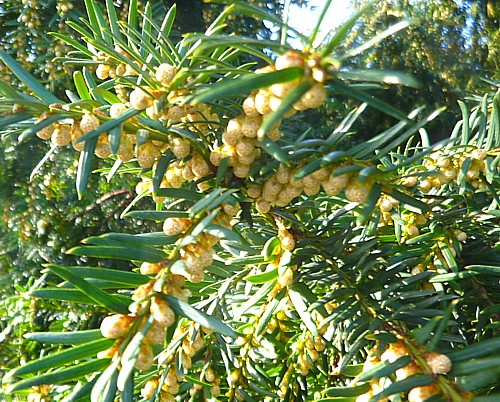
01-parkgate-canopy.jpg

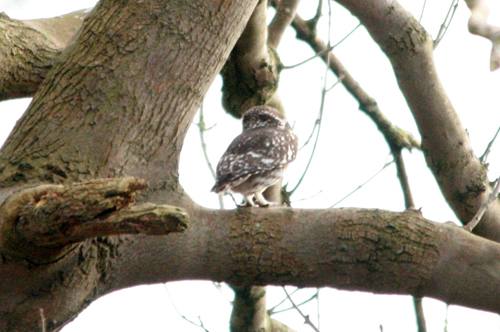
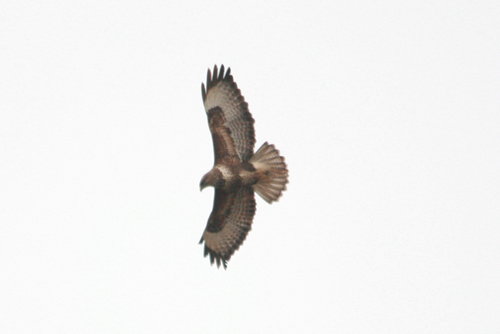
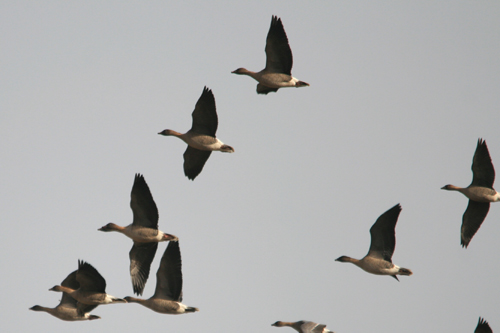
The birding was excellent. At least three Little Egrets were poking about, and there was a Great White Egret further out, seen to be stalking and stabbing its prey. Five Snipe flew over, and the pools close in had Mallards, Black-headed Gulls and Lapwings, a single Moorhen and a Heron.  Then the Lapwings went up, so we checked the sky, and there was a hunting Peregrine, which chased and caught a pigeon. Several hundred Pink-footed Geese took to the air. The WEBS count reckoned there were about 800 of them altogether. The best bird of the day was a superb male Hen Harrier, flying directly southwards, quite near to the sea wall. On the Wirral Way were a Great Spotted Woodpecker, a Jay, a Buzzard, Redwings, Linnets, a Pheasant and a Goldcrest.
01-parkgate-sign.jpg
It started sleeting in mid-afternoon, so the 3.30 bus back to Liverpool was a welcome sight.

Posted in MNA reports | 1 Comment

Fungi Puzzle

From Tony Carter, 24th December 2012

Despite the rain, suitably dressed, I ventured out to Allerton Golf Course on Christmas Eve. The course was closed for play, allowing me to wander without the danger of avoiding flying golf balls. Two interesting fungi species turned up.

The first was Psilocybe cyanescens (Blueleg Brownie). This was an uncommon fungus until woodchip became popular. It can now be found, sometimes in large numbers, where woodchip or sawdust has been used, also on timber that has been used for edging lawns. Some grow regularly in my greenhouse. This one was on the ground beside a tree stump, presumably existing on the bits left after the tree was cut down.  It is a very nondescript species until it is touched or rubbed and then it turns blue. This because it contains the psychedelic drug psilocin (and psilocybin). It is a criminal offence to be in possession of this fungus (I may have to turn myself in).

psilocybe-cyanescens-all-gc-1212.jpg

Many of the common small brown fungi that grow on lawns and in fields contain psilocin and are similarly illegal. As it is impossible to identify them without a microscope, I have never understood how these laws are enforced. I have to take them home before I can tell what they are, so it is not obvious that you have committed a crime until it is too late.

monkey-puzzle2.jpg

The second specimen, totally new to me, was Hohenbuehelia cyphelliformis. A bit of a mouthful, being named after an Austrian naturalist, Ludwig Samuel Joseph David Alexander von Hohenbühel Heufler. This tiny fungus is only 5mm in size, so I was lucky to spot it. It is occasionally found in southern England, so is probably a first for VC59 (the Vice-county of South Lancashire, between the Mersey and the Ribble). The very interesting thing about this find is that it was on a small branch that had fallen from a Monkey Puzzle Tree, Araucaria aruacana, that grows beside the old hall (now the clubhouse). The literature says that it is always on broadleaf wood. Auracaria is most definitely coniferous, sporting some of the largest cones of all. Any fungus growing on a Monkey Puzzle Tree is an oddity. It is being dried so that it can be sent to the collection at Kew Herbarium.

Posted in MNA reports | 1 Comment

Winter Fungi

From Tony Carter 21 December 2012.

At this time of year, the focus of mycological interest turns to bracket and crust fungi that are to be found growing from trees and inhabiting the underside of fallen trunks and branches. Because the physical differences of many of these species of fungi are very slight, it is essential to examine their spores to be able to identify them. Now is when they produce their spores. This is why you should never prune plum trees in winter because of the prevalence of the spores of Chondrostereum purpureum (Silver Leaf Fungus).

Taking advantage of a lull in the persistent rain, I went for a walk around the area comprising Clarke Gardens and The Eric Hardy Reserve in south Liverpool.  A particular venerable yew tree has been supporting a large expanse of a fungus that I had been unable to identify despite taking regular samples over the past year. This time I had success as it had decided to shed its spores. It turned out to be one of the most common fungi, Schizopora paradoxa (Split Porecrust). However, this is highly unusual as there is only one previous record, on the National Database, of this fungus growing on yew.

tn_schizopora-paradoxa.jpg

Interestingly, earlier in the year, this same tree produced another fungus, Nectria coccinea (a form of Coral Spot). Again, only one previous record on this substrate.

tn_nectria-coccinea-taxus-clarke-gardens-0912.jpg

I proceeded further to the lower level of The Eric Hardy Reserve. This was a morass as the stream had obviously overflowed. The mud was over ankle deep and two recently fallen trees made negotiating the path very difficult.  Some gilled fungi were present. Large quantities of Flammulina velutipes (Velvet Shank), a common winter fungus that happily survives frost, were growing from a number of tree sections. It is said to be edible but very slimy and uninteresting. The highly edible enokitake mushroom is a cultivar of this and is found in Asian grocery stores.

tn_flammulina-velutipes-hardy-res-0111.jpg

I also recorded Mycena filopes (Iodine Bonnet), Coprinus micaceus (Glistening Inkcap) and Crepidotus cesatii (Oysterling).

I then spotted two small purple specimens, growing under the protection of a large log. My immediate thought was that they were young Lepista nuda (Wood Blewit) another common winter fungus. But there was something about them (jizz) that made me take them for further examination. It turned out to be a good decision because, under the microscope, the spores were those of an Inocybe, the only purple one I know being Inocybe geophylla var. lilacina (Lilac Fibrecap). This is a common enough species but had me fooled because it lacked the typical pointed cap of the genus. This species is poisonous as it contains muscarine. It has been mistaken for the edible Laccaria amethystina (Amethyst Deceiver). I originally thought it was the edible Wood Blewit. This highlights the difficulties and dangers of identifying fungi purely from their physical appearance.

tn_inocybe-geophylla-var-lilacina-hardy-reserve-1212.jpg

Extracting myself from the mud, I returned home with a couple of crust fungi for further examination. I am still struggling with them. I have extracted all the necessary microscopic information but I may lack the literature to successfully identify them. A good excuse to buy myself a Christmas present?

Posted in MNA reports | 1 Comment

Waterloo, 2nd December 2012

It was cold and overcast, but not frosty, like it had been the last two mornings. On the way through town to Central Station I spotted a recently-dead pigeon in Basnett Street. It had its wings half spread, and its head up, but its breast was all bloody and damaged. It looked as if it had flown into the ground and died as it made a crash landing. Had it been chased by a Peregrine?

On the way from Waterloo Station to the beach there was a fine Magpie’s nest in bare tree on South Road.

36-waterloo-magpie-nest.jpg

On the Boating Lake there were numerous Canada Geese, Mallards and Black-headed Gulls. One of the BHGs was wearing a Darvic ring, but we couldn’t get its number. There were a few Coots charging each other aggressively and about five Tufted Ducks.

36-waterloo-lake-birds.jpg

A small flock of Starlings were roaming about. As we headed for the promenade, the sun came out rather weakly, shining on the sea captain’s houses. One Ragwort was still flowering on the dunes.

36-waterloo-houses.jpg

The tide was coming in fast, and the gulls were high up on the beach. Most were Herring Gulls but there were a few Common Gulls amongst them. A small flock of Sanderlings arrived and scuttled busily around the feet of one of the Iron Men. We looked through the railings to Seaforth Nature Reserve, but there was nothing interesting to see, just a few Cormorants and a Heron. There was a large flock of something further back. Grey Plovers?  We ate our lunch overlooking the Marine Lake, watching the exertions of a rowing team.

36-waterloo-rowers.jpg

Just over the fence into the Freeport is a mural of old Crosby on the side of a big warehouse, showing the Titanic, the Overhead Railway, Five Lamps, the sand dunes, an old bathing machine and a rather splendid Cormorant!  36-waterloo-mural.jpg

Then we headed up to St Faith’s Church at the junction of Crosby Road North and Kingsway. They were having a Christmas Tree Festival, with over 40 trees lining the nave, each decorated by a different charitable group. In true C of E style the ladies of the church were offering refreshments and an assortment of home-made jams and pickles. The church has a memorial to a former parishioner, Joseph Bell, the Chief Engineer of the Titanic, who was lost with the ship. They also have a stained glass window to another of their “old boys”, Robert Runcie, the former Archbishop of Canterbury.
If it isn’t too early, Happy Christmas to all!

36-waterloo-christmas-trees.jpg

No further walks until 20th January 2013.  Walks in January and February 2013 will meet 10am Queen Square, and destination will depend on the weather.

Anyone is welcome to come out with the Sunday Group. It is not part of the MNA, although it has several overlapping members. We go out by public transport to local parks, woods and nature reserves all over Merseyside, and occasionally further afield.  We are mostly pensioners, so the day is free on our bus passes, and we enjoy fresh air, a laugh and a joke, a slow amble in pleasant surroundings and sometimes we even look at the wildlife!
If you want to join a Sunday Group walk, pack lunch, a flask, waterproofs, binoculars if you have them, a waterproof pad to sit on if we have to have lunch on the grass, and wear stout shoes or walking boots. We are usually back in Liverpool City Centre by 4pm at the latest.

Posted in Sunday Group | 1 Comment

MNA Coach Trip Leighton Moss RSPB Reserve

Twenty five MNA members joined our final coach trip of the year to the popular destination of Leighton Moss RSPB Reserve. The coach driver dropped off the majority of the group down at the coastal hides that overlook Morecambe Bay, saltmarshes and coastal pools. The Allen and Eric Morcambe Hides have recently been replaced with money from the Heritage Lottery Fund. They afforded us some great views of a Peregrine sat on a fence post, Lapwings 600+ which were flighty as ever taking off if any Carrion Crow came too close, Curlew 14+, Redshank, a lone Spotted Redshank in its silvery Winter plumage and prominent eyestripe, plenty of Winter ducks with Shoveler 25+ pairs, Pintail 3 pairs, Gadwall 3pairs, Wigeon 175+ and Teal 200+. Out at the back of the saltmarsh Greylag Geese 50+ were joined by the odd Canada Goose, Shelduck, Grey Herons, Mute Swans, Little Egret 4+ and a Great White Egret.

mna-leighton-moss-yellow-brain1.jpg

Yellow Brain

We noted the fungi with Jelly Ear Auricularia auricula-judae, Blushing Bracket Daedaleopsis confragosa, Candlesnuff Fungus Xylaria hypoxylon and Yellow Brain Tremella mesenterica. A small woodpile held Oysterling Crepidotus sp. Crystal Brain Exidia nucleata and a Mycena sp.  An interesting find was Willow Jelly Exidia recisa an orange-brown gelatinous conical fungi which grows in groups on dead branches of Salix (willow) still attached to the tree.

mna-willow-jelly.jpg

Willow Jelly

We slowly wandered back along the lane to the main reserve finding some Coral Spot Nectria cinnabarina en route and watching a rattling Mistle Thrush. An unfortunate road casualty was a Blackbird. Not wishing to add to the fatality list myself with the number of speeding drivers I moved the corpse to some ivy for a photo.

mna-blackbird-corpse1.jpg

Dead Blackbird 🙁

We walked along the causeway to Public Hide passing the impressive Oakmoss Lichen Evernia prunastri on the trees. More wildfowl with numerous Gadwall 44+ pairs, Coot 120+, few Shoveler, Tufted Duck 7 pairs, Goldeneye 2 females, a lone Cormorant and a superb sub-adult male Marsh Harrier – it should have returned to Africa by now but was expertly manoeuvring over the reeds intensively searching for prey occasionally dangling its feet as it dived into the reeds. We had more excitement as the whole of the wildfowl gathering suddenly swam into open water away from the reedbed. An otter has recently been doing the rounds and had earlier taken a Coot.

mna-public-hide.jpg

View From Public Hide

We walked along towards the Grizedale Hides. More Willow Jelly Exidia recisa along with Velvet Shank Flammulina velutipes and Bleeding Broadleaf Crust Stereum rugosum.

mna-leighton-broadleaf-crust1.jpg

Bleeding Broadleaf Crust

A number of people had been putting out handfuls of bird seed on tree stumps along the path and some seed placed in a hollowed out fallen tree trunk proved a great hit! Blue and Coal Tits were joined by a Nuthatch, Treecreeper and a couple of Marsh Tits – very similar in appearance to Willow Tits some handy ID hints include the Marsh Tits distinctive ‘pitchu’ call, lack of a pale wing panel and presence of a  pale ‘cutting edge’ to the bill. As the gloom began to descend we heard the distinctive raspy “scaip-scaip” call of Common Snipe over the reedbed along with some bellowing from the Red Deer. As a finale to the day we were treated to the swirling aerial display from the massive Starling flock before it descended into the reedbed to roost for the night. A great trip to end the 2012 MNA programme!

Posted in MNA reports | 1 Comment

Chester, 18th November 2012

On a bright sunny morning, after an overnight frost, we took the 10.15 train to Chester and set off on our usual walk along the canal.

35-chester-canal.jpg

There were only a few Mallards, one Moorhen, and the usual town tykes, the pigeons and the Black-headed Gulls. A Pied Wagtail flew off from the bank and some Himalayan Balsam was still in  raggedly flower. At the Telford warehouse the sky was full of pigeons, which congregate on the roof there.

35-chester-pigeons.jpg

Below it there were the resident pair of Mute Swans. There are usually more of them, but either the cygnets have already dispersed or their brood failed this year.

35-chester-swans.jpg

We lunched in Water Tower Gardens, glad of the warm sunshine. We seem to be wading ankle deep through carpets of golden or bronze leaves more than usual this autumn. Is it a bumper year, or is it simply that park staff have been reduced because of the recession, and there is nobody to sweep them up? Then past the strange but colourful sculpture, based on jockey’s silks, and onto the Riverside Promenade.

35-chester-sculpture.jpg

35-chester-racecourse.jpg

Between the Roodee racecourse and the river the verge was full of the dead stalks of Giant Hogweed and Teasel. There was also an umbellifer in very late flower. Was it Common Hogweed?

35-chester-hogweed.jpg

We left Chester earlier than usual because another Waxwing hunt was proposed. They had been reported from the Stanley Road / Lambeth Road corner, but by the time we got there, they had gone. However, a flock of about 200 were back in Fountains Road on Wednesday 21st. They were very skittish, flocking around and trying to land on just two or three trees with golden berries. They never seemed to settle for more than a second or two, then they were off again. The trees were mostly stripped, anyway, with just a few berries left on the lower branches. But it’s a year-tick for me, anyway. Here’s a couple of “pocket camera pictures”, which I know won’t win any awards!

35-wednesday-waxwings-1.jpg

35-wednesday-waxwings-2.jpg

Posted in Sunday Group | 1 Comment

Southport Waxwing Hunt, 11th November 2012

We go to a different Remembrance Service every year, and this year it was Southport’s turn. We enjoyed the playing of the brass band, but the laying of wreaths was a rather long drawn-out process, especially on such a cold day.  But at least it was dry and bright. One poppy posy was for “Women and children victims of conflict and war”.

34-southport-poppy-spray.jpg

We found a spot in the sunshine by the Marine Lake for lunch and watched four male Mute Swans displaying at each other.

34-southport-swans-displaying.jpg

One swan had a leg ring which JC noted for passing on to Sabena. There were lots of Black-headed Gulls and Herring Gulls around, mostly juveniles.

34-southport-juv-gull-on-lamp.jpg

They gathered around hoping for crumbs from our sandwiches, and we noticed that one BHG appeared to be wearing a BTO leg ring. Just as we were getting the binoculars on it, a dog walker came along and scattered them, and we couldn’t locate it again. There were also some Mallards and Coots, and one Cormorant on the island.

34-southport-bridge-and-birds.jpg

We were bemused by a set of fingerposts, promising cycling, swans and lobsters!

34-southport-lobster-fingerpost.jpg

On our way back through the town we were happy to see a good display of seaside paraphernalia fluttering bravely in the cold.

34-southport-widmills.jpg

There are Waxwings about, so we set off to see if the 40-odd reported on Thursday and Friday at Blundell Drive were still there. Regrettably, they weren’t. There were about half a dozen ornamental berry trees along the street, which had been stripped bare, and although we waited around  for a while and watched the skies, there was no clue to where they had flown off to when their berries ran out.

34-southport-denuded-trees.jpg

We walked back to Hillside station through the suburban streets, spotting Goldfinches, Jackdaws and a Jay. There were plenty of other red berries around, also Privet and Ivy berries and a spectacular glowing beech hedge.

34-southport-beech-hedge.jpg

Posted in Sunday Group | 1 Comment

Pickerings Pasture, 4th November 2012

Pickerings Pasture is always a lovely place to visit, especially on a sunny autumn day.

33-pickerings-pasture-bridge-with-teasels.jpg

Our first birds were Starlings, Chaffinches and a Mistle Thrush in the hedge along Mersey View Road. The tide was out, exposing the huge sandbanks, which had lots of Lapwings and Black-headed Gulls, with a few Lesser Black-backed Gulls and Carrion Crows. As we were enjoying the sparkling view, the Lapwings all went up and we searched the sky for a raptor, but there weren’t any about. Sometimes Lapwings must just fly around for no reason at all.

33-pickerings-pasture-white-poplars.jpg

The sunshine caught some very handsome tall trees with just a few white leaves left at the top, strikingly catching the light. The fallen leaves were dark brown on one side and downy white on the other, so they were probably White Poplars.

33-pickerings-pasture-poplar-leaves.jpg

There was a Kestrel overhead as we ate our lunches, and some very late blue Cranesbill flowers were out. As the tide started to come in we watched the “tidal bore” rippling over the sandbanks – a continuously-moving wavefront with white water at the leading edge.

33-pickerings-pasture-industry.jpg

We spotted the MNA’s sign at the hide and bird feeding area.

33-pickerings-pasture-mna-sign.jpg

There were Canada Geese feeding on the grass, with some Magpies amongst them. A few Cormorants on the bank, and a single Redshank. A Raven cronked overhead. In the shrubbery a Blackbird was eating Holly berries and a Robin poked about under the feeders. Blue Tits, Great Tits and Greenfinches were at the nut and seed holders. The Greenfiches dominate the Great Tits, as these two lucky shots show. The first shows the Great Tit feeding, but being watched by the Greenfinch over on the right.  A moment later the Greenfinch has muscled in and the Great Tit is in retreat.

33-pickerings-pasture-great-tit.jpg

33-pickerings-pasture-great-tit-and-greenfinch.jpg

Then we spotted a Kingfisher, which is always a treat. It flew over the pool, then sat on a green fencepost, fidgeted a bit, flew to a branch near the hide, then made off.

33-pickerings-pasture-ash-buds.jpg

On the way back to the entrance, we looked at the Ash trees but most looked OK, with fat black buds ready for next spring. At the edge of a copse was a madly quivering tree, which must have been an Aspen, surely. (“Willows whiten, aspens quiver, little breezes dusk and shiver … ” from The Lady of Shalott.)  Next to a huge bramble patch about 30 Redwings were on red berries, a Buzzard cruised overhead and in the distance near the Visitor’s Centre, about 200 Fieldfares were flying between an Oak and a couple of Lombardy Poplars.

33-pickerings-pasture-guelder-rose-leaves.jpg

There were a lot of delicate flying insects on the path beyond the hedge next to the wildflower meadow. Light-coloured, about the size of midges. I wonder what they were? It seems very late for them. A mixed flock of Starlings and Redwings flew past. In the hedges we spotted a Long-tailed Tit, the wonderful golden leaves of a Guelder Rose and bright red rose hips.

33-pickerings-pasture-rose-hips.jpg

Posted in Sunday Group | 1 Comment

Ainsdale Sand Dunes Reserve, Sunday 28th October 2012.

From Tony Carter:  The North West Fungus Group held a foray at Ainsdale Sand Dunes Reserve. Despite the heavy showers and wind sixteen Group members turned out and we were very pleased to be joined by David Bryant.

We spent the whole day, mostly in the woodland, as we were unable to progress very far on to the dunes because of the strength of the wind.

Peter Gahan, the Reserve Manager, was very keen that we should find him a Tulostoma melanocyclum (Scaly Stalkball) as he had never seen one and he hopes to make it a flagship species for the site. These are hard to spot in the sand as they look like rabbit droppings, which are numerous on the dunes. One of the group eventually found one when she accidently dug it up thinking it was a small puffball. There were a couple more, so we marked the spot for Peter to examine later.

tulostoma-melanocyclum-ainsdale-nr.jpg

Tulostoma melanocyclum (Scaly Stalkball)

Not everything can be identified in the field and quite a lot had to be taken home for more detailed research. We eventually identified 108 species. Thirteen species had not previously been recorded for the Reserve. This might be because we had some very experienced mycologists with us. Also we were unable to follow our usual route because of the weather, so we explored parts of the Reserve we had not been to before. It was so wet, it was impossible to get the camera out most of the time, but in a dry spell I photographed this impressive Pleurotus ostreatus, the Oyster Mushroom.

 pleurotus-ostreatus-ainsdale-1012.jpg

Pleurotus ostreatus, the Oyster Mushroom

One of our most experienced members identified Panaeolus reticulatus, one of the Mottlegills. This may be a first for the UK although it is recognised in Europe.

Another lucky find was of a rare species, Mycenella margaritispora, a very tiny Bonnet fungus. The reason for its rarity is probably because it is only 4mm in size. The finder went to pick another fungus only to find this one attached to a piece of vegetation in his hand.

mycenella-margaritispora-x-20.jpg

Mycenella margaritispora, a very tiny Bonnet fungus

Another fact of note is that the Elaphocordyceps ophioglossoides (Snaketongue Truffleclub), that I mentioned in my last report from Ainsdale, has increased in number from my last visit in September. Because it grows from an underground truffle, people want to see them, which means they have to be dug up. Because the existence of this species at Ainsdale is fragile, we resisted the temptation. Hopefully they will continue to increase.

Posted in MNA reports | 1 Comment

Fossils, rocks and pubs part II, 28th October 2012

It was a dispiritingly damp and drizzly day, but we all made it to William Brown Street, despite the clock change. This was our second “fossil” walk following the guidance in the booklet published in 2001 by the The Liverpool Geological Society called “Rock around Liverpool”. Today’s plan was to look at the old flagstones around the Museum and Art Gallery.

The old flags (“made of a fine mica-rich sandstone, probably the Haslingdon flags of Upper Carboniferous age”) show ripples and flutes – “ovoid hollows cut by currents in thin muddy partings in the sandstone which are then filled by the overlying bed of sand”. Here’s one from the junction of Byrom Street.

32-rocks-ripples.jpg

There are said to be “protruberances caused by a ragworm-like animal” outside the doorway of the International Library. We didn’t find them, but they are probably obscured by the hoardings protecting the refurbishment. We did spot what looks suspiciously like pairs of fossil worm burrows on the pavement on the west side of St John’s Gardens (opposite the tunnel entrance), in line with the first half-turret north of the steps and eight courses of flags in from the pavement edge. The paired holes are about three inches apart.

32-rocks-burrows.jpg

There is also said to be a horizontal burrow of a marine worm “near the side door of St George’s Hall and adjacent to the mid-bollard between the door and the lamp standard”. We couldn’t find that, despite identifying what we thought was the right spot, but there is one suspiciously new-looking flag there, so maybe the fossil burrow has been removed. Five flags east of the the parking circle are several flags showing “an elongate rounded hollow representing the remains of a Carboniferous Coal Measure tree root known as Stigmaria.”

32-rocks-tree-root.jpg

The bollards around the Wellington Column are made of a “nodular limestone from North Wales.” They include cross-sections of large Productus shells, the same as the ones in the steps of the Victoria Monument (see 16th September). There is also one splendid radially-symmetric creature which looks like a coral, in about the sixth bollard from the steps, south of the fountain.

32-rocks-coral.jpg

We took a break from the rain in the Walker Art Gallery. As part of the Liverpool Biennial art event, the artist Patrick Murphy has placed some brightly coloured pigeons on the outside of the building. The blurb says “Here they are welcome, colourful visitors. However, the installation also evokes questions about … feelings of being accepted or marginalised. The pigeons can be seen to represent any group that struggles to find a natural home.”

32-rocks-pigeons.jpg

The base of the William Rathbone statue in St John’s Gardens is of limestone, and shows “fine sections of crinoid jointed stalks”. I take that to mean round cross-sections. There are also more Productus shells and some wonderful tower shells. The vertical one on the second picture below is about 2½ inches long.

32-rocks-fossils.jpg

32-rocks-tower-shell.jpg

Then we went on our pub crawl, starting at Dr Duncan’s with its magnificent tiled ceiling, followed by the Grade II listed Crown on Lime Street with a wonderful plastered ceiling. Then the great Gin Palace on the Adelphi corner, the Vines (also known as the Big House): this is Grade II* listed (a higher classification than just Grade II), and the staff let us in to see the decaying splendour of the little-used ballroom.  The Central Commercial Hotel opposite Central Station is a riot of glittering cut-glass mirrors, and is also Grade II.

The manager of the Beehive at the bottom of Mount Pleasant confided to us that the bar was where “the Cameo murder was planned” in 1950. The Roscoe Head on the corner of Roscoe Street and Hardman Street is one of only seven pubs in Britain to have been included in all editions of CAMRA’s Good Beer Guide. The Philharmonic was very quiet, and I achived a lifetime ambition of sneaking a glimpse of the marble urinals in the Gents! Some of the less worldly-wise members of the group had to have it explained to them why the two lounges are called Brahms and Lizt (very little to do with classical music!).

At the The Cracke, John Lennon’s pub, we sat in the tiny back room called the War Office, and then we made our final call of the day at Peter Kavanaghs on Egerton Street. This is also Grade II listed, and has an eclectic mix of interesting old junk hanging from the ceiling: gas masks, chamber pots, old radios and toy prams. The snugs contain wall paintings of scenes from Hogarth and The Pickwick Papers. Earlier on, Olive had found a very damp tenner in the street, so finally, at our ninth pub, it was drinks all round!

Posted in Sunday Group | 1 Comment