Toxteth Moth

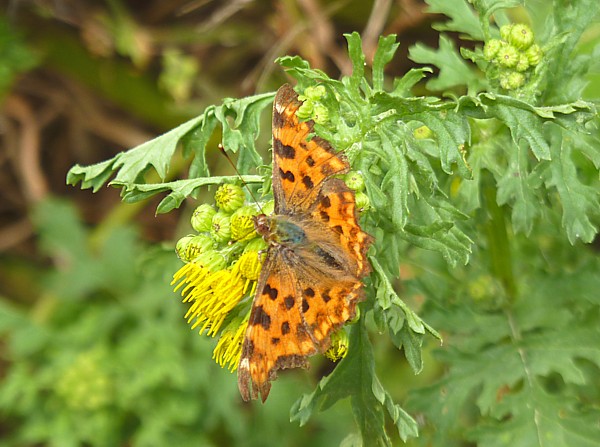
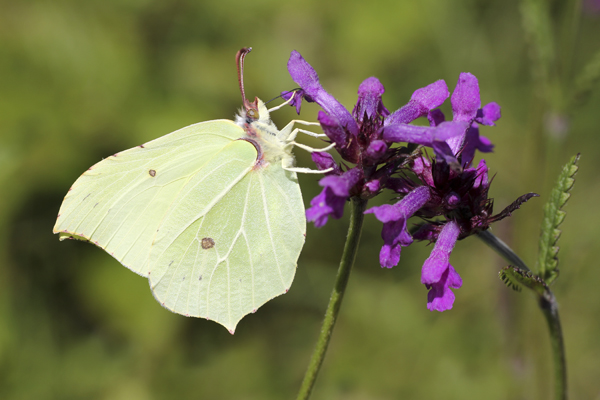
Had a rather nice Scalloped Oak Crocallis elinguaria resting near the entrance to my flat in Toxteth this evening 🙂

MNA Scalloped Oak Moth1


Posted in MNA reports | Comments Off on Toxteth Moth

Ainsdale to Woodvale, 13th July 2014

We walked down Shore Road, admiring the tall Hollyhocks in the gardens, to Sands Lake. At the jetty where people throw bread there were Jackdaws, Mallards in moult, but one mother with three smallish late ducklings. Plenty of Black-headed Gulls, some Coots and a Mute Swan with a Darvic ring but we couldn’t see the number. There was just one Lesser Black-backed Gull, or was it a Greater? I thought its legs were pink, which would make it a GBB, but it didn’t strike me as very big. There were no Herring Gulls nearby to compare the size.

30 Ainsdale Sands lake

Rain seemed to be threatening, but it didn’t come to much. Other birds included Swallows, and four or five Tufted Ducks further out. A Heron flew past and a mother Moorhen emerged from the reeds with two well-grown youngsters.

30 Ainsdale moorhen chick

We went around Sands Lake on the boardwalk and lunched on the picnic tables near the pub. Then we walked back up Sands Road to the start of the Trans-Pennine Trail, which runs southwards through mixed woods and sandy dune paths parallel to the Coastal Road.

30 Ainsdale gnarled trees

We noted Small Skippers and Meadow Browns. Flowers included Common Centaury, Yellow or Common Toadflax and a new one for me, Hop Trefoil.

30 Ainsdale toadflax


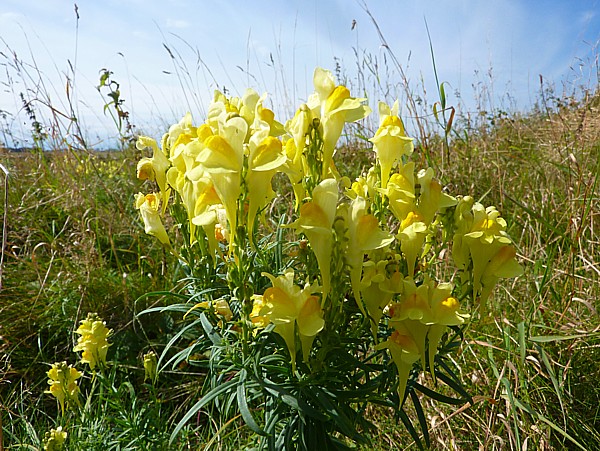
Yellow toadflax

30 Ainsdale hop trefoil
Hop Trefoil

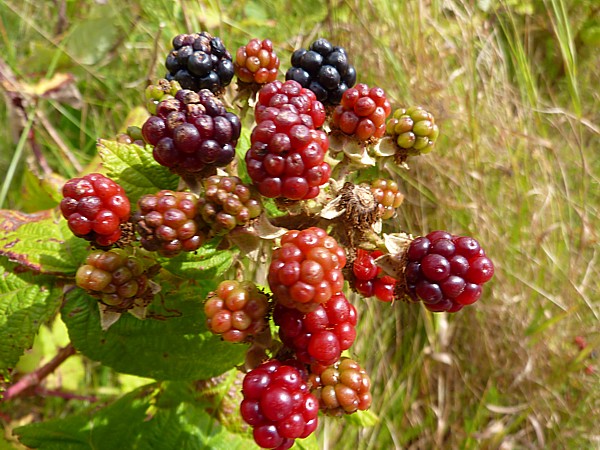
Autumn seems to be coming on at a rush and it’s only mid-July. The small wild apples were ripening and blackberries are going black at the tip of the bunch. Olive tasted one but it was bitter and she spat it out.

30 Ainsdale blackberries

The seed cases of Beech are looking fat and full, so are we going to have a second mast year in succession? Two Rowan trees were growing next to each other on the dunes, one flourishing and bearing orange berries, the other leafless, perhaps nearly dead, but bearing several clusters of bright red berries.

30 Ainsdale rowan red

As we walked the last section along the Coastal Road we spotted a big fungus on a tree stump on the verge. Is it a Chicken of the Woods?

30 Ainsdale chicken woods perhaps

This was our third leg of the Trans-Pennine Trail and we did another 1.75 miles of it, taking us to five miles from Southport.

Public transport details. Train from Central at 10.08, arriving Ainsdale at 10.42. Returned on the X2 bus from Liverpool Road / Woodvale Road at 14.13, arriving Liverpool about an hour later.

Posted in Sunday Group | Comments Off on Ainsdale to Woodvale, 13th July 2014

Welsh Borders 10th July 2014

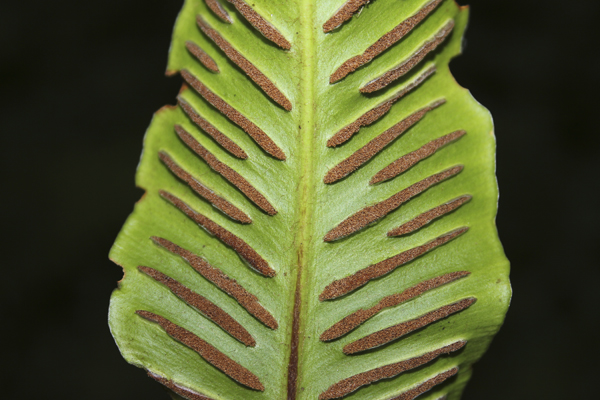
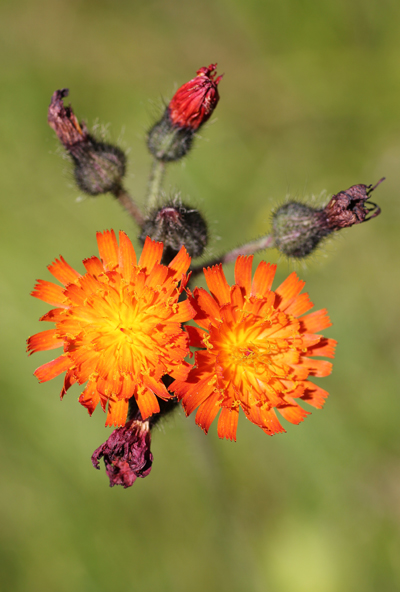
Richard Surman, Dave B and I headed down to the Welsh Borders to visit a couple of Shropshire Wildlife Trust Reserves close to Oswestry. Our first stop was Llynclys Common where we parked beside the Lime Kiln Pub, which had Fox-and-cubs Pilosella aurantiaca growing in the beer garden, crossed over to the nearby bridleway and climbed up a steep path through mixed woodland noting the green berries of Lords-and-Ladies Arum maculatum, Hart’s-tongue Phyllitis scolopendrium and Hard Shield-fern Polystichum aculeatum that is most commonly found on limestone rocks. It is a bipinnate fern with pinnules that have sharply pointed teeth and spine-pointed tips.

MNA Oswestry Hard Shield Fern1

Hard Shield-fern

A few Fungi Species with Artist’s Bracket Ganoderma applanatum, Birch Woodwart Hypoxylon multiforme and Common Tarcrust Diatrype stigma.

MNA Oswestry Tar Crust1

Common Tarcrust

We passed large patches of Enchanter’s-nightshade Circaea lutetiana and crossed through bracken scrubland where a few pale coloured Common Spotted-orchids Dactylorhiza fuchsia were growing and into the limestone meadow areas with a scattering of Yellow Meadow Ant Lasius flavus hills. Butterflies included a rather tattered Red Admiral Vanessa atalanta, a few Speckled Woods Pararge aegeria, plenty of Meadow Browns Maniola jurtina and Ringlets Aphantopus hyperantus. A number of large fast flying Fritillaries were swooping around the open glades between the woodland. Thankfully one settled for a photo that allowed for identification – a Silver-washed Fritillary Argynnis paphia whose caterpillar’s main foodplant is Common Dog-violet Viola riviniana.

MNA Oswestry Fritillary1

Silver-washed Fritillary

A small pond with Lesser Spearwort Ranunculus flammula and Broad-leaved Willowherb Epilobium montanum growing around its edges held Greater Water Boatman Notonecta glauca, a few unidentified Pond Snails and the reeds had a handful of Damselflies – Large Red Damselfly Pyrrhosoma nymphula and mating Common Blue Damselfly Enallagma cyathigerum. A rather spectacular metallic green-golden insect with fat body and shading on the wings landed close to me. It was a female Sawfly Abia sericea of the family Cimbicidae who are recognisable by their five segmented antennae ending in distinctive ‘clubs’.

MNA Oswestry Sawfly1

Sawfly Abia sericea

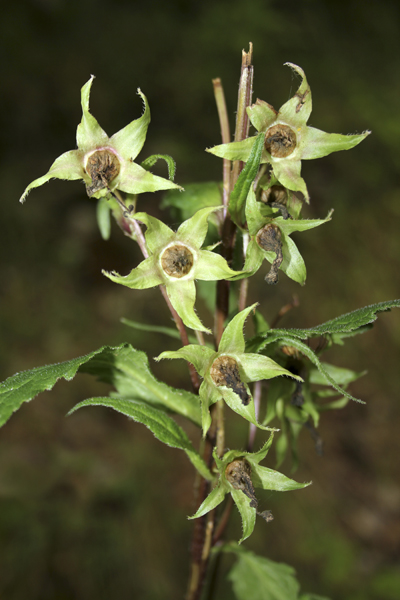
A Botanists paradise with lots of summer flowering plants- Red Campion Silene dioica, Perforate St John’s-wort Hypericum perforatum, Slender St John’s-wort Hypericum pulchrum, Tormentil Potentilla erecta, Wood Avens Geum urbanum, Common Bird’s-foot-trefoil Lotus corniculatus, Fairy Flax Linum catharticum, Herb-Robert Geranium robertianum, Hedge Woundwort Stachys sylvatica, Common Centaury Centaurium erythraea, Wood Sage Teucrium scorodonia, Selfheal Prunella vulgaris, Common Figwort Scrophularia nodosa, Eyebright Euphrasia officinalis agg. Lady’s Bedstraw Galium verum, Greater Burdock Arctium lappa, Welted Thistle Carduus crispus, Common Knapweed Centaurea nigra, Oxeye Daisy Leucanthemum vulgare, Black Bryony Tamus communis, Common Twayblade Listera ovata and Broad-leaved Helleborine Epipactis helleborine which had gone to seed.

MNA Oswestry Twayblade1

Common Twayblade

Walking back towards the car we spotted a Brown Hawker Aeshna grandis, a hedgerow umbellifer was identified as Ground-elder Aegopodium podagraria which had a few Hoverflies Cheilosia illustrata – a furry bumblebee mimic typically seen settled with its wings closed tightly over its back. Its body is usually pale haired with a black band across the centre of the thorax. We also had an unusual sighting of a Grey Heron standing on the tracks of a disused railway line – we thought that it could possibly be hunting for Lizards basking in the sun.

Our next stop was Llanymenech Rocks Reserve where limestone mining was carried out for more than 2000 years, right up until the First World War. Reminders of this ancient industry can be seen in the old stone tramways and a few winding houses. The village is home to one of only three remaining Hoffmann kilns in the British Isles.

MNA Oswestry Winding House1

Winding House

We walked through woodland noting a few tiers of Dryad’s Saddle Polyporus squamosus. AMigrant Hawker Aeshna mixta was zipping around and a Brown Hawker Aeshna grandis was flying around a small pond in a field with yurt tents. Entering the quarry a Spotted Flycatcher was seen chasing insects from its launch pad on the cliff face, Richard had a possible sighting of a Pied Flycatcher. There were half a dozen Common Swifts screeching around also Common Buzzard, Wood Pigeon, Pied Wagtail, Wren, Blackbird, Song Thrush, Common Chiffchaff, Long-tailed Tit, Magpie and Common Bullfinch.

MNA Oswestry Harvestman1

Harvestman

We ate lunch a Harvestman Phalangium opilio crawling around Wild Marjoram Origanum vulgare at my feet in search of prey. A few Butterflies were flitting around – Small White Pieris rapae, Speckled Wood Pararge aegeria, Meadow Brown Maniola jurtina and Ringlet Aphantopus hyperantus.

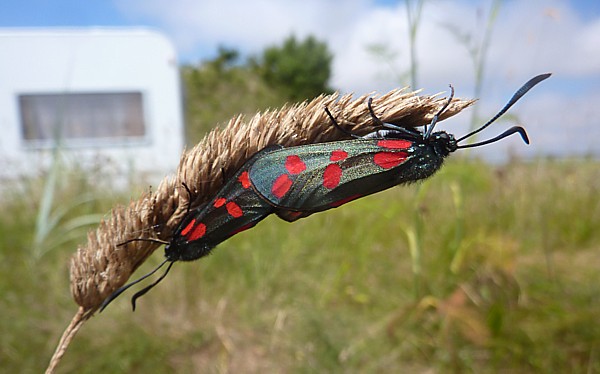
MNA Oswestry Burnet Moth1

Six-spot Burnet Moth

Day-flying Moths included over a dozen Six-Spot Burnets Zygaena filipendulae, a few ‘Waves’, a Barred Yellow Cidaria fulvata and a showy Scarlet Tiger Callimorpha dominula with dramatic blood-red underwings.

MNA Oswestry Grasshopper1

Meadow Grasshopper

MNA Oswestry Grasshopper2

Common Field Grasshopper nymph

Plenty of stridulating Grasshoppers including Meadow Grasshopper Chorthippus parallelus and Common Field Grasshopper Chorthippus brunneus – whose nymphs, including a ‘pink form’ were much in evidence amongst the rocky scree where Maidenhair Spleenwort Asplenium trichomanes was growing in profusion. Insects noted included Tapered Drone Fly Eristalis pertinax, Hoverfly Leucozona glaucia, Sloe Bug Dolycoris baccarum, Dock Bug Coreus marginatus and a female Thick-legged Flower Beetle Oedemera nobilis. A few Rose Sawflies Arge ochropus were foraging on umbellifers of Hogweed Heracleum sphondylium. This distinctive species has a black head and thorax and an orange body. The wings have a dark mark along the border, but no dark cross band. The legs are banded and look like its wearing football socks.

MNA Oswestry Bramble Sawfly

Rose Sawfly

MNA Oswestry View

A viewpoint offered spectacular views and also a lone Cinnabar Moth Tyria jacobaeae caterpillar feeding on Oxford Ragwort Senecio squalidus – later on an adult trapped in a web becoming our ‘Corpse of the Day’, a Small Tortoiseshell Aglais urticae and our first sightings of Small Heath Coenonympha pamphilus that seemed to favour this end of the quarry.

MNA Oswestry Small Scabious1

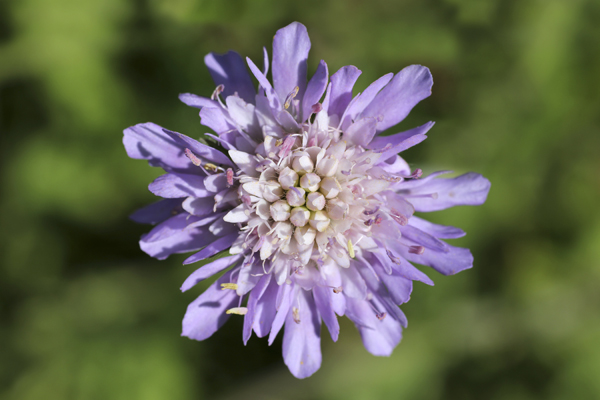
Small Scabious

Again fantastic botanically with new species for the day including Common Rock-rose Helianthemum nummularium, Agrimony Agrimonia eupatoria, Field-rose Rosa arvensis, Common Vetch Vicia sativa, Common Restharrow Ononis repens, Black Medick Medicago lupulina, White Clover Trifolium repens, Red Clover Trifolium pratense, Rosebay Willowherb Chamerion angustifolium, Common Milkwort Polygala vulgaris, Upright Hedge-parsley Torilis japonica, Wild Basil Clinopodium vulgare, Wild Thyme Thymus polytrichus, Greater Plantain Plantago major, Harebell Campanula rotundifolia, Crosswort Cruciata laevipes, Red Valerian Centranthus ruber, Small Scabious Scabiosa columbaria, Spear Thistle Cirsium vulgare, Goat’s-beard Tragopogon pratensis seedhead, Beaked Hawk’s-beard Crepis vesicaria, Yarrow Achillea millefolium, False Fox-sedge Carex otrubae and Pyramidal Orchids Anacamptis pyramidalis by the score.

MNA Oswestry Sedge1

False Fox-sedge

MNA Oswestry Goatsbeard1

Goat’s-beard

Posted in MNA reports | Comments Off on Welsh Borders 10th July 2014

Kirkby, 6th July 2014

29 Kirkby flower hill

Another fine and sunny day, and off to Kirkby, where we hear Knowsley Council have planted masses of wildflowers. Our first call was into the little Lime Tree Woods off Valley Road, where we noticed a Speckled Wood butterfly with half of one wing missing, probably pecked at by a bird.

29 Kirkby speckled wood

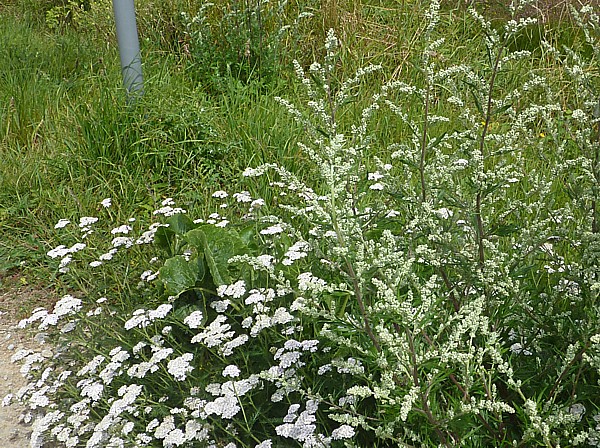
Once we had passed under the M57 motorway we saw the huge expanses of wildflowers on the eastern verge of Valley Road, stretching about a kilometre (over half a mile) along to Valley Park and St Chad’s. Different sections were planted with different mixes. Some had Corncockle, Poppy, Wild Oats and Ragged Robin. Another stretch had a lot of Yarrow, while a third had lots of Wild Carrot, Thistles and a tall plant that I think was Fat Hen [added later – no, it was Mugwort] .Sadly, most if it was past its best. We will make a note to come earlier next year when they are in their full glory.

29 Kirkby flower verge

Amongst them we saw a Gatekeeper, a Meadow Brown, a tall Orchid past its best and a Rabbit, running off over the hill. Birds included Swift, Magpie, Blackbird and Wood Pigeon. As we approached Valley Park we were delighted to see some mounds with the Poppies, Cornflower and Corn Marigolds still out.

29 Kirkby flower display


We had lunch in St Chad’s Gardens, where we met Chris F, who joined us for the afternoon. There was a Mistle Thrush on the lawn and Cut-leaved Cranesbill on the edge of a flower bed. We heard what sounded like the screaming of a bird of prey, or the calling of a juvenile for its parents, but we couldn’t see anything. One tall building did, however, appear to have a Wood Pigeon nesting on a ledge, an uncommon sight. St Chad’s churchyard has an unusual Great War Memorial Cross with some lovely words. “To the honour of the men of this parish who went forth in these years of war to fight for God and King, for justice and freedom, and in thankful remembrance of those who returned not again.”

29 Kirkby St Chads memorial


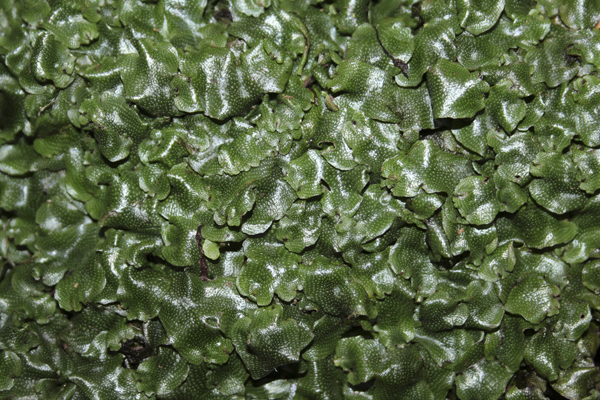
The churchyard had a long line of molehills, and many paths were edged with the Liverwort Marchantia polymorpha, which was throwing up its fruiting bodies.

29 Kirkby liverwort fruiting

The hopper at the top of a drainpipe was surrounded by copious bird droppings. Was it an old Kestrel nest? CF rummaged in the grass and found several Kestrel pellets.

29 Kirkby hopper

29 Kirkby Pellets


I took five of them home and took them apart. Mostly made up of matted black hair or fur, but there were a few small mammal bones – some tiny leg bones, a couple of bits of pelvis, possibly a bit of skull and some teeth. The picture below is the aggregated result from all five pellets.

29 Kirkby bones

Behind St Chad’s is a wildlife area called Millbrook Park with a small wetland around Simonswood Brook. It’s only small, but the wildlife is excellent. There was a Whitethroat singing in an Alder and four young Moorhens on the pond. A Sedge Warbler was singing from the reeds. There were both kinds of Water Lilies – the big white ones and the yellow Fringed Water Lily. Masses of Field Cranesbill around the edge and Flowering Rush in bloom in the shallows. It’s fairly uncommon, mostly found in the south of England, and probably planted here. There were Water Boatmen, Whirligig beetles and a Four-spotted Chaser. Two Small Tortoiseshell butterflies basked on the path. CF noticed that the Iris plants had brown discolouration on the edges of their leaves and drew our attention to the Yellow Flag Sawfly larvae climbing skywards.

29 Kirkby sawfly

As we retuned to the Civic Centre for the bus home we saw Jackdaws and a Swallow. The Rowan berries have nearly turned red and it’s only early July!

Public transport details: Bus 20 from Queen Square at 10.09, alighting at Valley Road / Aintree Lane at 10.40. Returned on 21 bus from Kirkby Civic Centre at 1.58, arriving Liverpool at 2.40.

Posted in Sunday Group | Comments Off on Kirkby, 6th July 2014

Freshfield (MNA) 5th July 2014

Nine MNA members met at Freshfield station at 10.30, for a planned walk to Ainsdale. In the event, the wildlife in the woods and gorse on the inland side of the railway was so absorbing that by the time we got to the beach at the end of Fisherman’s Path, it was time to return. It was a hot and sunny day, too, so we made the right decision.

28 Freshfield fishermans path

There were plenty of flowers and butterflies, even on the first part of the walk along the railway.  There were Meadow Browns, a large White, two Gatekeepers mating and a Small Skipper on Spear Thistle.

28 Freshfield small skipper

Sid found a sluggish Tree Bee in the shade, which posed obligingly on his hand before we released it into the sunshine.

28 Freshfield tree bee

There was a Robin on the path, and in the woods we heard a Chiffchaff calling. Some Coal Tits were flitting about in the pines, together with some Long Tailed Tits. We spotted a female Chaffinch, a Blue Tit and a Carrion Crow poking about in the short turf. A peeping noise overhead announced an Oyster Catcher flying north. Tony C was looking for Cramp Balls on burnt gorse, and he also found Tawny Grisette Amanita fulva, Common Fieldcap Agrocybe pediades and one that he thought looked like a young jelly fungus called Leafy Brain Tremella foliacea. He later reported that it was too young to get any spores so he couldn’t confirm its identification.

28 Freshfield jelly fungus


In a small pool in the stream there were Sticklebacks, Water Crowfoot and Watercress. On the wing were Broad bodied Chaser and Common Blue and Blue-tailed damselflies. The gorse held a Cinnabar moth, a Red Admiral, and several large Labyrinth spiders with their funnel-like webs.

28 Freshfield labyrinth spider

Both a Kestrel and Buzzard flew overhead at different times, and we noted a Whitethroat, a Dunnock, a Swallow and a Small Heath butterfly. As we lunched amongst the gorse we were joined by Dorothy C, who always manages to find us. A small brown Meadow Grasshopper perched on John C’s blanket. Beyond the railway and golf course Sid found a large hairy caterpillar on the path. We think it was a Drinker moth caterpillar. (Thanks to Sid for the use of his hand, again).

28 Freshfield drinker caterpillar

Along Fisherman’s Path we tried to identify as many flowers as possible, including Honeysuckle, Lady’s Mantle, Common Centaury, Self-heal, Wild Parsnip and Mullein.

28 Freshfield mullein


There was a light brown Campion Moth caterpillar on the seed heads of White Campion. It eats the seeds, and we could see a small hole in one seed head where presumably it had emerged.

28 Freshfield campion moth caterpillar


In the woody undergrowth we spotted a Wren and a young Robin. Speckled Wood butterflies were in the sunny glades, and there was a Comma in the sunshine. By the edge of the path were some Bloody Brittlegill Russula sanguinea, looking rather faded and chewed. (This photo by Jane Parker).

28 Freshfield Russula

When we reached the beach we went hunting in the sandy slack behind the first dune for Northern Dune Tiger Beetles. One or two people spotted one, but they are very fast and fleeting, and most people missed them. Chris B picked up a spiral Auger Shell, and commented that it couldn’t have been washed from the sea over the tall beachfront dune, so it may have been there for many years, from before the dune grew so high. He also said they are rarely seen much further north than here, although they are commoner towards Crosby.  Growing in amongst the Marram grass were small single toadstools of Dune Brittlestem Psathyrella ammophila.

28 Freshfield dune brittlestem

We saw several Linnets while we were on our way back to the station, and a flower head of Wild Parsley with at least 15 Soldier Beetles, many of them in mating pairs. This picture by Tony Carter is better, though, showing them on a white Umbellifer head.

28 Freshfield soldier beetles

And finally we spotted the plant we had been hoping for, the rare Dune Helleborine, growing right beside the path.

28 Freshfield dune helleborine

Here is Tony Carter’s full fungus list for the day.
Agrocybe pediades – Common Fieldcap
Amanita fulva – Tawny Grisette
Russula sanguinaria – Bloody Brittlegill
Tremella foliacea – Leafy Brain (probable)
Psathyrella candolleana – Pale Brittlestem
Psathyrella ammophila – Dune Brittlestem
Melanotus horizontalis – Wood Oysterling
Inocybe napipes – Bulbous Fibrecap
Daldinia fissa on the burnt Gorse
Botryobasidium conspersum

If you are interested in the wildlife of the north-west of England and would like to join the walks and coach trips run by the Merseyside Naturalists’ Association, see the main MNA website for details of our programme and how to join us.

Posted in MNA reports | Comments Off on Freshfield (MNA) 5th July 2014

Hillside to Ainsdale on the Velvet Trail, 29th June 2014

It was another gloriously hot and sunny day, a day for interesting flower and insects in the dunes. The flowers started outside Hillside Station, where there is a wildflower bank.

27 Velvet meadow

We crossed the open ground next to Royal Birkdale golf course and through the footpaths joining Selworthy Road to the Coastal Road, where we had got to on our first leg. Last week I met John Dempsey, the ranger, and he recommended the Velvet Trail / Green Beach instead of the Ainsdale and Birkdale Reserve. That involved crossing the busy coast road, but we made it safely, and it was certainly worth it.  The sandy path wanders and braids through the dunes and slacks, sometimes rather difficult to find, but if in doubt, keep high. At this time of the year the dunes are covered with flowers, the commonest being Rest Harrow, here with a clump of Sea Holly.

27 Velvet Sea Holly and Rest harrow

There were dozens, if not hundreds, of pretty pink Pyramidal Orchids, and patches of bright yellow Biting Stonecrop.

27 Velvet pyramidal orchid

27 Velvet biting stonecrop


There were Meadow Browns flying up everywhere. I don’t think any of them were Graylings, but they were very fast and active, and it was hard to check every one. We also spotted Large Skipper, a few Small Heaths, Cinnabar moths (their caterpillars on the Ragwort looking very fat) and one unidentified White Butterfly. One very fat gold and green beetle was probably a Sand Chafer, but it was off before I could take a picture. We didn’t see any Northern Dune Tiger Beetles, but I spotted one last week when I was doing the recce.

27 Velvet tiger beetle

We lunched high on a dune, with a Skylark singing and views of Snowdonia to the south, and towards Blackpool to the north, with the Lake District just discernible in the furthest distance.

27 Velvet view to Blackpool

Other flowers included Harebell, a tall yellow umbellifer which was probably Parsnip, Common Centaury, Yellow Wort, Hound’s Tongue just over, Sea Spurge. One lonely Giant Hogweed towered by the beach.

27 Velvet Hogweed

Sadly, it was a bit early for the rare Grass of Parnassus and Dune Helleborine, but by a slack with Reed Mace and a willow bush there were about 20 plants of Marsh Helleborine. Around the corner there were masses more.

27 Velvet marsh helleborine


In amongst them was one late Bee Orchid.

27 Velvet Bee orchid


As we neared Ainsdale and Shore Road we came across a fenced-off slack, protected for Natterjack Toads. We didn’t see any, nor any of the Adder’s Tongue Fern that is supposed to grow in this area, but there were masses of purple and white Broad-leaved Everlasting Pea.

27 Velvet everlasting pea


On the roundabout by the Sands pub there is a sculpture of an aeroplane taking off, commemorating two historic transatlantic flights from Ainsdale beach in the 1930s.

27 Velvet plane sculpture

This was our second leg of the Trans-Pennine Trail and we did about 1.75 miles of it, taking us to three and a quarter miles from Southport.

Public transport details: Southport train from Central at 10.08, arriving Hillside 10.45. Returned on the train from Ainsdale at 3.22.

Posted in Sunday Group | Comments Off on Hillside to Ainsdale on the Velvet Trail, 29th June 2014

MNA Coach Trip South Stack RSPB 28th June 2014

MNA South Stack Lighthouse Summer

A rather wet and bedraggled group of MNA members boarded the coach for our outing to South Stack RSPB Reserve on Anglesey. Although there was continued rain and  patches of fog during our drive along the scenic north Wales coast by the time we reached Holyhead the weather had thankfully dried somewhat but was very breezy.  A Silver-studded Blue Plebeius argus feeding on Bell Heather Erica cinerea and a Rose Chafer Cetonia aurata on the umbellifer Sea Carrot Daucus carota subsp. gummifer caught our attention as we walked along to Ellen’s Tower.

MNA South Stack Rose Chafer1

Rose Chafer

We peered over the edge to the cliffs at the nesting auks, Razorbills, Common Guillemots (Terry finding a bridled form Guillemot amongst the masses) and Herring Gulls all having their own community groups on different zones on the cliff. The lack of chicks was apparent, we would have expected the parents to be busy feeding hungry mouths but many birds appeared to be still on eggs due to their late arrival back here during the spring. Also present were Kittewakes, Lesser Black backed Gulls, the odd Fulmar, a few Gannets flying by and a few Manx Shearwaters twisting in flight. Our first mammal was a Harbour Porpoise Phocoena phocoena it’s dorsal fin occasionally breaking the surface quite close to the Lighthouse Island. Ron Crossley later noted at least 3 or 4 of these cetaceans. A young Peregrine perched on top of a rock above the cliffs surveying the scene below before taking off and flying directly over the member’s heads and a fine male Stonechat perched on the heather.

The Sea Carrot was proving popular with numerous Marmalade Hoverflies Episyrphus balteatus, a lone Pied Hoverfly Scaeva pyrastri, a few Common Malachite Beetle (a.k.a. Red-tipped Flower Beetle) Malachius bipustulatus, a few Tachinid Flies Tachina fera and many unidentified smaller insects.

MNA South Stack Tachinid Fly1

Tachina fera

There were a number of pale yellow Grasshopper nymphs springing amongst the heather. Walking up the rocky path towards the road I noted Sea Campion Silene uniflora, Red Campion Silene dioica, Thrift Armeria maritima subsp. maritima, English Stonecrop Sedum anglicum, Tormentil Potentilla erecta, Common Bird’s-foot-trefoil Lotus corniculatus, Tufted Vetch Vicia cracca, Bittersweet a.k.a. Woody Nightshade Solanum dulcamara, Wood Sage Teucrium scorodonia, Wild Thyme Thymus polytrichus, Foxglove Digitalis purpurea, Yellow-rattle Rhinanthus minor, Lady’s Bedstraw Galium verum and Pineappleweed Matricaria discoidea.

MNA South Stack Thrift1

Thrift

I wandered along to road to where the steps descend to the Lighthouse Island and began the walk down. Peering over the edge I could see masses of Oxeye Daisies Leucanthemum vulgare plus some Golden-samphire Inula crithmoides with its upright fleshy stems. Growing around the steps was Sea Beet Beta vulgaris subsp. maritima, the delicate pink flowers of Rock Sea-spurrey Spergularia rupicola and Sea Plantain Plantago maritima. A variety of maritime Lichens were covering the rocks with Verrucaria maura, plenty of Sea Ivory Ramalina siliquosaas well as unidentified species.

MNA South Stack Rock Sea Spurrey1

Rock Sea-spurrey

I climbed back to the top and met up with Barbara and co who pointed out a few spikes of Common Spotted-orchid Dactylorhiza fuchsia. There were a few Butterflies with Large Skipper Ochlodes venata, Small Tortoiseshell Aglais urticae, Red Admiral Vanessa atalanta, Meadow Brown Maniola jurtina and Six-spot Burnet Moth Zygaena filipendulae. We wandered along a path through a field where more Silver-studded Blues Plebeius argus were trying to find sheltered positions from the wind to sun themselves – later heard that Alexander and Camilla had seen a mating pair close to the car-park. A boggy patch of ground held Water Forget-me-not Myosotis scorpioides and Selfheal Prunella vulgaris.

MNA South Stack Silver Studded Blue

Silver-studded Blue

I briefly stopped at the visitor centre – another double treat for ‘Corpse of the Day’ a Razorbill and a Manx Shearwater skull.

MNA South Stack Razorbill Skull1

Razorbill Skull

MNA South Stack Manx Shearwater Skull1

Manx Shearwater Skull

In a sheltered sunny spot behind Ellen’s Tower a Common Lizard Zootoca vivipara (formerly Lacerta vivipara) was sunning itself on a rock. Close by a Magpie Moth Abraxas grossulariata was flitting around, Common Red Soldier Beetles Rhagonycha fulva were bonking on the Sea Carrot – many of the females seemingly unimpressed and continuing feeding and a hyper-active Ruby-tail Wasp Chrysis sp. was manically running around a rock. Chris B caught another Rose Chafer and also a Thick-legged Flower Beetle (a.k.a. False Oil Beetle) Oedemera nobilis.

MNA South Stack Common Lizard1

Common Lizard

MNA South Stack Ruby Tailed Wasp1

Ruby-tailed Wasp

We walked along the cliff path noting Kidney Vetch Anthyllis vulneraria, Common Restharrow Ononis repens, Sheep’s-bit Jasione montana, Eyebright Euphrasia officinalis agg. and Hedge Bedstraw Galium mollugo and staring in awe at the spectacular cliff scenery.

MNA South Stack Sheepsbit1

Sheep’s-bit

MNA South Stack Restharrow1

Common Restharrow

MNA South Stack Kidney Vetch1

Kidney Vetch

Our jaws were to drop even further when the young Peregrine that we had been watching during the day patrolling the cliff face and having a go at the Herring Gulls decided to fly in and perch on a rock on the cliff edge not 12feet from us! Chris B, Richard Surman, Christine Barton and I were privileged to this amazing view noting the heavily streaked breast and small head features of this bold youngster, probably a male.

Out in the water bobbing around was our second mammal of the day an Atlantic Grey Seal Halichoerus grypus. Further along the path six Chough took to the air, adjusting their wings to hang in the breeze. The others took the main path to the coach but I headed across the heath adding our second Reptile – a small Adder Vipera berus that quickly slithered into cover as I passed.

If you are interested in the wildlife of the north-west of England and would like to join the walks and coach trips run by the Merseyside Naturalists’ Association, see the main MNA website for details of our programme and how to join us.

A wide photographic selection of birds, marine life, insects, mammals, orchids & wildflowers, fungi, tribal people, travel, ethnography, fossils, hominids, rocks & minerals etc. is available on my Alamy webpage
Posted in MNA reports | Comments Off on MNA Coach Trip South Stack RSPB 28th June 2014

Childwall Woods and Fields, 22nd June 2014

Yet another hot and sunny day, right from the start, but Childwall Woods were cool and shady.

26 Childwall woods

On the edges of the sunny glades plants were stretching to the light. A Horse Chestnut sapling no more than five feet tall had grown its two main leaves about a foot across, perhaps more. Common Nettle seed heads reached up to about six or seven feet. There was Enchanter’s Nightshade, Wood Avens and Herb Robert by the path edges and a huge display of Bramble flowers with lots of honey bees on them. We saw just one butterfly all day – a Speckled Wood. There seem to be very few at the moment. Are we too early?
There weren’t very many birds about, either, just Magpies, a Jay, Wood Pigeons and the occasional calls of Greenfinches. In a sunny glade we found our first orchids. Valiant efforts were made to identify it, and we suppose it might be the Southern Marsh orchid, although they are all very hybridised and variable.

26 Childwall orchid 1


Then we spotted a very drowsy Elephant Hawkmoth in the grass. It seems to have some injury or blemish in its left “armpit”. Its food plant Rose Bay Willowherb was growing nearby.

26 Childwall elephant hawkmoth

There is a Victorian postbox in the wall of the Childwall Abbey pub.

26 Childwall postbox


We lunched in the Garden of Remembrance at the back of All Saints, Childwall, which is the only surviving mediaeval church in Liverpool, with a 14th century chancel. It is Grade I listed. A Robin came looking for crumbs but it was too late, we’d packed up. Then back through the woods and into Childwall Fields. There is a smashing view to the north and north-east, way over the motorway and on to a church spire on the left skyline. Prescot? Eccleston? Knowsley?

26 Childwall view

There were more orchids in the fields. We thought this paler patterned one with spots on its leaves might be a Common Spotted, and the matching pair, which also had spotty lower leaves, could be some more Southern Marsh.

26 Childwall orchid 2


26 Childwall orchids 3&4


Public transport details: 75 bus from Liverpool ONE bus station at 10.02, arriving Woolton Road / Cabot Green at 10.29. Some returned on the 81 bus from Woolton Road opposite Cabot Green at 2.05, while others got the 75 back to Liverpool from the same stop at 2.06.

Posted in Sunday Group | Comments Off on Childwall Woods and Fields, 22nd June 2014

Great Orme 17th June 2014

MNA Orme2       Making the most of a glorious sunny day we headed over to Llandudno and the Great Orme. Richard Surman dropped DaveB and me at the beginning of the marine drive and for a few minutes we watched a hyper-active Humming-bird Hawk-moth Macroglossum stellatarum zipping around low to the ground, occasionally hovering for a second to feed with its long proboscis on flowers. We’d just been talking about how these Sphingidae are becoming increasingly common in the UK migrating here from Southern Europe. We soon found another migrant, this one a Noctuidae – a Silver Y Moth Autographa gamma, this moth can turn up in thousands under the right conditionsAfter introducing some MNA members to Thick-legged Flower Beetles (a.k.a. False Oil Beetle) Oedemera nobilis on the Norfolk holiday we soon started spotting a few here feeding on Red Valerian Centranthu ruber.

MNA Bloody Cranesbill

Bloody Cranesbill

The strikingly coloured Bloody Cranesbill Geranium sanguineum contrasted with the Common Rock-rose Helianthemum nummularium on the slopes beneath the towering limestone outcrops. Dave spotted a plant called Dropwort Filipendula vulgaris that has a passing resemblance to its cousin Meadowsweet Filipendula ulmaria. A pair of visitors was peering down at something on the stone wall edging the path so we went to investigate – it was a Cinnabar Moth Tyria jacobaeae – we told them they would more likely to be familiar with the Cinnabars yellow and black stripey caterpillars. We also pointed out a flowering Bee Orchid Ophrys apifera spike – ‘how did you see that?’ they asked. I spotted a Drinker Moth Euthrix potatoria caterpillar that clearly had been taking lessons from the rock-climbing lads, attached half-way up a rock-face.

MNA Orme Bee Orchid

Bee Orchid

Lady’s Bedstraw Galium verum, Thrift Armeria maritima, Wild Thyme Thymus serpyllum and the odd Harebell Campanula rotundifolia were the main flowers growing on the cliff edge with Rustyback Fern Ceterach officinarum growing on the stone wall There was a scattering of butterflies with lone Small Skipper Thymelicus sylvestris, Large Skipper Ochlodes venata, Small Copper Lycaena phlaeas, Small Tortoiseshell Aglais urticae, Small Heath Coenonympha pamphilus and half a dozenSilver-studded Blues Plebejus argus. We watched as a Kestrel zoomed overhead vocally chasing a Raven all along the outcrop face and off its patch. A few Shelduck had joined a group of Cormorants on a wave cut platform above the sea and I briefly had views of a Black Guillemot but couldn’t re-locate it after it had dived.
MNA Great Orme Lichen1

Maritime Lichens

MNA Great Orme1

We met up with Richard who had climbed over the stone wall and was on the cliff meadow with scope trained on the cliff nesting ledges below the lighthouse. We watched the comings and goings of the lines of Kittewakes, Fulmars, Razorbills, Guillemots and Cormorants. We noted that sometimes the seabirds were quite noisy especially the Kittewakes calling their name but suddenly for no apparent reason the cliffs became quite silent for a while before the racquet started up again. The characteristic ‘Chough’ call drew our sight back to the outcrop behind us – one Chough heading into a hole in the turf, another perched close by and a further six birds flying away from us. We also watched the antics of a few Rock Pipits – a few displaying and one tucking into some Common Rock-rose flowers. We headed to the car parked beside the Rest and Be Thankful Café to park and drove along to an undisclosed location.

MNA Wales Scenery1

V-shaped Valley

Why the secrecy? It is the location of the most northerly and elevated Dartford Warblers in the UK. We parked up  overlooking a beautiful V-shaped valley and walked along a track passing a huge outcrop of Rhyollite stained black in places with manganese and supporting a collection of Navelwort a.k.a. Wall Pennywort Umbilicus rupestris.

MNA Wales Dave Richard

MNA Wales Rhyolite2

Rhyolite

A few birds with Mistle Thrush, Swallow, House Martin, Swift, Jackdaws and Raven. A marshy area held a few male Broad-bodied Chasers Libellula depressa, flowering Lesser Spearwort Ranunculus flammula, Water Forget-me-not Myosotis scorpioides along with a skittish Pied Wagtail that was unsure of whether to land with our presence. Plenty of Nettle Rust Puccinia urticata on the Stinging Nettles Urtica dioica. The trees outside a Farm held Long-tailed Tits, Chaffinch and Linnets also a Redpoll buzzed overhead. We took the path skirting the property Stonechats calling and giving good views from the bracken. The track emerged at a shallow pond where wild Welsh Ponies were grazing around the edge. A few more Broad-bodied Chasers Libellula depressa along with a few Common Blue Damselflies Enallagma cyathigerum. ‘Corpse of the Day’ was a desiccated Common Toad Bufo bufo.

MNA Wales Toad Corpse1

Toad Corpse

MNA Wales Foxglove1

Foxglove

MNA Wales English Stonecrop1

English Stonecrop

Flowering plants included White Campion Silene latifolia, Tormentil Potentilla erecta, Foxglove Digitalis purpurea, English Stonecrop Sedum anglicum and Heath Bedstraw Galium saxatile. We walked through the Bell Heather Erica cinerea and Bilberry Vaccinium myrtillus to the spot where Dave had seen these birds previously.

MNA Wales Bilberry1

Bilberry

We waited and scanned for movement but things were quite in the heat of the afternoon, only a few Meadow Pipits putting in an appearance, another Redpoll overhead and a Small Heath Coenonympha pamphilus.

MNA Wales Peacock Caterpillars1

Peacock Caterpillars

No luck so we called it a day and began the walk back. From a distance I noticed a patch of black amongst the nettles and on investigating found a writhing mass of Peacock Inachis io caterpillars on Nettles, later on a stone wall we had a Ruby-tailed Wasp Chrysis sp.

Posted in MNA reports | Comments Off on Great Orme 17th June 2014

City Farm, Walton, 15th June 2014

25 Walton farm gate

Another warm day, but overcast and sultry. Rice Lane City Farm is in the old Walton Park cemetery, and the entrance is on Rawcliffe Road. They keep Saddleback pigs, red cattle, a herd of small brown woolly sheep, a couple of asses, several interestingly-varied chickens and a lop-eared rescue rabbit called Alfie, who was found in the street being attacked by a cat. He now wanders freely in the farmyard and likes to be tickled.

25 Walton Alfie

The old cemetery surrounding the farm was once the Liverpool Parochial cemetery and although it is still in use for occasional private burials, it is now mostly used as pasture. It was once the resting-place of the paupers who died in Liverpool and Walton Workhouse hospitals, the most famous of whom was the Irish writer Robert Noonan, who wrote under the pen-name of Robert Tressel. His best known work is The Ragged-Trousered Philanthropists. His grave site was re-discovered in the 1970s and is now marked with a large gravestone, commemorating him and the twelve other people in the same plot.

25 Walton Tressel grave


Not many birds today. Magpies, of course, we heard a Great Spotted Woodpecker and there was a Goldfinch on the wire over the railway. On the picnic table were several of the fearsomely-spiky larvae of the Harlequin ladybird.

25 Walton harlequin larva

The wildflower bank by Walton Station, planted by David Bryant a couple of years ago, is being left to its natural succession. In the first year it was a great display of the classic cornfield flowers like Poppies and Corn Marigolds. Last year a lot of Red Campion came up, and this year there is a very interesting mixture. We noted Mullein, Evening Primrose, Ragwort, Red Campion, Ox-eye Daisy, Corncockle, Birds’s Foot Trefoil, Sorrel, Rape (gone over) and Teasel, but no Poppies, because the soil hasn’t been turned. We spotted a Cinnabar moth and one white butterfly, and there were plenty of bees.

25 Walton wildflower bank

We ended the day with a circuit of Rice Lane Recreation Ground, admiring the Field Maple trees and the huge areas of flowering Bramble around the edge. Should be a good blackberry autumn!

Public transport details: 130 bus from Queen Square at 10.20, arriving Rice Lane/Yew Tree Road at 10.40. Returned on the 21 bus from Rice Lane / Fazakerley Road at 2.46.

Posted in Sunday Group | Comments Off on City Farm, Walton, 15th June 2014