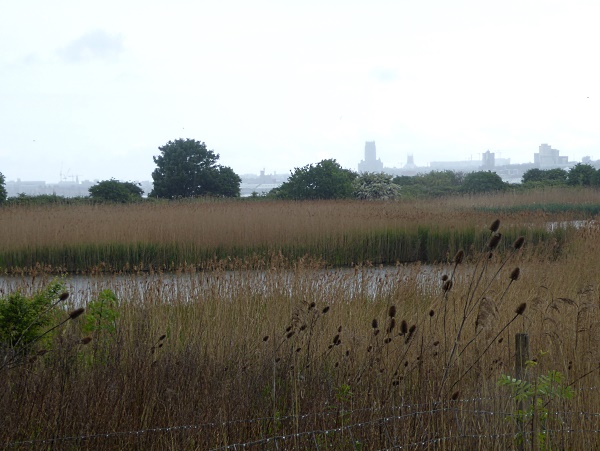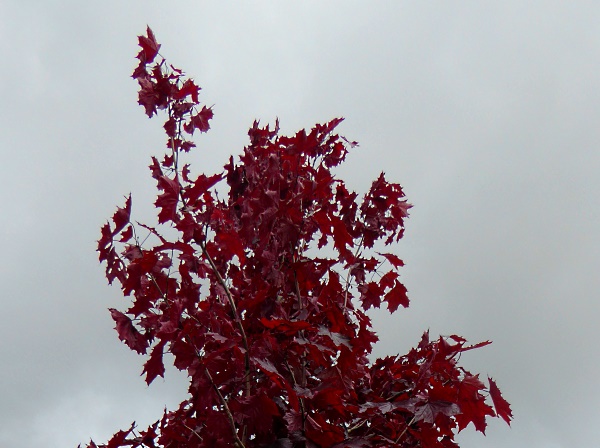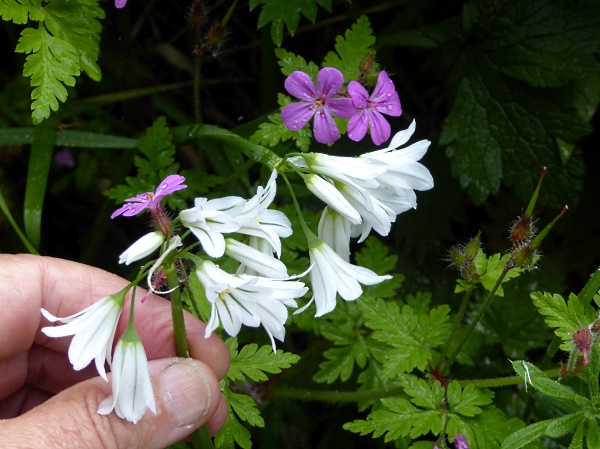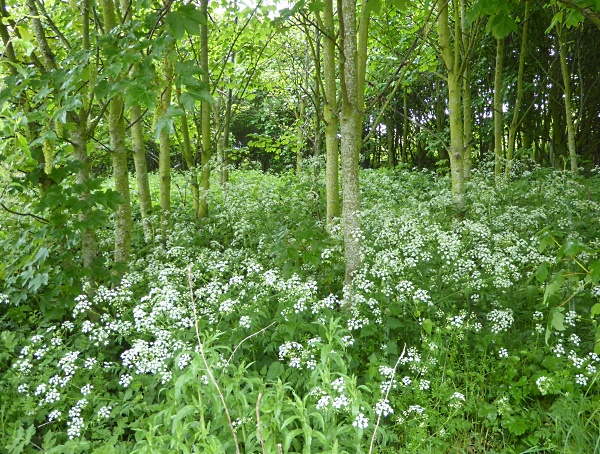
Southport, 8th May 2016

17 Southport tide in

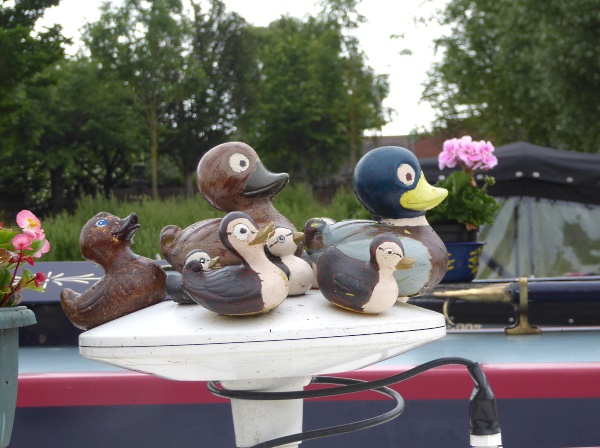
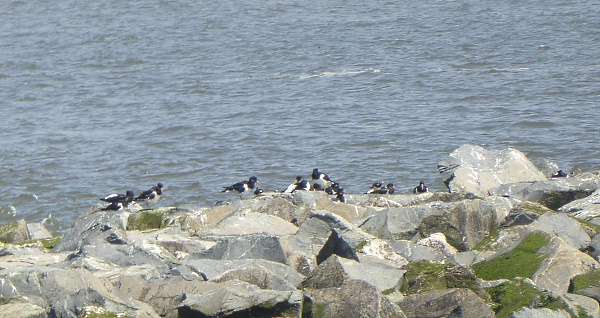
The RSPB were having a “Birds from the Pier” event, which was odd because, unusually for Southport, the tide was in. The only birds to be seen were those flying past in groups, called out by Sefton Ranger John Dempsey.  Large groups of Dunlin flew south, heading for Birkdale Green Beach. Oystercatchers were going north, as were several flocks of Grey Plovers, a pair of Shelduck, and a Cormorant. One Lesser Black-backed Gull flew by and there were Swallows overhead. The only other “birds” were a row of Carolina Wood Ducks on the shooting gallery!

17 Southport Wood Duck

I asked some fishermen what they usually caught off the pier, and they said flatfish, sea bass and eels, but nobody had a fish to show me, the only catch having been a small Dab, returned to the sea. Several butterflies appeared to be coming in off the sea – Large Whites and a Comma. Were they commuting from Lytham?

We amused ourselves in the “penny-in-the-slot” machines for half an hour or so, being most taken with a very old machine called The Harlot. In a beautiful little doll’s-house-like room, two men were in bed with a blonde woman (who was no lady, we assume). The door at the back was slightly ajar and there was another man lurking there. When we finally got a coin to work, the entire “show” took about two seconds. Both men in the bed sat up abruptly then lay down again, and the door flew open to reveal that the lurking punter was a vicar!

17 Southport The Harlot

By now it was very hot indeed, and as we made our way back to the train we moved against crowds of people arriving, and the shops were doing a roaring trade in ice cream and candy floss, fish and chips, buckets and spades.

17 Southport buckets and spades

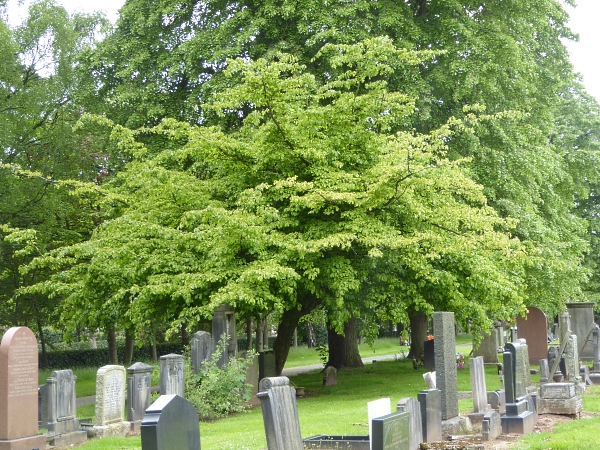
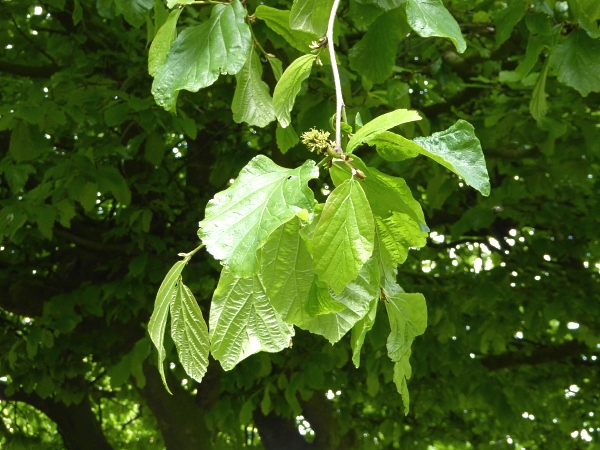
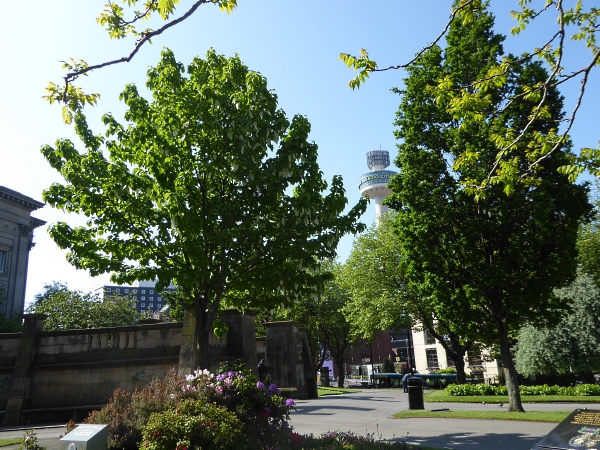
Tree news: The unidentified tree in Williamson Square, outside the Liverpool FC shop and nearest to the Playhouse, is coming into leaf. They are pinnate leaves, with each leaflet very finely toothed, and spear shaped. I’m leaning towards it being a Japanese Rowan Sorbus commixta, often used for town plantings in recent years.

17 Southport Japanese Rowan maybe

The pink Japanese Cherry Prunus serrulata var. Kanzan, whose profuse blossom we missed two weeks ago near Crossens, is now all out, and even starting to go over.

17 Southport cherry blossom

The Wych Elm Ulmus glabra is in flower, with clusters of nutlets each surrounded by a papery membrane.

17 Southport Wych Elm

My local bird news is that the Swifts are back. A small group nest near me every year, and two of them appeared on Saturday 7th May. By Monday 9th there were seven of them. We have also had a Blackbird drama. My neighbour reported a nesting pair in one of her garden shrubs, with three eggs. On Friday she was distraught. “It’s been murder in here!” A rival male had appeared and fought the resident. After vanquishing him, he methodically removed each egg, broke them open and ate the contents. That evening he was sitting on a chimney pot, happily proclaiming his victory.

17 Southport killer Blackbird

This morning, Monday 9th May, two male blackbirds were flying at each other through my garden, and they had a knock-down drag-out fight at high noon, in and out of my shed. Afterwards one sat gasping on my fence, looking bedraggled, but there was no sign of the other one. No idea who’s winning, but the ousted father clearly had some fight left in him!

Public transport details: Train from Central to Southport at 10.23, arriving 11.10. Returned on the 14.28 train, arriving Liverpool about 15.15.

Posted in Sunday Group | Comments Off on Southport, 8th May 2016

Leasowe Lighthouse 7th May 2016

A great start for the day when Hugh pointed out a rather exhausted looking Whinchat sitting on the grass beside the Burton Biscuit /Typhoo Tea factory. Fifteen members dashed across Pasture Road avoiding the traffic and turned into Tarran Way walking through the small industrial estate and along a track running adjacent to the railway line. Whitethroat, Blackcap, Robin, Wren, Dunnock, Great Tit, Skylark, Starling, Blackbird,  Greenfinch, Chaffinch, Goldfinch, and a flock of around forty Golden Plover started the list rolling.

MNA Leasow Crack Willow Catkins1

Crack-willow

MNA Leasowe Grey Willow Catkins1

Grey Willow

The Willows had me puzzled eventually identifying Crack-willow Salix fragilis and Grey Willow Salix cinerea, flowering bushes with Blackthorn Prunus spinosa, Apple Malus sp. and Hawthorn Crataegus monogyna. A scattering of plants with Garlic Mustard a.k.a. Jack-By-The-Hedge Alliaria petiolata, Common Vetch Vicia sativa, Alexanders Smyrnium olusatrum, Mediterranean Spurge Euphorbia characias, Green Alkanet Pentaglottis sempervirens, Red Valerian Centranthus ruber, Wild Teasel Dipsacus fullonum, Smooth Sow-thistle Sonchus oleraceus and Spanish Bluebell Hyacinthoides hispanica. A Holly Blue Celastrina argiolus perched on the leaves of Giant Hogweed Heracleum mantegazzianum.

MNA Leasowe Green Alkanet2

Green Alkanet

MNA Leasowe Holly Blue

Holly Blue

On the Moreton Brickworks Mere were a handful of Mallards some with ducklings and a splendid male Mandarin Duck. We only had time to scan across the old Brickworks site noting Buzzard, Collared Dove and Swallow before we were accosted by a rather cantankerous bloke who insisted we had no right of way up the track, were going to trample on the fishermen’s gear etc. When his accusations became even more skewed we decided to head back along the track before turning into Lingham Lane. Around eight Swifts screeching overhead were new Year ticks for most members and were quickly followed by Lesser Whitethroat, Spotted Flycatcher, Garden Warbler, Willow Warbler and Chiffchaff. Around the more civilised setting of Lingham fisheries pond a few Swallows were sat on electricity wires along with a Pied Wagtail, Canada Goose overhead, Moorhen in a field, Song Thrush, Magpie and Carrion Crow. A few 22-spot Ladybirds Psyllobora vigintiduopunctata were collected in a tube to show those members who had eagerly continued onto the Lighthouse for lunch. I’d just opened my lunch box when a small Beetle with shiny brass/copper appearance landed beside my Tuna sarnie. ChrisB identified it as a Sun Beetle Amara sp. a member of the Ground Beetle Carabidae family.

MNA Leasowe Striped Millipede1

Striped Millipede and Springtail

After re-fuelling I had a mooch around, ChrisB overturned a few planks of wood and uncovered a couple of White-legged Snake Millipedes Tachypodoiulus niger and a Striped Millipede Ommatoiulus sabulosus curled beside a teeny Springtail Collembola sp. Along by the horse paddocks we watched another Spotted Flycatcher zipping from its fence perch after insects. According to the Dee Estuary Birding website there had been 27 Spotted Flys recorded today – a record count! St Mark’s Flies Bibio marci were active flying around with dangly legs and a number of mating pairs.

MNA Leasowe Mating St Marks Flies Reed1

St Mark’s Flies

A Cuckoo called which couple of members managed to see as it flew into a copse where a Mistle Thrush was perched up in one of the trees. In the paddocks a couple of female Wheatears hopped around and a Little Egret flew by. More plants with Field Horsetail Equisetum arvense, Lesser Stitchwort Stellaria graminea, Water Avens Geum rivale, Water Forget-me-not Myosotis scorpioides and Dove’s-foot Crane’s-bill Geranium molle. Buff-tailed Bumblebees Bombus terrestris were bumbling away and a Large White Pieris brassicae fluttered by

We watched a male Reed Bunting singing, Chris B had a few Mepits before climbing the embankment to look out to sea. The tide was in and Waders were flocked together on the rocky groyne structure with around eighty Dunlin in various stages of reaching full Summer plumage, three Ringed Plover and a couple of Redshank. A couple of pairs of Sandwich Terns screeched on their fishing sortie – an evocative sound of the Summer coastline. ChrisB and DaveH found a nesting colony of Vernal Mining Bees Colletes cunicularius in a small blowout – this spring-flying species coincides its foraging with the blossoming of Creeping Willow Salix repens on coastal dunes. ‘Corpse of The Day’ was a Cormorant but was in such an extreme state of decay I even declined to photograph it. On the embankment another Sun Beetle Amara sp. scuttled through the short grass and we noted a scattering of Sea Wash Balls – the egg case of the Common Whelk Buccinum undatum and a few Mermaids Purses of Skate Raja batis that had been blown in by the wind. ChrisB headed back down to the reedbed and was rewarded by a singing Sedgie.

MNA Leasowe Nursey Web Spider1

Nursery-web Spider

We passed the Lighthouse and walked along the edge of the road. I spotted a Nursery-web Spider Pisaura mirabilis in its typical pose on a rock, also plenty of Wolf Spiders, a Green Nettle Weevil Phyllobius pomaceus and a few 7 Spot Ladybirds Coccinella septempunctata. A male Stonechat with bright green caterpillar in its beak perched up in a Bramble patch adjacent to a stand of the invasive Japanese Knotweed Fallopia japonica. He was soon joined by a female – they have declined as a breeding species on the Wirral so fingers crossed for this pair. Back along Pasture Rd stopping briefly to peer across the bridge to the River Birket – a Pheasant was in the adjacent field and a couple of male and a female Orange Tips were flitting along the riverside vegetation enjoying the sun. All to soon we were back at Moreton Station for our homeward journey after a day packed with a great selection of Summer migrants for this local site.

If you are interested in the wildlife of the north-west of England and would like to join the walks and coach trips run by the Merseyside Naturalists’ Association, see the main MNA website for details of our programme and how to join us.

Posted in MNA reports | Comments Off on Leasowe Lighthouse 7th May 2016

Cilcain, North Wales 30th April 2016

MNA Cilcain Scenery2

Richard Surman, DaveB and I returned to Cilcain near Mold in Flinshire, North Wales for a circular walk that we did a few years ago. Singing Chiffchaff, Wren, Prune, and Blackbird greeted us on arrival. A Silver Birch Betula pendula had a gall called Witches’ Broom caused by a Fungus Taphrina betulina which stimulates the tree to produce numerous extra shoots, resulting in a dense nest-like cluster. A mixture of Wild Daffodils and garden cultivars including some with ruffled, double centres lined the country lane edges. Dog’s Mercury Mercurialis perennis was very prevalent, Dave pointed out a little wildflower that is easily overlooked because it is so small – Moschatel a.k.a Town Hall Clock Adoxa moschatellina. Each stem bears five flowers, one on the top and one on each of the four side faces of a cube. There was also Wood Anemone Anemone nemorosa, Garlic Mustard Alliaria petiolata, Greater Stitchwort Stellaria holostea, Lesser Celandine Ranunculus ficaria that had taken a battering from the recent wet weather, Wood Forget-me-not Myosotis sylvatica, English Bluebell Hyacinthoides non-scripta and Ramsons Allium ursinum. As we walked up the lane Blue Tit, Great Tit and Blackcap were added to the list and after hearing a familiar burst of song we located a male Redstart perched on a fence post on the edge of a copse before flitting around briefly with a Willow Warbler putting in an appearance close by.

We scanned the first of the small fishing lakes which had a couple of Little Grebes diving on the lower lake and a pair of Tufties floating on the higher lake.

MNA Cilcain Sycamore Flowers

Sycamore flowers

The Sycamores Acer pseudoplatanus had already developed pendulous clusters of the monoecious yellow-green flowers called ‘racemes’. Marsh-marigold Caltha palustris and Opposite-leaved Golden-saxifrage Chrysosplenium oppositifolium was growing along the edge of a bubbling stream. A Song Thrush sang it repetitive notes and a Yellowhammer asked for a ‘little bit of bread and no cheese’ from the top of a flowering European Gorse Ulex europaeus before taking flight a dash of yellow against a dark grey sky.

We began climbing onto the moor passing the edge of the larger fishing lake which held a couple of Canada Geese. There was some flowering Bilberry Vaccinium myrtillus and a few flowers of Tormentil Potentilla erecta. It was quite squelchy in places underfoot and we chose the driest route traversing a few seasonal streams draining off the moor. Then the darkening sky unloaded its first hailstones forcing us to take what little shelter there was under a Hawthorn Crataegus monogyna. As the hail eased off we continued noting the odd Raven and Carrion Crow and another migrant a female Wheatear. Richard spotted a small mammal scurrying through some hail covered bracken as we approached I had a glimpse as the Vole headed into cover.

MNA Cilcain Tawny Owl Pellets

Tawny Owl pellets

I found a couple of rather wet Owl pellets beside the track amongst the hailstones – Richard mentioned that there are Tawny Owls in the area – they looked about the correct dimensions for those. Another band of hail moved through – we weren’t the only nutters out and about though – a couple passed us, a few mountain bikers and half a dozen lads on the Duke of Edinburgh scheme stopped to check the route to Moel Famau.

MNA Cilcain Scenery1

The hail eased again allowing great scenic views over a wintery looking landscape. We stopped for lunch and a much needed slurp of hot coffee. Bright orange cushions of the algae Trentepohlia aurea were on the stone wall behind the wooden seat, the orange pigment haematochrome (β-carotene) hides the green of the chlorophyll.

MNA Cilcain Trentepolia

Trentepohlia aurea

Dave was chatting to me when Richard quite calmly said ‘sorry to interrupt’ there are twelve Ring Ouzels in that bare tree over there. Unbelievable! They soon took to the air calling a faint ‘tac-tac’ as they headed north following the line of the Clywdians. I said I’m sure I can hear more calling and steadily more took to flight from an adjacent Larch copse. We counted them off reaching a tally of 18 individuals – roughly a half/half mix of males and females – an utterly fantastic spectacle! Then a Cuckoo called from the copse sitting on top of one of the Larches briefly before taking to the air looking extremely raptor like as it too followed in the same northerly direct as the Ring Ouzels.

We began descending noting a couple more Wheatears hopping on the short swarthy grass and stopped again when a bubbling noise came from the heather – Black Grouse! We decided it was probably in the dip over the top of the heathery hillock so was unfortunately out of view.

We headed through a gate into more wooded conditions – a few Common Dog-violets Viola riviniana and Primroses Primula vulgaris in flower. Richard mentioned that he thought this would be a good spot for Redstarts and one appeared on cue. We had a couple of Mistle Thrushes in a field, also Chaffinches and Goldfinches before stopping again for the Highland Cattle munching away at their hay.

MNA Cilcain Highland Coos

Highland Coos

As we approached the village the sun put in an appearance and more Wildflowers appeared in the verges with White Dead-nettle Lamium album, Herb-Robert Geranium robertianum, Cow Parsley Anthriscus sylvestris, Crosswort Cruciata laevipes, the leaves of Greater Celandine Chelidonium majus, Green Alkanet Pentaglottis sempervirens, Red Valerian Centranthus ruber and Greater Periwinkle Vinca major. A Rook perched on the electricity wire outside a cottage – undoubtedly from the nearby Rookery of around 40 nests. A House Martin zipped by and I had a brief glimpse of a Rabbit Oryctolagus cuniculus. A Tree in one of the gardens had a few layers of old Artist’s Bracket Ganoderma applanatum.

MNA Cilcain St Marys

We had a nose around the churchyard of St Mary’s adding Greenfinch to the list and noting a few plants with flowering Grape-hyacinth Muscari neglectum and Petty Spurge Euphorbia peplus growing from the cracks between horizontally laid gravestones.

MNA Cilcain Grape Hyacinth

Grape-hyacinth

MNA Cilcain Petty Spurge

Petty Spurge

The water in the pond besides the Cilcain waste water treatment building was barely visible the surface covered with the erect stems of Marsh Horsetail Equisetum palustre and a scattering of Marsh-marigolds Caltha palustris.

Another migrant as a Swallow zipped over the car as we headed back down the lane for the return journey home after a quite unforgettable day!

If you are interested in the wildlife of the north-west of England and would like to join the walks and coach trips run by the Merseyside Naturalists’ Association, see the main MNA website for details of our programme and how to join us.

Posted in MNA reports | Comments Off on Cilcain, North Wales 30th April 2016

Port Sunlight, 1st May 2016

16 Sunlight view

The Gingko trees in Williamson Square are just sprouting and the leaves of my neighbourhood Whitebeams are coming out like hands clasped in prayer.

16 Sunlight Whitebeam

Despite these signs of advancing spring, there was a fine drizzly rain all day. We started in the Dell at Port Sunlight, first taking note of a droopy conifer on the bank at the southern end. Was it a  Brewer’s Spruce? A Morinda Spruce? These conifers are very hard!

16 Sunlight Dell and droopy conifer

The famous big Tulip Tree by the bridge had its leaves just coming out and we also looked at the Honey Locust with the spikes on the trunk. There is said to be a Wollemi Pine in the Dell, near the bridge, but despite us looking very carefully for little lime-green conifers, there was no sign of it. But there were many young saplings, none with much foliage to identify them by, but some of them still had their labels on. There was a Grand Fir, a Mulberry and our Tree of the Day, the uncommon Antarctic Beech Nothophagus antarctica. It’s native to Chile, and also grows on Hoste Island in Tierra del Fuego, so it has the distinction of being the southernmost tree in the world. It’s a narrow sapling, about 10 feet tall, at the top of the south-east facing bank, behind the Lyceum Club, standing in a Daffodil bed. You would take the dark brown bark for some kind of cherry, while the leaves look rather hawthorny.

16 Sunlight Antarctic Beech

The only birds out and about in the rain were a couple of Robins and a Blackbird.  Around the corner was another Tulip tree, with low branches near to the bank and a flower bud easy to see.  It would be a good one to look at when it’s in flower.

16 Sunlight Tulip tree bud

We walked up past Hulme Hall and noticed the wonderful green leafy hedge along Queen Mary’s Drive. It isn’t Beech, because that’s not out yet, so it’s probably Hornbeam. John, as a professional gardener, admired how carefully it had been trimmed, with no sign of machine “thrashing”.

16 Sunlight Hornbeam hedge

Then we looked at the Hillsborough Memorial garden on the balcony overlooking the War Memorial , which today had fresh flowers and messages, following the recent conclusion of the “Truth and Justice” inquest.

16 Sunlight Hillsborough tributes

There is a Judas Tree between 32 and 33 Greendale Road and we went to look at it, hoping it would be in flower, but we were too early. There were some lovely young Maples along the pavement though, with thin pink and gold leaves. There’s a bewildering variety of Maples in the book, and I wouldn’t like to hazard a guess what they were.

16 Sunlight Maple foliage

We cut through some footpaths and came out by the Lady Lever Art Gallery.  By now we were quite bedraggled but we couldn’t think of anywhere to sit in shelter to have our sandwiches. We knew none of the available cafes would allow us to eat our own food. Perhaps the lobby of the Lady Lever would let us sit there? I must have looked pretty pathetic, because as soon as I told the man on the desk about eight wet pensioners needing shelter, he sprang into action, rang a manager and they opened up the “Sustain Room” in the basement for us. Thanks very much, guys!

Afterwards we looked around the Art Gallery. I like to spot wildlife even there, and here is a detail from a painting called “The Garden of the Hesperides” by Lord Leighton, apparently showing a Little Egret and a Great White Egret.

16 Sunlight Egret painting

The New Ferry Butterfly Park was having an Open Day with some fund-raising stalls. I got some home-made cakes, some note cards with drawings by our old friend “local artist Bob Hughes”, and a small Feverfew plant. Some of the others bought Strawberry plants, while John bought a Tombola ticket and won a large scented candle, said to be good for romance! They had a Cowslip meadow, and sprouting amongst the flowers were hundreds of spore-bearing stems of the Common Horsetail Equisetum arvense. These brown shoots are only found in spring, while the sterile green feathery ones grow the rest of the year.

16 Sunlight Cowslips and horsetail

There was some odd-looking Mistletoe on an Apple tree, which one of the helpers said was African Mistletoe. Alas, there were no butterflies on the wing today, they don’t like the rain either, but the Marsh Marigolds by the pond put on a good show.

16 Sunlight Marsh Marigolds

Public transport details: Train from Central at 10.15 towards Chester, arriving Port Sunlight at 10.30. Returned on the 14.41 train from Bebington Station, arriving Central at 3.00.


Posted in Sunday Group | Comments Off on Port Sunlight, 1st May 2016

Churchtown Botanic Garden, 24th April 2016

15 Churchtown lake view

We had a long run on the bus this morning, almost the whole route of the 47. My goal was to see the magnificent pink Cherry trees on Preston New Road, planted in the last half mile before the Crossens terminus. There are over 100 of them lining both sides of the road, and when they all come out together they make a magnificent pink tunnel. Sadly, we were about a week too early.

15 Churchtown cherry road

As we walked down Balmoral Road there were a few spots of rain, and it was overcast and chilly. We entered the Botanic Garden at the north end, and lunched overlooking the (empty) flowerbeds outside the Fernery. We paid it a quick visit, appreciating the humid warmth inside.

15 Churchtown fernery

As we strolled around the aviary the sun started to come out. They have many small birds in the parrot / budgie line and also Peacocks, a huge black Turkey and a pair of very ugly Muscovy Ducks with some very cute cream and brown ducklings (or are they goslings?) It’s hard to believe such handsome young birds will grow up to be so strange-looking. The ugly duckling in reverse! They also had a pair of Shelduck, which I do prefer to see in the wild. Happily, they also had Mandarin ducks, and it was nice to see a pair together. When we see stray Mandarins in parks, there’s usually only a single bird, and we joke that we should set up a dating agency for them!

15 Churchtown Mandarins

They also have a pair of Golden Pheasants and a pair of Lady Amherst’s Pheasants.

15 Churchtown Lady Amherst

Nothing exciting on the lake. Black-headed Gulls, lots of Mallards, several Moorhens nesting and a pair of Mute Swans. One mother Mallard had 11 well-grown ducklings. There had been 12 of them when I recce’d on Saturday 16th April, so perhaps I miscounted, or perhaps she has lost one.

They have a mini-Arboretum, which is a low grassed area within a bank of old Beeches. They have a young Deodar (behind the cherry blossom on this picture).

15 Churchtown Deodar and cherry

There is also a row of four young conifers, and the two on the left are very intriguingly droopy.

15 Churchtown four young conifers

The leftmost one has foliage in the Yew / Redwood / Hemlock group, and I hoped for a while it was a California Nutmeg Torreya californica, but couldn’t match it in the book. California Nutmeg leaves are supposed to smell of sage or turpentine, but these didn’t. The second droopy one was some kind of Cypress. I think it might be a Nootka Cypress Chamaecyparis nootkatensis var. Pendula, described as a tree with upturned branches from which the foliage “hangs in curtains” (yes). Male flowers “abundant, massed at the tips” (yes) and cones “globular, 1cm across, each scale with a large curved spine” (yes, they have the spine, but I’m not sure if it’s curved.)

15 Churchtown cypress males flowers

15 Churchtown cypress cones

The third one was some kind of golden Cypress and the fourth one was probably a Spruce. That’s about as far as I get with conifers!

Near the lakeside was a fallen Oak, with last year’s golden brown foliage still on, but apparently quite dead. The kids are using it as a climbing tree.

15 Churchtown fallen oak

Under a stand of Scots Pines were lots of well-chewed cones. Looks like the work of Squirrels, probably Greys, but we didn’t see them.

15 Churchtown chewed cones

There’s a Tulip Tree on the lawns by the lake (with no distinctive leaves yet, but I cheated and read the nameplate) and also this old Mulberry outside the shop. The sign, which looks quite old, calls it a Common Mulberry Morus nigra, but we call it the Black Mulberry nowadays. “A small very long-lived tree which becomes gnarled and picturesque with age. Dark-green heart-shaped leaves and dark purplish-red edible fruits. Native to west Asia but has been grown in Britain since about 1500. Often found in quadrangles and college gardens.”

15 Churchtown mulberry

Before we left we shopped for pots of Tulips. They were selling pots of 6 ready-to-flower plants for £2.99 each or two for £5. A bargain!

Public transport details: Bus 47 from Queen Square at 10.10, arriving Preston New Road / Glenpark Drive at 11.25. Returned on the 49 bus at 2.06 from just outside the main entrance of the Botanic Garden, arriving Southport Monument 2.16, in plenty of time for the train at 2.28 back to Liverpool.

Posted in Sunday Group | Comments Off on Churchtown Botanic Garden, 24th April 2016

Rivacre Valley Country Park, 17th April 2016

14 Rivacre Bluebell carpet

The wayside flowers were out next to the ramp up from Overpool station platform – Dandelion, Red Dead-nettle and Forget-me-Not. The way to Rivacre Valley is north along Overpool Road, first left onto Seymour Drive, and at its western end, just on the curve, there’s a path behind some garages that leads down to the Rivacre Brook. The path then crosses Rossmore Road West then carries on into the Country Park. The northernmost section is a Local Nature Reserve and appears to be ancient woodland, with native bluebells, a few Wood Anemones and carpets of Lesser Celandine.

14 Rivacre Lesser Celandines

The breaking buds of the trees were showing well in the bright sunshine. The Weeping Willows were  greening, the Horse Chestnut leaves are out and they are about to flower. The Ashes show no sign of coming out, but the Oak buds are starting to break. Does that herald a dry summer? “Oak before Ash, only a splash”. The Norway Maple trees have their acid-yellow flower tufts out, with some leaves following.

14 Rivacre Norway maple flowers

Birds included Starlings and House Sparrows along the houses, a Robin by the station, several Chiffchaffs calling, a Song Thrush, Magpies, Great Tits, Blue Tits and Long-tailed Tits. We heard two Green Woodpeckers, which seemed to be calling or “yaffling” to each other, and we heard a Great Spotted Woodpecker, too, but it was just as hard to find. Another call was a Nuthatch, also not seen. We did spot a Jay up in a tree, and a Buzzard overhead. There were lots of little bridges going back and forth across the brook, which looked like Kingfisher country. We lingered over them, but no sighting. We met a lady later who said she had seen a Kingfisher very early that morning, but they probably hide away as soon as it gets busier. On a green lawn was Corpse of the Day, a dead Wood Pigeon, clearly the prey of an early-rising Sparrowhawk. It had started to pluck it, but must have been disturbed, because the dead WP was otherwise untouched. Perhaps its owner will come back when most people and dogs have gone.

14 Rivacre WP corpse

When we first entered the valley, the Bluebells were English or hybrid, but as we went further in they appeared to be mostly native, with droopy stems, flowers just on one side, and white anthers.

14 Rivacre Bluebell

More evidence that the woodland was undisturbed was offered by the patches of Wood Anemones.

14 Rivacre Wood Anemones

The Willow buds were breaking out, too. Most Willows bear either male or female flowers, according to my book, which surprised me, and this set of “sticky-up” flowers must be females.

14 Rivacre Willow flowers

Near the closed Ranger hut there is a pond with small tadpoles, perhaps hatched a week. One Hawthorn was flowering and a bank of Cowslips were out.

14 Rivacre Cowslips

A small stand of Birch trees had their catkins and female flowers out, too. The male catkins hang down, but the females are erect before they are fertilised.

14 Rivacre Birch male catkins

14 Rivacre Birch female catkins

While I was rummaging in the Birch trees, the others saw the Sparrowhawk, but I missed it. Now that the day had well warmed up the butterflies came out. We saw a Peacock, a Small White, several Brimstones on the move and a couple of Commas, one of which sat still long enough to be photographed.

14 Rivacre Comma

Near the crossing of Rivacre Road there’s a disused tall brick tower called Borewell Station number 2, with one side covered with Ivy. High up there was a nest of a pair of Grey Wagtails. The female was well hidden, sitting in the nest in deep shadow, but the male flitted back and forth in the sunshine.

14 Rivacre Grey wagtail

While we were looking for a Mistle Thrush, a dark shape ran swiftly along a high bank. A Fox!  We only saw it briefly but we were all pretty sure it was a fox by the way it ran low with its long brush straight out behind. A Treecreeper was busy along the brook, and also some kind of little brown warbler, showing well, hopping around the branches hanging over the brook. John thought it was too round and chubby to be a Chiffchaff, but there was no other clue. The last birds of the day were two male Bullfinches flashing across a gap in the undergrowth.

Public transport details: Train from Central at 10.30 towards Ellesmere Port, arriving Overpool at 11.02. Returned from Overpool Station at 15.22, arriving Liverpool 15.55


Posted in Sunday Group | Comments Off on Rivacre Valley Country Park, 17th April 2016

Thornton Hough, 10th April 2016

13 Thornton Hough monkey puzzle

In Thornton Hough village there’s a tall old Monkey Puzzle tree Araucaria araucana (on the right of the white house). It’s not the tallest on the Wirral, which honour is held by a tree south of Arrowe Country Park, near the junction of Pensby Road and Mill Road, but this one must be close. There’s a Rookery in the village, too, behind the corner building called The Store.

13 Thornton Hough rookery

We walked north along Thornton Common Road, noting a Greenfinch and two Great Tits, then turned left at Crofts Bank Cottages, and right onto the footpath across the fields to Brimstage. The first field was sown with grass for silage, then several fields of Oil Seed Rape, some in flower and some just coming out.

13 Thornton Hough rapeseed flower

The paths were lined with Lesser Celandine, still closed until the sun came out. A Wood Pigeon flew by and a Skylark launched itself into the air, singing its heart out. In the trees were Goldfinches, and then a Yellowhammer. Completing the yellow theme, was a clump of Yellow Archangel in a shady corner. The native plant is Lamiastrum galeobdolon subsp. Montanum, which has plain green leaves and is found mainly in the south, but these were the naturalised garden escapes, subsp. argentatum, with the white marks on the leaves. It has spread rapidly in the last 30 years and was pronounced an invasive alien in 2013.

13 Thornton Hough yellow archangel

We lunched by some ponds, hearing a Nuthatch and a Chiffchaff. There was a Robin on a gate. Back on the path, we noted a cluster of about ten Oak apples on a twig on the verge, which we thought was a broken branch, but it was a very small rooted tree. Never seen so many Oak Apples on a tree so small. The Blackthorn was out.

13 Thornton Hough blackthorn

In the sunshine on a sheltered bank there were butterflies on wing. We found a Small Tortoiseshell and this Peacock.

13 Thornton Hough peacock

There was also a Red-tailed Bumble Bee on a Dandelion.

13 Thornton Hough red-tail

We heard a Pheasant, but we still haven’t seen one. By the base of a tree a splendid patch of Lesser Celandines was open.

13 Thornton Hough Lesser Celandine patch

Near Brimstage a cowpat had several Yellow Dung Flies Scathophaga stercoraria.  They look like males to me, because the females are greener. They don’t eat the dung themselves but lie in wait and predate other flies which come visiting. The females lay eggs in dung, too, so the males have a second reason to hang around there.

13 Thornton Hough yellow dung flies

Where the path emerges onto Brimstage Road there’s an Ash tree with a huge distorted base to its trunk, where the roots have become exposed.

13 Thornton Hough Ash bole

Over the road is a straggly-looking Larch, showing its cones of last year and red firework flowers.

13 Thornton Hough larch

A Horse Chestnut flower bud, nearly ready to open.

13 Thornton Hough Horse Chestnut bud

Swallows often nest in Brimstage courtyard, in the tunnel over the stairs, but there was no sign of any today. Then we set off again back to Thornton Hough, noting Coltsfoot and Red Dead-nettle near the Maze. Some Carrion Crows were attacking a Buzzard. The path off Talbot Avenue was  very muddy, and we had to manoeuvre through the hedges around the miry bits, and why are there always spiny Bramble, Holly and Hawthorn just there?  That slowed us down, so we didn’t get back to Thornton Hough until 5 to 3, having missed the return bus by 10 minutes.

Public transport details: 437 bus at 10.30 from Sir Thomas Street, arriving Thornton Hough / Seven Stars at 11.10. On the way back, missed the hourly 487 at 2.46, so we got the 87 at 3.01 towards Eastham Ferry, arriving Spital Station at 3.15. Then the train at 3.22, which arrived Liverpool 3.40.


Posted in Sunday Group | Comments Off on Thornton Hough, 10th April 2016

Dibbinsdale 3rd April 2016

Spring has arrived in Dibbinsdale with the woods filled with birdsong, proclaiming territory and attracting mates for the breeding season ahead. I watched one Great Spotted Woodpecker drumming away on a dead tree and heard a further three drumming elsewhere on the reserve. A Chiffchaff was belting out its name – I’d had my first of the year in the back garden on Easter Sunday. A Green Woodpecker was yaffling, a Treecreeper spiralling a tree, Buzzard mewing overhead, garrulous Jays squabbling, Nuthatches both calling and occasionally singing – a song that to my ears wouldn’t sound out of place in a tropical rainforest, Song and Mistle Thrushes plus the usual Robins, Wrens, Blackbird, Tits etc.

MNA Dibbinsdale 2016 Wood Anemones1

Wood Anemone

It was still very muddy underfoot after the winter rains but emerging from the woodland floor was a carpet of Wood Anemones Anemone nemorosa whose plants start flowering soon after the foliage emerges from the ground and before the canopy becomes too dense. It is a good indicator species of ancient woodland as it is surprisingly slow to spread (according to Plantlife six feet in a hundred years!) relying on the growth of root-like stems called rhizomes rather than the spread of its seed that is mostly infertile.

Dog’s Mercury Mercurialis perennis was prevalent with swatches of its fresh green spear-shaped leaves and clusters of small, greenish flowers, again spreading by its underground rhizomes and often becoming so expansive that it shades woodland floors and crowds out rarer species. Dog’s Mercury is highly poisonous containing methylamine and trimethylamine – the latter a compound that can give an aroma not dissimilar to rotting fish is probably responsible for its foetid smell.

MNA Dibbinsdale 2016 Ribes1

Red Currant

Also flowering Lesser Celandine Ficaria verna, a few leaves of Wood Sorrel Oxalis acetosella, Red Currant Ribes sp. the occasional Primrose Primula vulgaris, flowering Native Bluebells Hyacinthoides non-scripta and in the boggy areas beside Dibbin Brook in Patrick’s Wood were clumps of Marsh-marigold Caltha palustris.

MNA Dibbinsdale 2016 Bluebells1

Bluebells

MNA Dibbinsdale 2016 Turkeytail1

Turkeytail

Fungi included Turkeytail a.k.a. Many-zoned Polypore Coriolis (Trametes) versicolor, Lumpy Bracket Trametes gibbosa, Bleeding Broadleaf Crust Stereum rugosum, Peniophora cinerea, Birch Polypore Piptoporus betulinus, Birch Mazegill Lenzites betulinus, Oyster Mushroom Pleurotus ostreatus and Glistening Inkcap Coprinus micaceus.

MNA Dibbinsdale 2016 Broadleaf Crust1

Bleeding Broadleaf Crust with Peniophora cinerea

I had been on the look-out for Scarlet Elf Cup Sarcoscypha coccinea and found a number on a branch pile at the Bromborough end of Otter Tunnel. They were a bit past it and had lost their cup-shape but when emerging from the tunnel I spotted some fresher specimens on a mossy log amongst the flowering Opposite-leaved Golden-saxifrage Chrysosplenium oppositifolium.

MNA Dibbinsdale 2016 Scarlet Elf Cup1

Scarlet Elf Cup Fungi and O-l Golden-saxifrage

MNA Dibbinsdale 2016 Scarlet Elf Cup2

Other sightings included blotches on Holly Leaves Ilex aquifolium caused by the Holly Leaf Gall Fly Phytomyza ilicis and long sinuous larva mines on Dog Rose Rosa canina caused by the Rose Leaf Miner Moth Stigmella anomalella, an Orange Ladybird Halyzia 16-guttata, and Pincushion Moss Ulota sp.

MNA Dibbinsdale 2016 Pincushion Moss1

Pincushion Moss

If you are interested in the wildlife of the north-west of England and would like to join the walks and coach trips run by the Merseyside Naturalists’ Association, see the main MNA website for details of our programme and how to join us.
Posted in MNA reports | Comments Off on Dibbinsdale 3rd April 2016

Leasowe, Sunday 3rd April 2016

12 Leasowe lighthouse
In the Crosby suburbs as I set out my local Weeping Willow was shading from light gold to pale green, although the Weeping Ash outside Saints Peter and Paul church was still bare and grey. Bright yellow Forsythia was well out, new leaves of Privet were budding amongst the old, the Magnolias were almost fully out and the first leaves of Horse Chestnut looked droopy and delicate.

12 Leasowe Magnolia

12 Leasowe horse chestnut leaves
As we walked down Pasture Road past the old Cadbury’s factory there was a big bird high above us, being mobbed by a single Herring Gull. An Osprey! It headed off south-westwards, towards the River Dee and North Wales. What a very good start to the day! Some birders we met later said it was probably the one that had been reported on Hilbre the day before.  We turned into North Wirral Coastal Park along the Birkett. Flowers seen today included Winter Heliotrope (just leaves now), Green Alkanet, lots of  Lesser Celandine still closed up, one very forward Cow Parsley just starting to bloom, Greater Periwinkle, Coltsfoot and Alexanders.

12 Leasowe Coltsfoot

12 Leasowe Alexanders

There was a flowering bush that ought to have been Blackthorn, but it wasn’t very thorny.
12 Leasowe Blackthorn perhaps

Another flowering shrub was some kind of upright Cherry, definitely not Blackthorn or Hawthorn.
12 Leasowe cherry type

The Hawthorn blossom isn’t out yet, but the older branches are covered in a lichen that was probably  Xanthoria parietina. It has many common names, but I like “maritime sunburst lichen”.

12 Lichen on hawthorn

We had heard reports of several Ring Ouzels that had been in the Leasowe area that morning. There were little knots of birders scattered about, concentrating on particular spots, but they all said one HAD been there, but had just flown off. We were really looking for Wheatears, which pass this way at this time of year. We met Barrie B, who said he and his friend had seen several Wheatears that morning, but we had no luck. Towards Lingham Farm there are plenty of House Sparrows. In the hedgerows and around the farm buildings were Collared Dove, Wren, a Dunnock singing high up, Goldfinches and a Robin. There was a black bird on the Birkett. Was it the Ring Ouzel? No, just a Blackbird. At Lingmere Fishery there were only a pair of  Canada Geese and a single Lesser Black-backed Gull.  Near the pond we saw a little brown job hopping around the lower branches of a tree. A Willow Warbler or a Chiffchaff? John whistled the Chiffchaff’s call  to it and it responded with the same notes, so it was definitely a Chiffchaff.  A broken Elder branch bore a cluster of Judas Ear fungus.

12 Leasowe Judas Ear

We lunched overlooking the beach, with a Skylark singing overhead. There were two or three Little Egrets fishing, as well as Shelduck, Redshank and Oystercatchers.

12 Leasowe Little Egret

Then we walked westwards along the grassy bank overlooking the beach. A Kestrel was hovering and we heard a Cock Pheasant but didn’t see him. I love the colours of the yellow sand and the blue sea reflecting the sky, shading out to a darker blue in the distance near the wind farms.

12 Leasowe sand and sea

Then up the Bridleway into the horse fields then returned along the single-file path towards the Lighthouse. The hedges held Great Tits, Greenfinches, Goldfinches and Long-tailed Tits. Red Dead-nettle was flowering, as well as one small clump of Red Campion. One of the paddocks held a flock of Linnets, and a single white butterfly flew in the distance, probably a Small White. We headed back past the Lighthouse, still looking for Wheatears, and in the field opposite we found a pair of Stonechats perching up on grasses and bushes, then dipping down into cover. This is the female.

12 Leasowe Stonechat

I saw what I thought might have been a Wheatear in the bushes near Pasture Road, but nobody else could see it, so that will have to be a “maybe”  Then back up towards Moreton, noting a clump of Speedwell in bloom by the factory railings. There was an unexpected setback at the station. Following an incident on the line at Hoylake, all trains were suspended, so we had an unplanned walk up to Moreton Cross and a long “scenic” bus journey around obscure parts of the Wirral to get to Birkenhead bus station, then a bus back to Liverpool.

Public Transport details: West Kirby train from Central Station at 10.05, arriving Moreton at 10.25. We should have got the 2.41 train from Moreton, arriving Liverpool 3.05, but the trains were suspended. Got the 423 bus at Moreton Cross / Hoylake Road at 2.58, arriving Birkenhead Bus Station at 3.40, then the 437 at 3.45, arriving Liverpool Whitechapel at 3.55. In retrospect, we probably should have got the same number bus in the opposite direction, which takes nearly as long, but goes all the way to Liverpool.


Posted in Sunday Group | Comments Off on Leasowe, Sunday 3rd April 2016

Marshside, Sunday 20th March 2016

We got off to a very good start with a Peregrine Falcon flying over Bank Hall Station, heading into town.  It was the Spring equinox, the sun was shining, the Magnolia buds were just breaking, but there was still a chill in the air.

11 Marshside junction pool

As we walked along Marshside Road towards the car park, we spotted Canada Geese, Greylag Geese, Pink-footed Geese, Shelduck, Shoveller, Redshanks, Moorhens, a pair of Teal and many grazing Wigeon.

11 Marshside Wigeon

Five MNA members were there, and there were eight of us in the Sunday Group, although four of us are also MNA members. On the way to the Sandgrounders hide we noted Lapwings, a Coot and what appears to be a breeding colony of Black-headed Gulls on an island. There was supposed to have been a Mediterranean Gull mixed in with them recently, identified by its darker head, but nobody spotted it today.

11 Marshside BHG island

We lunched in Sandgrounders, admiring a pair of Avocets right in front of us.
11 Marshside Avocets

There were also Black-tailed Godwits probing the water, a pair Oystercatchers and two Jackdaws. Way over to the left of Polly’s Pool was a flock of Golden Plover. They were hard to make out, even with Alexander’s telescope. There was said to be a Little Egret, but it was hiding in a ditch. A pair of Mallards slept in the reeds, a pair of Gadwall dabbled for food, and a Shelduck caught the bright sunshine.
11 Marshside Gadwall

11 Marshside Shelduck

As we left the hide, I spotted Green Alkanet in bloom, and a large fly inside a blooming Daffodil. It was quite still and appeared to be hanging on to the daff’s pistil for dear life. It’s definitely a Drone Fly, Eristalis sp., but it’s hard to tell whether it was the Common Drone Fly Eristalis tenax, with a dark face stripe (impossible to see) and curved fourth segment (tibia) of the rear leg, or whether it was the Tapered Drone Fly Eristalis pertinax, which is identified by its pale front legs, also impossible to see. Since that back leg looks completely straight, I guess it’s the Tapered, but I may be wrong.

11 Marshside Drone Fly

There were Tufted Duck  and Little Grebe on Junction Pool, and as we were walking along to Nel’s Hide, we spotted Mute Swans. A Little Egret posed by an island, looking very photogenic, but it moved as soon as I got my camera out, drat it!  From Nel’s Hide we could see Pintail, Redshank, a Lesser Black-backed Gull, a flotilla of Shelduck and more Teal.

11 Marshside Teal

Some of us spotted three Brown Hares on the far bank, but not me.

11 Marshside hide view

We had 14 new ticks today on the Sunday Group’s Bird list for the year, now standing at 68.

Public transport details: Bus 47 from Queen Square at 10.10. (We would normally get the train to Southport, but there were rail engineering works from Hunt’s Cross to Sandhills, so we were avoiding and outflanking the dreaded rail replacement bus.) Arrived Stanley Road near Bank Hall Station at 10.20, and got the 10.31 train to Southport, which was the one we would have been on from Central, if it had been running. That arrived Southport 11.05, then bus 44 from Hoghton Street / London Street (opposite the Little Theatre) at 11.17, arriving Elswick Road / Presall Lane at 11.30.  Returned from Marshside Road / The Fog Bell at 2.29 (the 2.15, late) arriving Southport at 2.38, and we got the 2.58 train back to Liverpool.


Posted in Sunday Group | Comments Off on Marshside, Sunday 20th March 2016