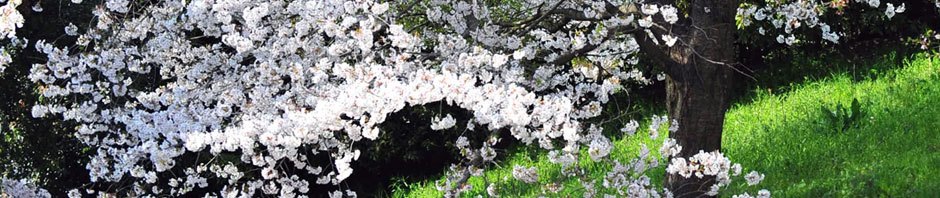
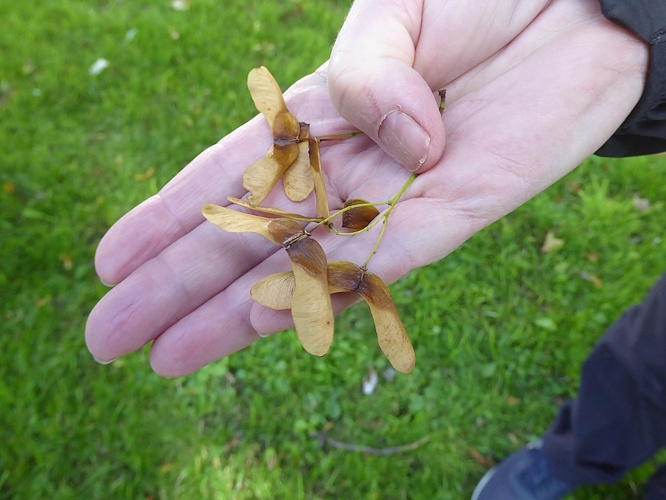
Following Wirral Council’s decision to label many of the trees in their parks, and the publication of tree trail maps for five of them, we planned to look at some of the more unusual trees they had identified in Mayer Park. The first two trees I wanted to see were in the green space on the opposite side of the road from the park. A Cappadocian Maple Acer cappadocium (no. 36) is at the north end, close to Heath Road. Its leaves are the usual Acer-type five-lobed shape, but the lobes are fat and rounded with fine tapering points. The seeds are paired helicopters, of course, with the wings widely-spread.
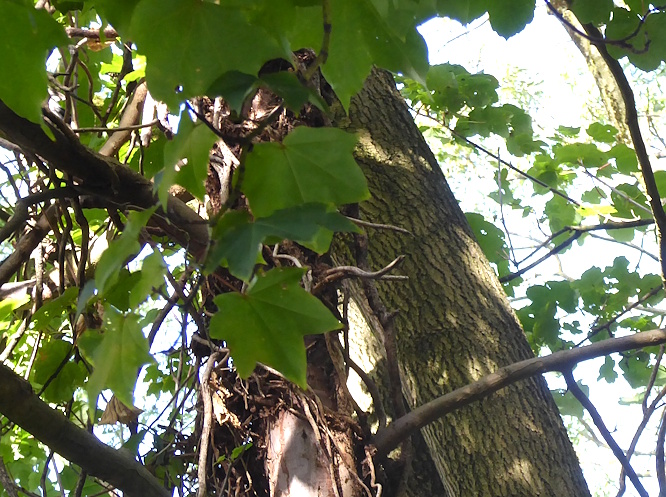
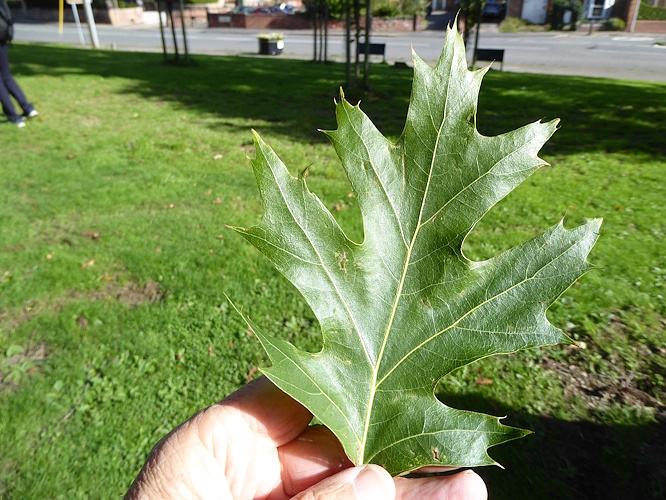
At the south end, near the junction with Bromborough Road, is a Scarlet Oak Quercus coccinea (no. 48). It has large, deeply-lobed leaves, which are said to turn a striking red in the autumn. I have never seen one in its full scarlet glory, but it should be visible from the Parkgate bus if we pass it at the right time of year.
Then we crossed the road to the main park. It was once owned by Joseph Mayer of Liverpool, silversmith, antiquary and philanthropist. He lived in Bebington, and in 1869 bought the building next door to his house, with five acres of land, and transformed them into a library and public park for all the people of the area. I imagine some of the older trees may be Mayer’s original plantings, possibly now 150 years old. As we crossed the park to the north-east corner we spotted a few birds – Magpies and Wood Pigeons of course, but also a tiny bird moving within a deep conifer, very likely to be a Goldcrest. Grey Squirrels were scampering everywhere, and the warm sun brought out three species of butterfly: Speckled Wood, Large White and a Painted Lady.
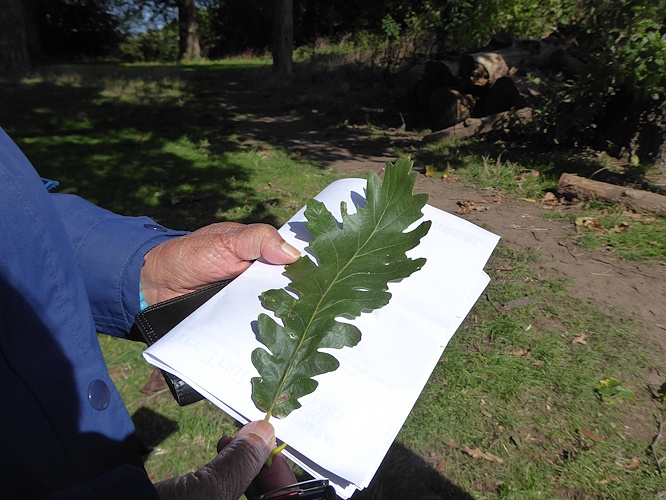
Hungarian Oak, Quercus frainetto (no. 25) has some of the largest leaves in the oak family, up to 25 cm long and deeply lobed. No other oak has leaves with so many lobes.
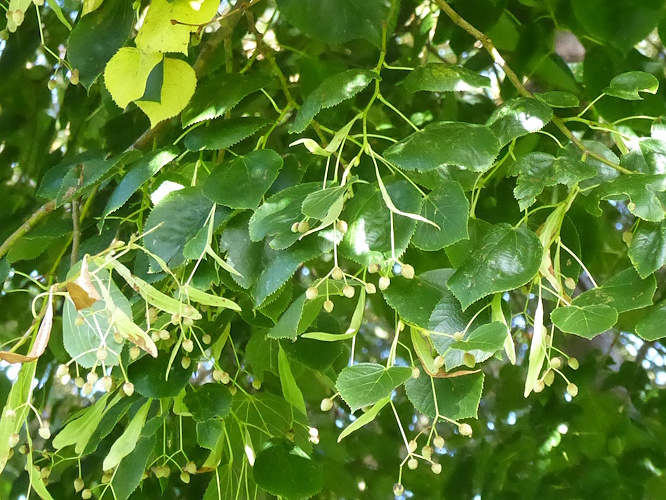
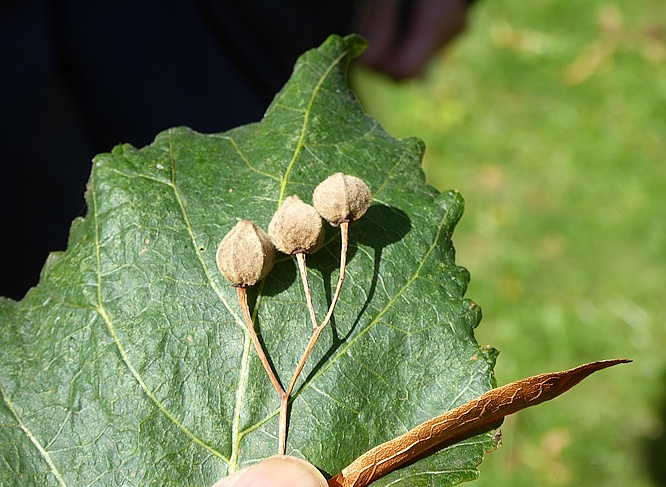
Then we looked at two species of Lime, the Crimean or Caucasian Lime Tilia x euchlora (no.19) and the Large-leaved Lime Tilia platyphyllos (no. 13). The several species of Lime are very hard to distinguish, so this was a good opportunity to see identified specimens and compare them. We noted the smallish, shiny, serrated leaves of the Crimean Lime and its dense, weeping lower branches, but we didn’t find the very oblique stems on the leaves or the five ribs on the little seeds. However, the Large-leaved Lime definitely did have the thick, dull, cabbagey leaves the books describe, and their larger seeds were definitely 5-ridged.
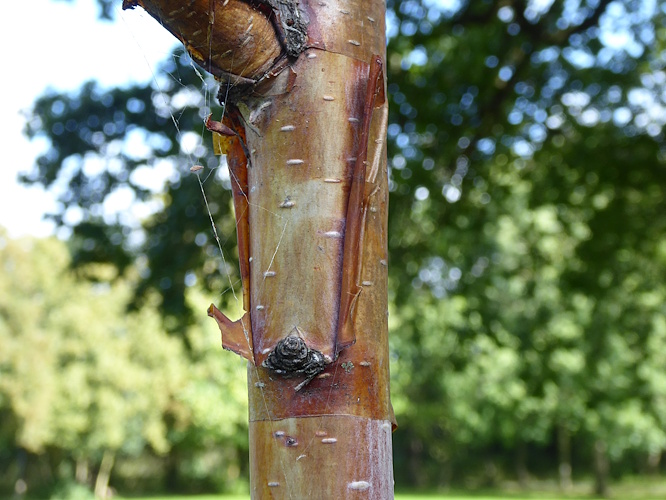
Our last tree was just a newly-planted sapling, a Chinese Red Birch Betula albosinensis (no. 11). This species is a new one on me (a lifer!) looking like any other young Birch tree except that the bark was orangey-red and peeling.
Wirral’s innovation is really helpful for learning to identify trees, with so many labelled and mapped. They have included many commoner trees, too, not just rarities. The only caveat is that the name plaques appear to be affixed with a single galvanised nail, which is only partly hammered in. Some of the plaques we looked at were moving in the wind, and might not stay up for very long!
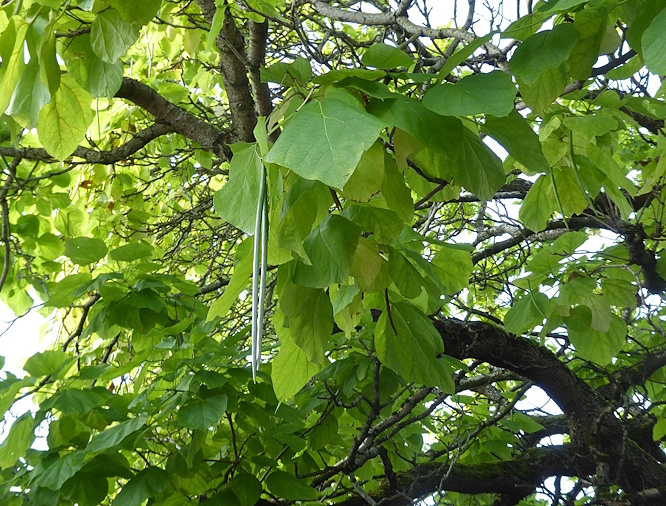
After lunch in Mayer Park’s ornamental garden we headed down Ellen’s Lane, under the railway bridge and we were in Port Sunlight. Our visit to the Garden Centre to use their facilities was enlivened by the enthusiasm of some of the group for the large Indian Bean tree Catalpa bignonioides at the back of the “sheds and seats” area near the exit. The tree isn’t “Indian” (Asian), it originates from the Eastern United states, and neither is it a “bean” (not a legume). The long cylindrical pods contain winged seeds and remain on the tree throughout the winter before splitting and releasing the seeds.
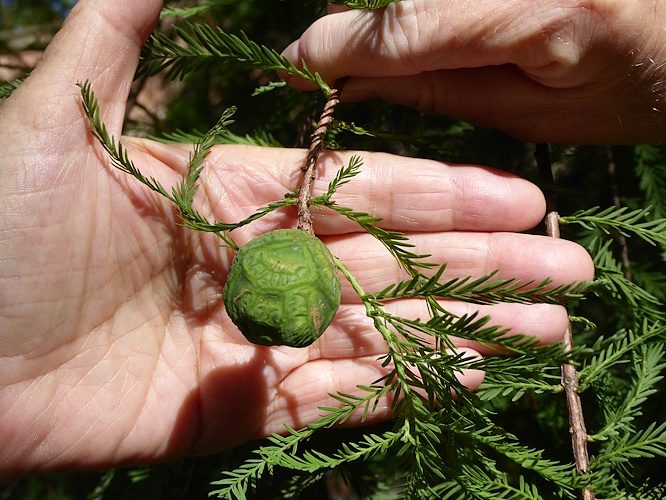
We walked around Christ Church’s graveyard and noted how most of the Weeping Ashes we see nowadays are quite bare and scrawny. I think they are suffering from Ash Dieback disease. Better news on the Swamp Cypress Taxodium distichum in the Dell. It appears to be bearing cones for the first time! It must have loved the recent hot summer, but it is, I’m sure, another sign of global warming.
Public transport details: Bus 464 from Sir Thomas Street at 10.16, arriving Heath Road / The Village at 10.45. Returned from Port Sunlight station at 14.07, arriving Liverpool Central at 14.30.
No Sunday walk next week. On 4th October we plan to go to Princes Park, and details of the meeting place will be advised.
Anyone is welcome to come out with the Sunday Group. It is not strictly part of the MNA, although it has several overlapping members. We go out by public transport to local parks, woods and nature reserves all over Merseyside, and occasionally further afield. We are mostly pensioners, so the day is free on our bus passes, and we enjoy fresh air, a laugh and a joke, a slow amble in pleasant surroundings and sometimes we even look at the wildlife!
If you want to join a Sunday Group walk, pack lunch, a flask, waterproofs, binoculars if you have them, a waterproof pad to sit on if we have to have lunch on the grass or a wet bench (A garden kneeler? A newspaper in a plastic bag?), and wear stout shoes or walking boots. We are usually back in Liverpool City Centre by 3pm at the latest.
If you are interested in the wildlife of the north-west of England and would like to join the walks and coach trips run by the Merseyside Naturalists’ Association, see the main MNA website www.mnapage.info for details of our programme and how to join us.