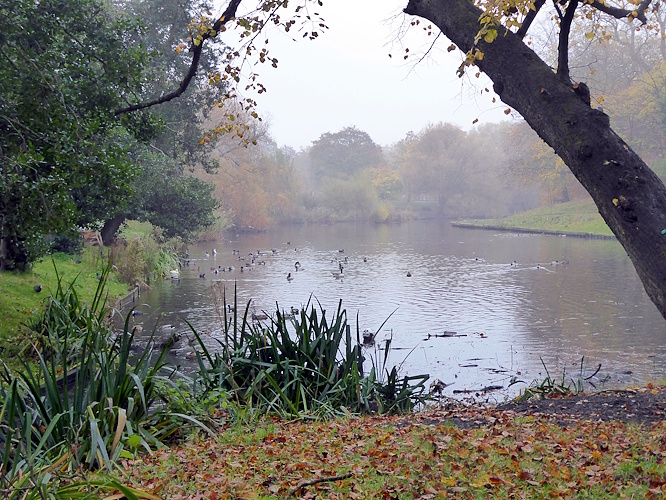
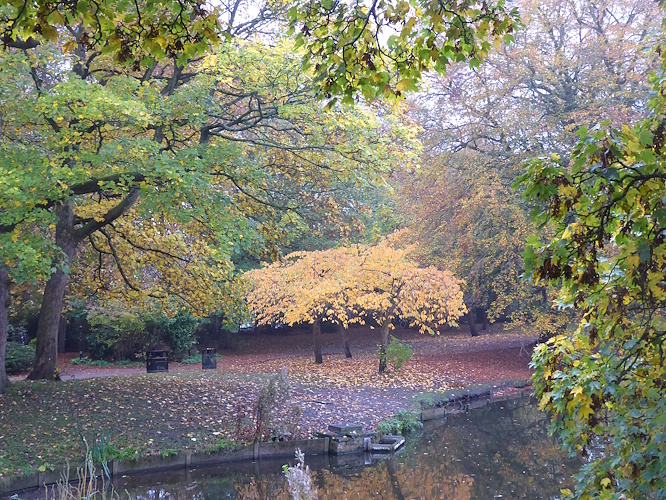
It was a misty morning, and the storms of last weekend had all blown away. It turned out to be a beautiful day, with gorgeous autumn colours everywhere.
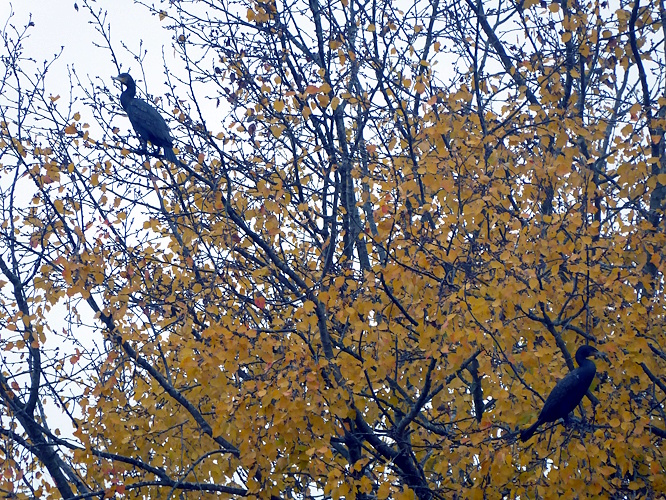
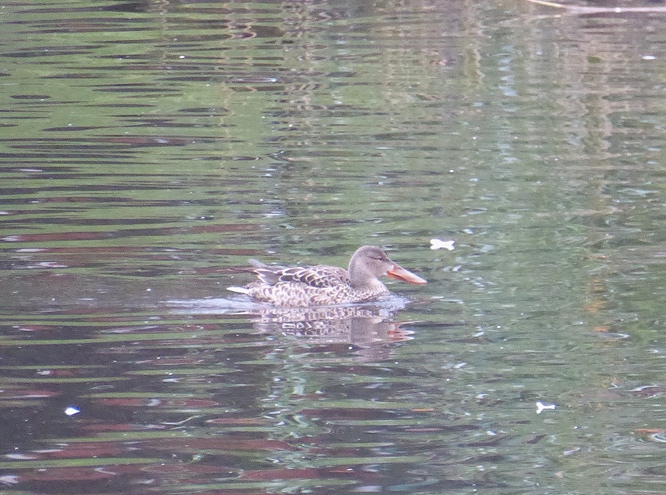
On and around Greenbank lake there were Pigeons, Canada Geese, Mallards, Coots, Moorhens and a few Black-headed Gulls. Beyond them, with its head down and swimming in circles, was another bird. Was it a Shoveller? Then it vanished. There were also a couple of Cormorants up a tree, unusual perches for them.
In the Walled Garden, a Blackbird was eating Cotoneaster berries, while another in a verge was tossing fallen leaves about. In this sheltered spot, there was more confusion of the seasons. Both the Mexican Orange (Choisya) and a Holly bush were in flower.
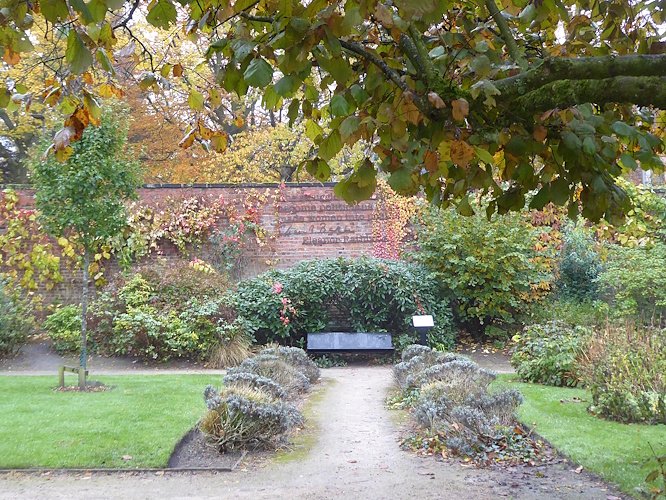
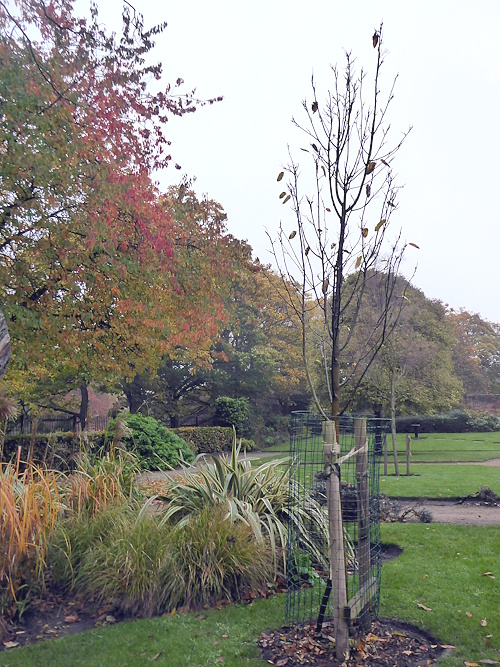
One tree I wanted to look at was the Bastard Service Tree, formerly known as Sorbus x thuringiaca, a natural hybrid of Rowan and Common Whitebeam. It’s a rare native tree, but is now usually planted in streets and parks. The one in Greenbank is the upward-growing variety ‘Fastigiata’, and isn’t much to look at, just a tall sapling still protected by its posts, webbing and netting.
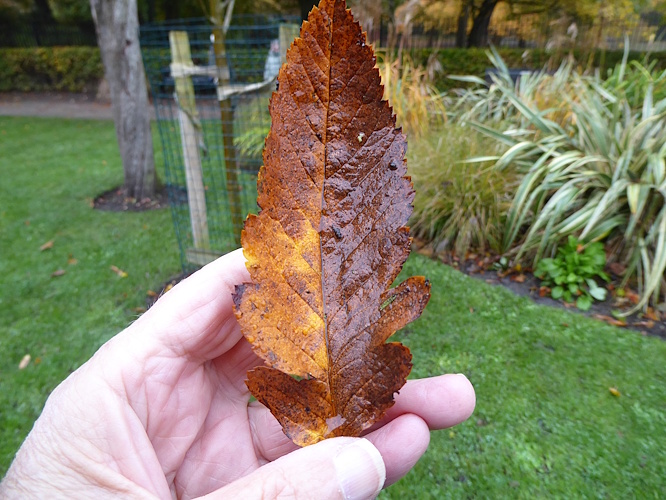
Its leaves are distinctive however, looking like they have tried to divide into leaflets near the stalk (like Rowan) but the divisions become less prominent towards the tip, where it turns into a single leaf (like Whitebeam). It has recently been reclassified as Hedlundia thuringiaca.
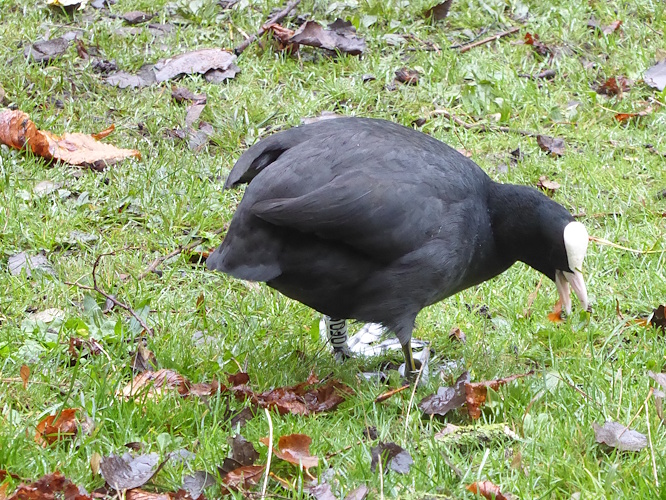
We spotted one Coot on the lake bank with a leg ring, possibly DFO or OFO, but it was DFD. I reported it online to the Waterbird Colour-Marking Group. It was ringed as an adult in Greenbank Park on 17th December 2025, then spotted and reported there three times since, on 19th December 2025, 5th January 2026 and our sighting today. Coots clearly find (or are hatched in) a place they like, and stick to it, unadventurously.
We went around the lake again, looking for the vanishing Shoveller and finally found three of them, a male and two females, swimming together. They weren’t in adult summer plumage, and it might just be that they had been moulting, but could they be a first-winter brood of siblings? Did Shovellers breed in Greenbank Park this year, only 3 miles from the city centre?
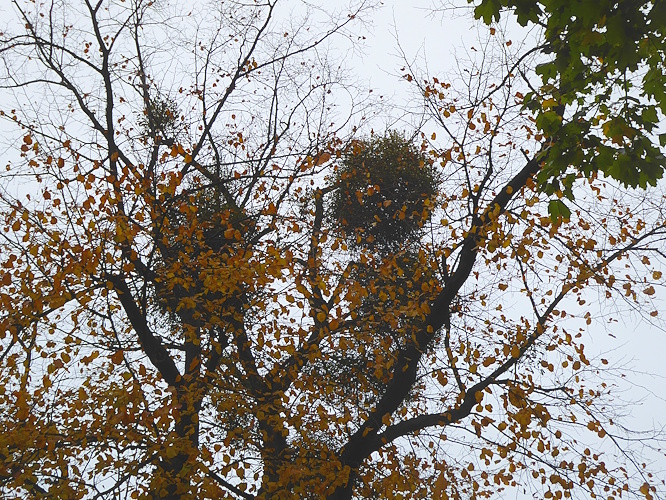
We walked along to the Penny Lane corner with Greenbank Road. (For those of you outside Merseyside, yes, THAT Penny Lane.) Mistletoe is unusual in Liverpool, but there is a cluster here and it grows on trees that aren’t its classic hosts. One bunch is on a dying False Acacia or Black Locust Robinia pseudoacacia and opposite it there are four or five bunches on a Lime. (While two of us were looking at the Mistletoe, the others spotted two Fieldfares in the same group of trees!)
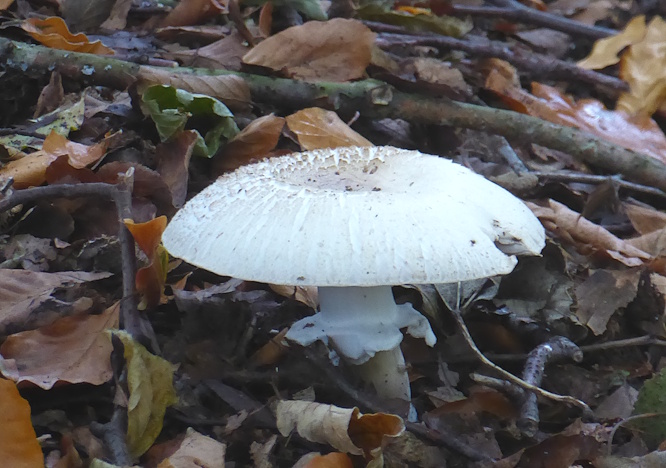
Down Ibbotsen’s Lane there was a Robin on a gatepost and a cluster of elegant fungi growing up through Beech leaf litter.
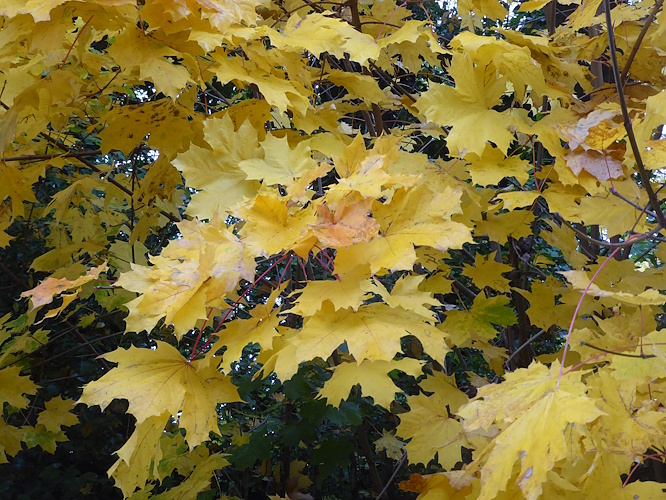
The Norway Maples in the hedge had turned a vivid sunshine yellow.
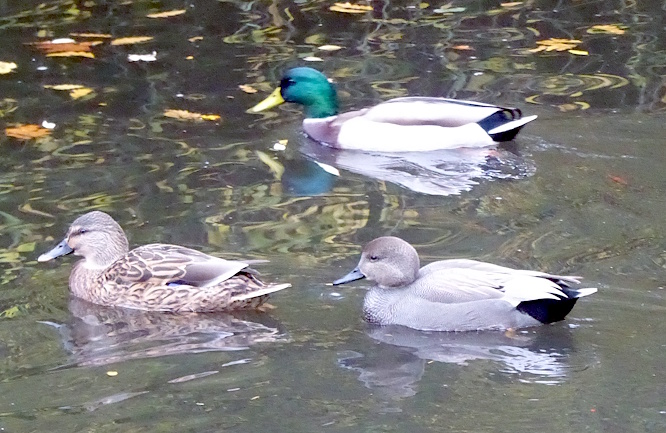
We entered Sefton Park at the bridge over the Fairy Glen, where we met a Liverpool RSPB member who said there was a report of a Mandarin Duck in the park. He hadn’t seen it, and although we looked in all the usual places, we didn’t see it either. But we spotted a different uncommon bird for a city park, a Gadwall. He was hanging about with Mallards and seemed to be interested in one particular female, vying for her company against the drakes.
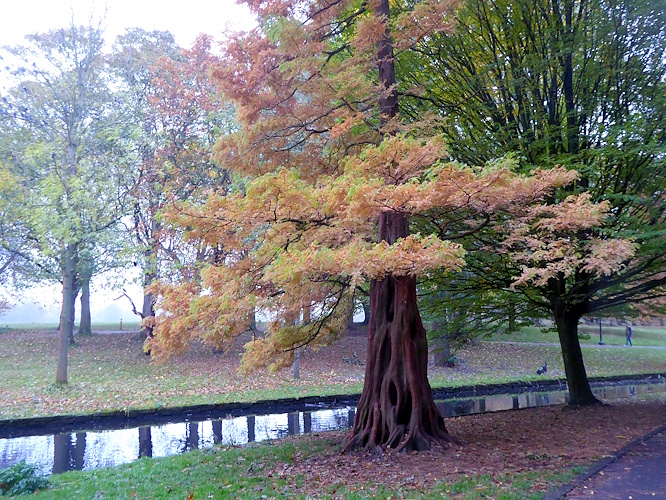
All around us as we lunched were lovely yellow and orange autumn trees, although not many reds. The Norway Maples justified their existence by glowing bright yellow, a Tulip Tree hanging over the water had a dainty mix of leaf colours, while the Dawn Redwood with its wonderful twisty trunk was going rusty-red.
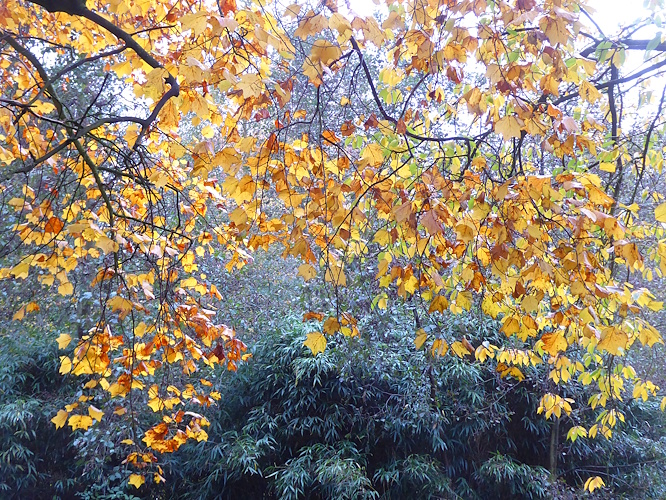
Along the path north of it was a Golden Ash (Fraxinus excelsior ‘Jaspidea’), which spends most of the year looking like an ordinary Ash, then turns golden all at once for just a couple of weeks.
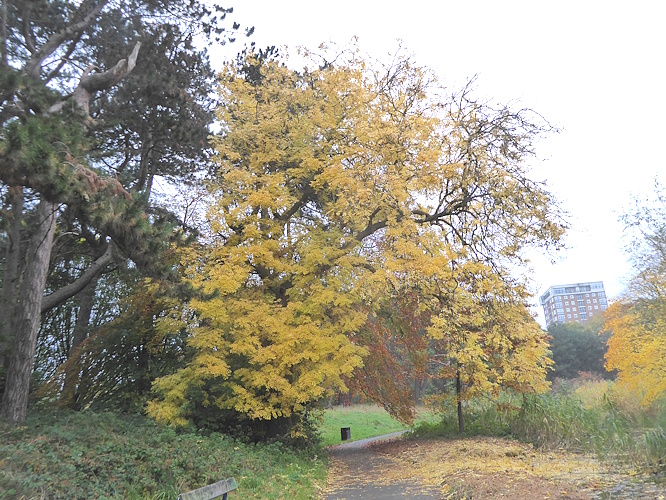
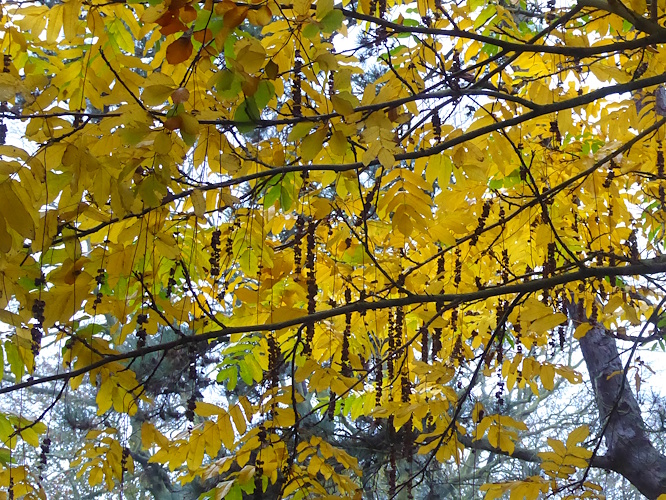
Near the Rathbone statue is a clump of Caucasian Wingnut trees Pterocarya fraxinifolia which had also joined in the “going golden” game.
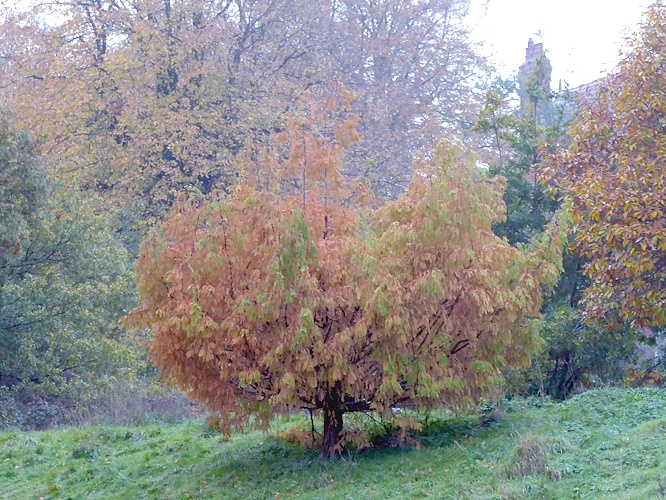
On the west side of the lake the young Swamp Cypress Taxodium distichum was changing colour prior to losing its foliage. This, the Dawn Redwood and the native Larch are the only deciduous conifers.
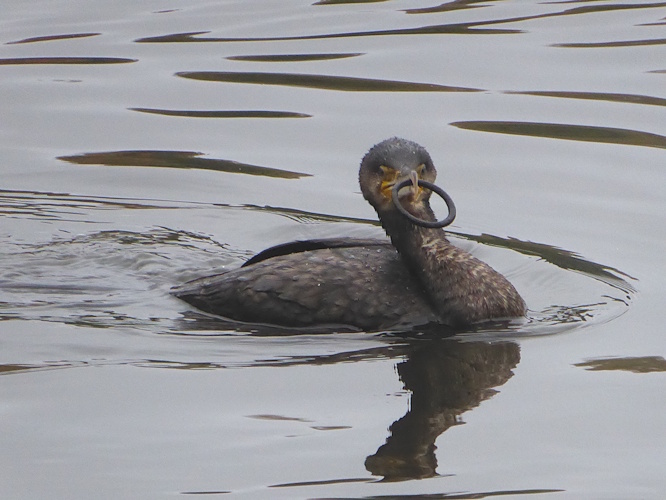
Lake birds were the usual Mallards, Coots, Moorhen, Black-headed Gulls, Mute Swans and Canada Geese. A small handful of Tufted Duck swam amongst them, while some Cormorants perched on the chain posts. At the south end of the lake, by the Boathouse kiosk, one Cormorant was swimming in the shallows. We realised he was injured, with something around his wing, stopping him from diving strongly. He was able to forage successfully for small fish near the edge by putting his head down and working his feet vigorously and seemed to be doing OK. Janet, who has connections to animal rescue, said she had heard there was an injured bird reported here but the rescuers had been unable to find it. This must be it. Meanwhile the Cormorant itself had found a small rubber ring or washer and looked like he wanted to eat it. He clearly didn’t understand our entreaties to drop it, but eventually let it go anyway. We hope the rescue people will find him (or her) soon.
Public transport details: Bus 75 from Elliott Street at 10.02, arriving Smithdown Road / Borrowdale Road at 10.17. Returned from Aigburth Road / Jericho Lane on the 82 bus at 2.30, arriving city centre at 2.55.
Next week we are going to Landican Cemetery and Arrowe Park. Meet at 10 am at Sir Thomas Street for the Heswall buses 471 or 472.
Anyone is welcome to come out with the Sunday Group. It is not strictly part of the MNA, although it has several overlapping members. We go out by public transport to local parks, woods and nature reserves all over Merseyside, and occasionally further afield. We are mostly pensioners, so the day is free on our bus passes, and we enjoy fresh air, a laugh and a joke, a slow amble in pleasant surroundings and sometimes we even look at the wildlife!
If you want to join a Sunday Group walk, pack lunch, a flask, waterproofs, binoculars if you have them, a waterproof pad to sit on if we have to have lunch on the grass or a wet bench (A garden kneeler? A newspaper in a plastic bag?), and wear stout shoes or walking boots. We are usually back in Liverpool City Centre by 3pm at the latest.
If you are interested in the wildlife of the north-west of England and would like to join the walks and coach trips run by the Merseyside Naturalists’ Association, see the main MNA website www.mnapage.info for details of our programme and how to join us.