Princes Park, 24th November 2024

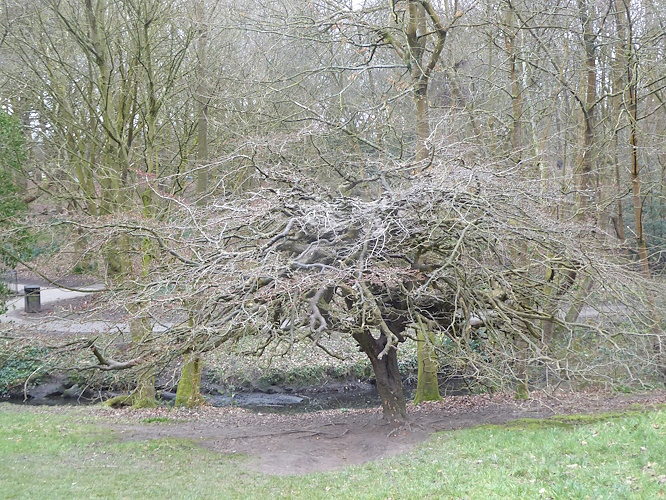
Princes Park is the earliest public park in Liverpool, and the nearest to the city centre. It was originally a private development, funded by the sale of grand perimeter houses, and designed by the famous Joseph Paxton. It opened in 1842. It was a mild dry day, but overcast and gloomy. Last week’s Storm Bert blew off most of the remaining autumn-coloured leaves, but a few are still hanging on in sheltered corners.

We looked at some of the rare and interesting trees. Their Wollemi Pine, still in its weed-filled cage, has grown quite tall but is now looking a bit tufty.

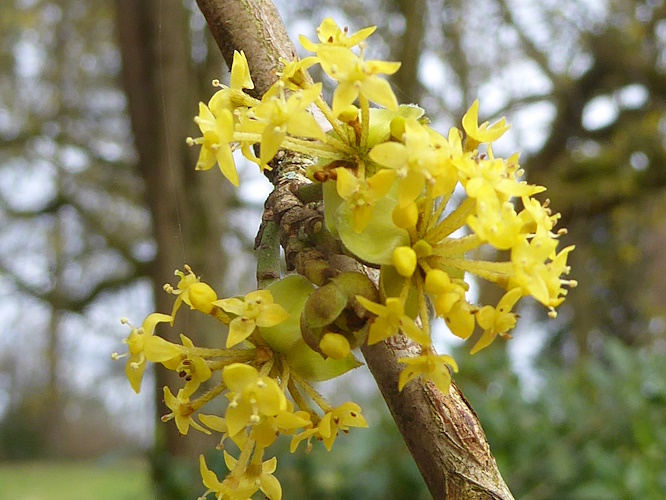
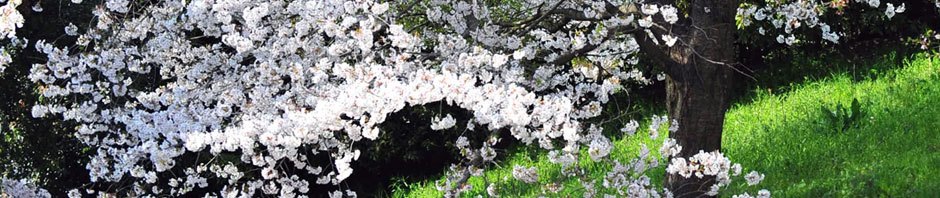
We didn’t find the Golden Rain / Pride of India tree again, and we should have had the map with us. There is a Cherry Walk, with nothing much to see at the moment, of course. The park is also said to have some Great White Cherries, a variety once extinct in Japan, but restored from a cutting in a Sussex garden. The ones here are near the tennis courts, in the north-west arm of the park, a spot we rarely go to. We ought to make an effort to catch the cherries in bloom next spring. We also looked at the Joseph Paxton memorial tree, a Chinese Tulip Tree, looking very promising within its set of fine railings.

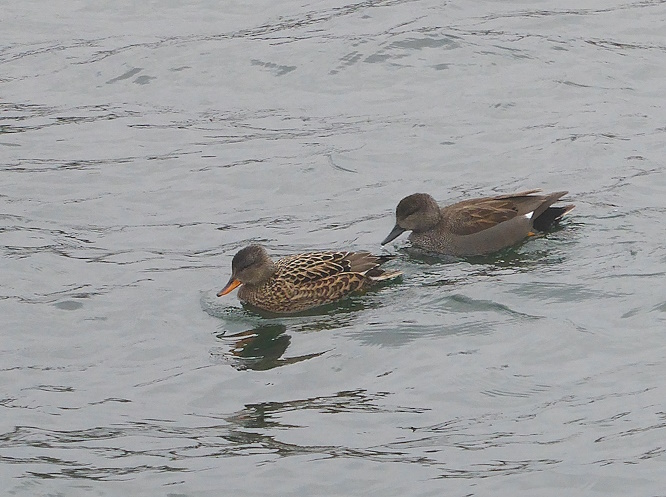
We could hear Ring-necked Parakeets but hardly caught sight of them. Otherwise the open spaces had Pigeons, Crows and Magpies. The lake had Mallards, Coots and lots of Moorhens. The male and female Moorhens have identical plumage, but the males are slightly larger. Is this a male-female pair? With the male at the top of the picture?

Also on the lake was one distant Tufted Duck and two Little Grebes.

We made a quick sortie out of the park to the nearest McDonalds to use their facilities, then back for lunch. Under a nearby Oak, a Jay was poking through the leaf litter, but there didn’t seem to be any acorns left.

On the way out we noticed a big red-berried Cotoneaster. The Friends’ tree map says it is a variety called ‘Cornubia’, and Trees and Shrubs Online says “This is one of the very finest of the larger growing cotoneasters.  It bears enormous crops of brilliant red fruits and is not surpassed in that respect by any other cotoneaster.

Public transport details: Bus 86A from Elliott Street at 10.10, which didn’t go the way we expected, so we had to walk back to the park from the Women’s Hospital. Returned from Princes Road / Princes Gate West on bus 75 at 1.17, arriving Liverpool 1.25.
Next week we plan to go to Chester, meeting at Central Station.

Posted in Sunday Group | Comments Off on Princes Park, 24th November 2024

New Brighton, 17th November 2024

After our unseasonably mild autumn, today was “hats and gloves” weather. From Wallasey Grove Road station we walked towards the seafront, then went the “wrong” way, westward along Bayview Drive, to the Harvester pub and Wallasey beach.  We had heard rumours that one or two Snow Buntings had recently been seen there, but no luck. As a consolation tick a Meadow Pipit flew inland from the beach and later we spotted a busy Pied Wagtail on the prom. Two Crows had found a high perch on a dune overlooking the beach and were supervising all the comings and goings.

I was spotting plants in flower, to see what was surviving into this colder weather. The winter-flowering shrub Laurustinus was just coming into bloom. By the roadside was a wild Dog Rose; some Ivy had just a few late flowers hanging on; there was Gorse, which flowers in every season; Daisies in the grass, some kind of Sow Thistle and a Hawkweed; the tough roadside “weeds” Hairy Bittercress, Groundsel and Shepherd’s Purse; Sea Rocket was sprawling beside the gone-over flower heads of Sea Holly and further back from the dunes were Ragwort and Yarrow. That’s 13 species.

A few late flowers of Ivy
Sea Rocket
Ragwort

Further along Wallasey beach, near the kitesurfing school, four brave young souls were cavorting in the cold water and heavy surf. Brrrr!

Then we headed north-east along King’s Parade towards New Brighton. It was blowy and chilly, with scattered sharp showers driven by the stiff breeze, but at least the wind was behind us. It was high tide around 11.30, and the waves were beating hard against the sea wall, crashing up in great walls of spray. At times the red cranes at Seaforth docks across the Mersey were almost obscured in the misty rain. (As on the opening picture)

We crossed over, away from the risk of unexpected drenchings, and looked at the gulls in the grassy “dips” between King’s Parade and Coastal Drive. A few Crows, Black-headed Gulls and Herring Gulls were hanging about there, waiting for the weather to improve so they could get back to their special feeding method. They collect live Cockles from the beach and drop them onto the hard pavement, which breaks them open. The edge of the grass was white with drifts of broken cockleshells.

After a pit stop in Morrison’s supermarket and lunch in a seafront shelter, we went around the back of the “Marine Point Retail and Leisure Park” to check out the birds on the pontoons on the Marine Lake.

Not very many today, and just the usual Redshanks, Turnstones and Dunlins. We were hoping tor a Purple Sandpiper or two, but not today.

Redshanks with red legs, a Turnstone in the middle with a white breast and dark back, and a tiny Dunlin at the front right with a buff back and one black leg showing.

As we watched them, small groups were flying off towards the beach, their high tide break over. How do they know the sand and mud is uncovering again? They can’t see any of the beach from their sheltered spot on the pontoons. Do they have a inherent feeling for the tide? Do they see others flying off and not returning? Or are they just too hungry to wait any longer?

Five Cormorants were perched on a navigation tower just off the beach. On the small sandy bay between the lighthouse and the Fort were over a dozen Redshank and about a hundred Oystercatchers.

Public transport details: New Brighton train from Central at 10.20, arriving Wallasey Grove Road at 10.40. Returned on bus 433 from King’s Parade / Morrison’s at 1.40, arriving Liverpool 2.15.
Next week we plan to go to Princes Park, meeting Elliot Street at 10 am.

Posted in Sunday Group | Comments Off on New Brighton, 17th November 2024

Kirkdale Cemetery, 10th November 2024

Yet another mild but dull day. We gave the big Remembrance Service in Liverpool City Centre a miss and sought peaceful contemplation elsewhere. Kirkdale Cemetery has the graves of 478 servicemen from the two world wars, as well some other men with links to history.  Many of the WWII victims buried there are from the Battle of the Atlantic, there are graves of Belgian and Russian servicemen, and of the 357 interments from WWI, over 100 were for Canadian servicemen who died at the country’s military hospital in Westminster Road, Liverpool.

The oldest soldier commemorated there is a Victoria Cross holder from the Indian Mutiny or Rebellion, Gunner William Connolly. He has a CWGC stone near the entrance but was buried somewhere near the far northern side.

We didn’t find the gravestone commemorating a Titanic connection, but found the one for Alexander Braid Johnston, Chief Engineer of the Carpathia, the ship that was first to arrive on the night of the disaster in 1912, and rescued over 700 survivors. He died in Liverpool 16 years later. His stone has fallen.

One of the greatest tragedies of WWI was the sinking of the passenger liner Lusitania, which was torpedoed off the coast of Ireland, on route from New York to Liverpool in 1915. The body of Chief officer John Piper was washed ashore near Kinsale 12 days later. The unusual letters “SPE” on his gravestone are thought to be an unauthorised later addition: when his body was found it wore a ring with those letters engraved on it, but nobody knows to this day what they mean.

As for wildlife, the cemetery has scattered mature trees, none looking like rarities, and no obvious new plantings.

We noted the usual birds of urban open spaces, Herring Gulls, Crows, Magpies and Wood Pigeons. The best bird of the day was a single shy Rook, which dodged behind a gravestone then flew off. It’s an awful picture, but it shows it’s definitely a Rook with that whitish beak and face. Unusual to see one on its own.

At lunchtime a fine drizzle started, so we abandoned plans to walk a section of the Loop Line, and headed for the bus.

Public transport details: Bus 20 from the temporary stop in Victoria Street at 10.17 (diverted from Queen Square for Remembrance Day) arriving Longmoor Lane / Greenwich Road at 10.45. Returned on bus 21 from Longmoor Lane / Bradville Road at 1.05m, arriving Queen Square at 1.40.

Posted in Sunday Group | Comments Off on Kirkdale Cemetery, 10th November 2024

Sherdley Park, St Helens, 3rd November 2024

Sherdley Park was once the private estate of a copper industrialist called Michael Hughes, who died in 1825. The estate fell into disrepair until it was bought by the local council in 1949. Now it is a huge open space, with a golf course occupying the western half. We approached it from the Lea Green end, at the south east corner of the park. One of the best trees of the day was a tall Swamp Cypress next to the path between the lake and the children’s play area, towering over the skateboard ramp.

The park lake is nestled in a small woodland. We noted only Mallards, Black-headed Gulls and a couple of skulking Little Grebes.

Out in the open grassland we saw only the boldest birds – Crows, Wood Pigeons and Magpies. We walked as far as the “Park Bar and Kitchen” next to the golf course, to use their facilities (open to all park users), then lunched in a fenced-off garden area called (by Google maps) the “Arboretum”. It definitely isn’t one of those, but appears to be the old formal garden of the ruined big house, a maze-like area of paths and tall trees, a few lawns, and lots of benches.

There seemed to be a lot more wildlife in that quiet and sheltered nook. There were lots of Grey Squirrels, a Great Tit, a Collared Dove and possibly a Nuthatch. Someone spotted our binoculars  and told us he had seen a Long-eared Owl in the woods beyond the western edge of the paths. We went to look, saw nothing and felt doubtful. The trees in the so-called Arboretum were mostly unremarkable, but we noted some lovely old Cherry trees, which will be glorious when they flower.

One Cherry in a sheltered corner appeared to be blooming already. It didn’t look like a winter-flowering type, and may have been deeply confused by this mild autumn.

There was also a tall and shapely Larch, lovely Beech hedges and a droopy conifer of the Cypress type, which may have been a Weeping Nootka Cypress, also known as the Afghan Hound tree.

Then it was time to find our way home. Permit me a grumble about the service of Northern Rail (the local trains out of Lime Street). They are very unreliable, especially at weekends. At Lime Street our train was listed on the departure boards but without a platform number, so we had to wait, wondering if it was to be cancelled. When the platform number was announced, there was a mad scramble to board and it left 5 minutes late. At Lea Green we saw that trains back to  Liverpool were only hourly, and one had already been cancelled. We decided not to risk returning by train and went home a roundabout way on two buses via St Helens bus station.

And just a note about Rimrose Valley Country Park, long-threatened by a road-building scheme for the docks. This week’s Budget Statement has cancelled the proposed road, so Rimrose is saved. Great news. The Chancellor’s statement said “As part of the government’s commitment to growth, it will take difficult decisions where there is not a clear value for money case to invest. After a review the Transport Secretary has decided not to progress with the following unfunded and unaffordable road schemes on the strategic road network: A5036 Princess Way…”

Public transport details:  Train from Lime Street at 10.30 (actually 10.35), arriving Lea Green at 11.05. Returned on the 29 bus from Marshall’s Cross Road / opp Eaves Lane at 2.10, arriving St Helens bus station at 2.15, then bus 10 at 2.25 arriving Liverpool at 3.20.
Next week we plan to go to Kirkdale Cemetery, meeting at Queen Square at 10am.

Posted in Sunday Group | Comments Off on Sherdley Park, St Helens, 3rd November 2024

Parkgate, 20th October 2024

Parkgate used to be small port on the river Dee. Over the last couple of hundred years it has silted up and is now mostly saltmarsh. The Dee flows in a narrow channel next to the north Wales coast. Over a decade ago, high tides used to flood the marsh and brim over the low sea wall onto the road. All the little creatures from the marsh would run about on the tarmac in panic. The RSPB dug out a few deep pools, mostly to control the mosquitoes, and now it hardly floods at all. Birds of prey still find it worth their while gather at high tide though, because the little mice and voles are easy for them to spot and catch. It was expected to be a good high tide, 9.65m at about 1.30pm, so we were expecting to see raptors gather. The other attraction was a flock of half a dozen Spoonbills, which had been lingering here for the last month or two. We were hoping to see them.

Last night we had Storm Ashley, with strong winds up to 40 mph, but they blew from the south, so it wasn’t cold. Our bus route took us across the Wirral, where all the street trees were green and gold, with occasional red-leaved Cherries and flashes of crimson from front garden Maples. The rain was lashing the bus but it stopped just as we arrived. Almost immediately we spotted a big brown bird with a lighter-coloured head, far out, flying south and occasionally wheeling and dropping into the reeds. I’m pretty sure it was a Marsh Harrier.

We could see a very distant cluster of big white birds, at least half a dozen of them, showing just their heads and necks. Were they the Spoonbills? It was hard to be sure, they were too distant. But we headed that way, towards the Old Baths area, hoping for a closer view. (When we were nearer we didn’t think any were Spoonbills after all. They were most likely to be Great White Egrets accompanied by about a dozen Little Egrets flying about. Such a large flock was unheard of just a few years ago.)

A Kestrel was hovering near the road, then it was harassed by several young gulls and flew off.

Also easily visible close in was a brightly-coloured male Pheasant with a drabber companion. We assumed it was a female, but I looked them up later, and the drabber one was a juvenile male. Father and son?

There were lots of ducks along the edge of one of the big pools. Definitely two Shovellers there, the ones with the bright white fronts, but the others are harder to identify at distance. Looking at the photo at home I realised there was probably another raptor in that picture. Near the top, left of centre, is a brown bird with a bright white mark between its body and tail. It looks like a “Ringtail”, a term used for “not-an-adult-male” Hen Harrier, i.e. a female or a juvenile. We didn’t notice it at all while we were there. A Hen Harrier is a pretty rare bird, so it’s a very good “tick”.

There were many other birds on the marsh, mostly concealed in the vegetation until some threatening predator put them up. Lapwings, Crows, Coots, Mallards, Moorhens, Greylag Geese, Wood Pigeons (and probably lots more). Sitting up on a tall plant was a Stonechat.

At the Old Baths, our usual picnic bench and its overhanging Tamarind tree were gone, with a new row of seats looking out over the view. Next to the owl sculpture was some White Poplar in the hedgerow. The undersides of its leaves are white and downy, and the last few clinging on in autumn make the tree look like it is blooming out of season.

As we ate our sandwiches we heard the unmistakeable calls of Pink-footed Geese, and then several hundred flew over our heads, out over the estuary and made for North Wales.

As we returned past the Boat House pub we noticed that Parkgate has now been designated part of the King Charles III England Coastal Path.

And the day isn’t complete without a tree to puzzle over. One front garden had this unusual pendulous tree, which we thought was a Weeping Larch, or was it some kind of Cedar? Never seen anything like that before. Which is it?

The arrangement of the needles was similar, the bark doesn’t solve the problem. When I looked closely at the picture at home I spotted some red-brown male pollen cones high up on the right side, so it must be some kind of Cedar. I think it also has some arrangement of scaffolding at the top, near the graft, to spread the branches and stop them falling straight down next to the trunk.  It’s a bit of a dog’s breakfast! Apparently these are sold as “Weeping Cedars of Lebanon” but most experts think they are the commoner Deodar or Himalayan Cedar, just given a romantic name to inflate the price!

Public transport details: Bus 487 from Sir Thomas Street at 10.29, arriving Parkgate, Mostyn Square at 11.25. Returned on the 487 from Mostyn Square at 1.30, arriving Liverpool 2.45.
Next week we plan to go to Landican Cemetery, meeting at 10 am at Sir Thomas Street.

Posted in Sunday Group | Comments Off on Parkgate, 20th October 2024

West Kirby, 13th October 2024

West Kirby is a place for outdoor sports of sea and air. We strolled along South Parade, watching the yachtspeople practicing their turns on the Marine Lake, and there was a powered paraglider overhead.

It was low tide, and people were heading out over the wet sand to Little Eye island.

Occasional Cormorants flew by and there were a few birds on the pontoon at the yacht club, mostly Redshank, a few Turnstones (not in the picture) and some Black-headed Gulls.

One Redshank was feeding, with its beak well down into the ooze.

We lunched in Coronation Gardens. There used to be a Persian Ironwood tree at the back of the shrubbery. When we last saw it, on 26 May 2019, it looked as if it was struggling in the salty winds. We couldn’t find it at all today, so it might have died.

At the southern end of the Marine Lake, out on the retaining walkway, it looked like the coastguard were up to something. An exercise?

As we walked back northwards, what little breeze there had been in the morning had died right down. The yachts were becalmed in the lovely pearly light, making reflections on the still water. You should just be able to make out the distant Point of Ayr Lighthouse at Talacre on the north Wales coast, with Anglesey behind it.

As for trees, there are hardly any worth mentioning in West Kirby outside of Ashton Park.  I noted the missing Persian Ironwood above, and there is a row of Stone Pines outside Morrison’s supermarket. Otherwise the only place of interest is Sandlea Park. Their biggest trees are Common Walnuts, and there are some Cedars as well as the rare hybrid Almond we are keeping an eye on. A flying bee caught our attention, feeding on some blue cultivated geraniums. It had a ginger hairy thorax, so I guess it was a Common Carder bee, said to be on the wing until November.

Public transport details: Usually we would go straight there and back on the train, but today there were rail replacement buses from Birkenhead North to Leasowe, so we worked around them. Train from Central at 10.05 to Birkenhead Park, arriving 10.15, then the 437 bus from Park Road N / Ashville Road E at 10.23, arriving Grange Road / West Kirby Station at 10.55. Returned on the 437 bus from West Kirby Station at 1.30, arriving Liverpool 2.25.
Next week we plan to go to Parkgate for the Spoonbills and a good high tide. Meet Sir Thomas Street in time for the 487 bus at 10.29.

Posted in Sunday Group | Comments Off on West Kirby, 13th October 2024

Calderstones Park, 6th October 2024

Is early October too soon for autumn colour nowadays? Calderstones, with its wealth of trees, should be a good place to answer the question. Near the southern entrance some of the rare Maples were starting to turn but around the “Veteran Sweet Chestnut” (marked on Google maps, no less!) all the small trees and bushes were still green. This huge tree is probably older than the park and possibly older than the gentleman’s estate which preceded it.

The first bright colour was on this Cherry tree in the text garden.

On the way to the Rose Garden we noted a Contorted Hazel, bearing just one hazel nut. How have the squirrels missed it? There is a group of young trees between the path and the wildflower meadow, some still in their planting cages. Nearest to the path is a healthy-looking Foxglove tree, then a sparse Judas tree (foliage hidden on the right) then two with pinnate leaves, one of which is the rare Pecan nut tree. Of the two, I think the Pecan is the one with yellowing leaves and vertically cracked bark. The other one, still green, not in a cage and with flaky rectangular-plated bark, is still a mystery.  Right at the back is a strikingly yellow young tree, which I tentatively identify as a Golden Ash.  (For detailed tree information I recommend the website “Trees and Shrubs Online” )

We had gone to the Rose Garden to look at the Golden Rain tree overlooking the pony paddock. When the MNA met here for the bat walk on 19th September the tree had brown leaves all over, far too early for that. Today it was all bare, no leaves and no pink seed lanterns. We are seriously concerned for its health. Later in the day we looked at the other Golden Rain tree near the Reader Bookshop, hemmed in behind the Mansion House, and that was still in leaf, some yellowing, but it looked fine.

Back near the Rose Garden we heard some calling Ring-necked Parakeets. Other birds today included Blackbirds, Magpies, Wood Pigeons, a Blue Tit and a possible Goldcrest, but there wasn’t much birdlife about.  The trees continued to delight, though. Look at this amazing Pink-leaved Rowan.  No idea which one it is. The Japanese Rowan is said to have parts of the outer leaves turning purple in early October, but they have orange-red berries. The Hupeh Rowan is said to have a pink variety, but the detailed description doesn’t match. No idea which one this is, but it’s lovely.

We lunched in the Japanese garden, where lots of maples were turning colour.

Then we went rooting about east of the Mansion House, where we had a good look at the  Douglas Fir, smelled its foliage (strong, sweet, fruity-resinous) and admired its intricate cones.

There is a rare Sweet Chestnut tree with white-edged leaves (variety ‘Albomarginata’), and we were charmed to see that the spiky seed-cases are also white. It’s a lovely thing, but some of the twigs are reverting to all green and there is a rotting hole at the base of trunk. It may be at risk of falling.

Nearby, the old trunk of the Shagbark Hickory is being swallowed by weeds and bramble, with fungi starting to break it down.

Around the corner is the Allerton Oak. It is thought to be the oldest tree in the park, possibly 550 years old, and the spreading branches are now carefully propped up. A sign next to it suggests it germinated in the reign of Henry VIII. It was Britain’s Tree of the Year in 2019.

Outside the gallery we were happy to see a sign asking people NOT to leave old pumpkins in the park. They aren’t “a gift to nature”, they can make hedgehogs and dogs sick. After having seen more autumn colour than we expected, our last treat was a row of lovely trees along the central reservation of Mather Avenue, just opposite our bus stop. The council tree departments don’t just plant any old trees on a site, they think it out beforehand. Here there are some lovely colour contrasts. The little pale green one on the left with just four thin branches and a tall leading shoot must be a Ginkgo, the small bright red one is a Sweet Gum Liquidambar styraciflua, then a Copper Beech, and I was too far away to identify the yellow and green ones. Great bit of municipal planting!

Public transport details: Bus 86A from Elliot Street stop GD at 10.15. arriving Mather Avenue / Ballantrae Road at 10.45. Returned on bus 86 from Mather Avenue / Storrsdale Road at 2.25, arriving city centre at 3.05.
Next week we plan to go to West Kirby, meeting Central Station at 10 am.

Posted in Sunday Group | Comments Off on Calderstones Park, 6th October 2024

Otterspool Park. 29th September 2024

Otterspool Park is the old carriage drive to the grand riverside house of a snuff miller. After the house was demolished in 1931 the drive became a route down to the “day out” destination of Otterspool on the banks of the Mersey. John remembers coming here when he was a child in the 1950s and 1960s, when the path was lined with neat lawns and clipped shrubberies. It hasn’t been kept in that style for many years, and now the borders are thickly filled with the remains of the elegant trees and shrubs which once lined the drive, all tangled up with Bramble and Ivy. It was a damp and rather gloomy day, with the Gothic effect enhanced by the cawing of Crows. Much of the fallen wood has been left, and one pile was covered with an explosion of fungi.

The Rhododendrons probably still bloom, and four or five lovely Cut-leaved (or Fern leaved) Beeches still sprinkle golden leaves on the paths in autumn. Less elegant are two scruffy-looking cedars, probably not Cedars of Lebanon (but they ought to be), which have sacrificed their elegant shapes while stretching for the light.

This tall tree is probably an Italian Cypress, which would once have been a striking punctuation mark along the neat edge.

There are two lovely ornamental trees on the south side of the bridge, either side of the drive. They are known for their spectacular autumn colour. One is a rarity, Red-veined Enkianthus, which turns crimson all over, and the other is Persian Ironwood, which becomes scarlet and bronze. Sadly, we were too early to see the intended effect.

Red-veined Enkianthus
Persian Ironwood

By the old café is a large Holm Oak, and we looked at its tiny undeveloped acorns. This is all we ever see, implying that these are the finished article, the mature fruits. But books and the internet have pictures of long, pointed brown acorns, just like other oaks, so why don’t they form on Merseyside?

Near the Promenade and skate park on the banks of the Mersey, some of the lawns have been planted with what is called the Otterspool Orchard, an experimental mix of young trees, part of a research project on climate change. We looked at them on our previous visit on 23rd April 2023. The so-called “Odunaiya planting mix” includes some rarities like Weeping White Mulberry, Black Mulberry, Pecan nut and some kind of rare Thorn tree, with fruits like Hawthorn, but larger, and plain-edged leaves.

As for birds, there were the aforementioned Crows, Wood Pigeons deep in the trees, Robins and Blackbirds on the woody edges.  Nearer to the river were gulls, Magpies and a Goldfinch. Nothing exciting on the river, and the tide was high. Up on the bank we spotted both Japanese Larch and  European Larch. The cones of European Larch have flattish scales while those of the Japanese Larch have rather pretty curled-out scales.  

European Larch with flattish cone scales
Japanese Larch with curled cone-scales

The sun was shining weakly on the way back, and we noticed some flowers still out – Herb Robert, Gallant Soldier and some late-flowering Bramble. My strawberries think it is spring, too, putting out a few tentative flowers.

Public transport details: Bus 82 from Elliot Street at 10.07, arriving Aigburth Road / Lisburn Road 10.30. Returned on 82 bus at 1.50 from Aigburth Road / Jericho Lane, arriving city centre at 2.10.
Next week we plan to go to Calderstones Park, meeting Elliot Street at 10 am for the 86 bus and entering the park at the south-west corner, near the Rhododendron walk.

Posted in Sunday Group | Comments Off on Otterspool Park. 29th September 2024

Wallasey Central Park, 22nd September 2024

How can I have walked with the Sunday group for over 20 year and never been to Wallasey Central Park?  We think our former leader Bob Hughes once took the group to a small, derelict area nearby, said that was it, and spoiled the idea for ever. Central Park is lovely, with a lake, a walled garden, café and toilets. It is the former estate of Sir John Tobin, who commanded ships in the slave trade and was later Lord Mayor of Liverpool. The Hall and 57 acres of land were bought by Wallasey Local Board after the death of Tobin’s nephew and opened to the public in 1891.

After a week of sunshine, it’s the autumn equinox and summer seems to be over. Fungi are popping up everywhere, including this huge group of little balls at the bottom of the old park wall, just by the bus stop where we arrived. Some are even emerging from the wall. Common Puffballs?

In the corner of the park by the disused old Egremont St John church there were several rows of tiny new trees, perhaps destined for other parts of the park when they grow larger, or perhaps intended to form a small forest walk right there. They were native species such as Hazel, Oak, Rowan, Hawthorn, Horse Chestnut, Scots Pine and there was even a baby Sycamore with prominent Tar Spot fungus.

We saw lots of Grey Squirrels, several Wood Pigeon and Crows, a Collared Dove and a Jay, which was scolding loudly from deep inside a tree canopy then flew off in a flash. There is a pair of small duck ponds on the southern edge, containing only multiple Mallards, one Moorhen and plenty of feral Pigeons on the banks.

The walled garden in the centre of the park was lovely, with a café run by the Friends, picnic tables, neat flower beds, a small orchard and a very clean and functioning loo block. 10 out of 10 for that.

It started to rain as we ate our lunch, but we carried on, determined to see all of the park. The main lake was full of Mallards, a handful of Canada Geese, just a couple of Coots, a few juvenile Herring Gulls and one Cormorant waiting out the rain.

Just as I was thinking how much bread it would take to support so many ducks I spotted this Canada Goose with the wing deformity called Angel Wing. It is generally thought to be caused by eating too much bread, and little else, and although the connection isn’t definitely proven, many park lakes display warning signs. No such signs here.

The path around the lake was full of fishermen, many sheltering under big umbrellas. One had his wife and two small glum children tucked in with him. Not much fun for them. We spotted one small fish being caught and returned. A Mirror Carp, he said.

There is so much fishing that the council have erected special litter bins with a place for recycling unwanted hooks and lines. We have never seen that before. The attached sign instructs “Do not steal fish” and “No fishing for food”.

Then there was a sudden commotion. An unfamiliar-looking white parrot-like bird was flying about, squawking and screaming in alarm, pursued aerobatically by one of the young Herring Gulls. The frightened prey escaped into one of the large Plane trees surrounding the lake and I was able to take a photo. It looks like a Cockatiel, probably an escaped caged bird.

Public transport details: Bus 433 from Sir Thomas Street at 10.20, arriving Liscard Road opposite Chatsworth Avenue at 10.41. Returned from Liscard Road / Martin’s Lane on the 433 bus at 1.51, arriving Liverpool 2.15.
Next week we plan to go to Otterspool Park, meeting Elliot Street at 10 am for the 82 bus, or at the gates at the junction of Jericho Lane and Aigburth Road.

Posted in Sunday Group | Comments Off on Wallasey Central Park, 22nd September 2024

Alexandra Park, Crosby, 8th September 2024

It was Heritage Open Day, and we wanted to go to some exciting events in Chester, but Merseyrail chose to do some engineering works, and we couldn’t face a rail-replacement bus to Chester from Hooton. That left us re-evaluating what was available, and we settled on St Nicholas’ Anglican church in Blundellsands. Since it didn’t open until noon, we used the morning to go to one of Crosby’s smaller parks, Alexandra Park.  It was opened in 1902 in honour of king Edward VII’s Queen, and most of the original tree plantings must now be over 120 years old with some coming to the ends of their lives.

A project is ongoing to replace the old trees with interesting younger specimens, and the park is on its way to becoming a small arboretum. One of the first trees we admired was this one with lovely shiny mahogany-coloured bark. We thought it was a Tibetan Cherry Prunus serrula, but when I looked at the list of plantings quoted in my blog post of 18 June 2017, I see it must be a Manchurian Cherry Prunus maackii ‘Amber Beauty’.

It started to rain, and we sheltered for a while beneath a huge old Beech, then headed for cover, passing several more interesting trees on the way.  Japanese Larch, Pin Oak, Paperbark Maple, and a young tree that looked like an Oak at first glance, but had fruits that clearly weren’t acorns. It was a Cut-leaved Alder, and as a clincher, we found an Alder Beetle on it.

Some of the older trees were interesting, too. A lanky False Acacia / Robinia had a dramatic lean to one side, but was still (just) supporting itself.

Higher up in the canopy there was a lovely Variegated Sycamore.

As we walked along Mersey Road towards the church, we noticed several young trees on the pavement on the south side. Two of them were upward-pointing trees (fastigiate), and looked like some kind of hybrid Elms, with a lot of Wych Elm in their ancestry. They were probably one of the new cultivars, bred to be resistant to Dutch Elm Disease.  We arrived at the church just as it opened for visitors. It was consecrated in 1874 and is coming up to its 150th anniversary in a month or two, so major celebrations are planned.

Public transport details: Bus 53 from Queen Square at 10.02, arriving Coronation Road opp Carnegie Avenue.  Returned on bus 53 from Bridge Road / Harlech Road at 1.45.
No walk next week, but the week after (22 Sept) we plan to go to Wallasey Central Park, meeting Sir Thomas Street at 10am.

Posted in Sunday Group | Comments Off on Alexandra Park, Crosby, 8th September 2024