Birkenhead Park, 16th March 2025

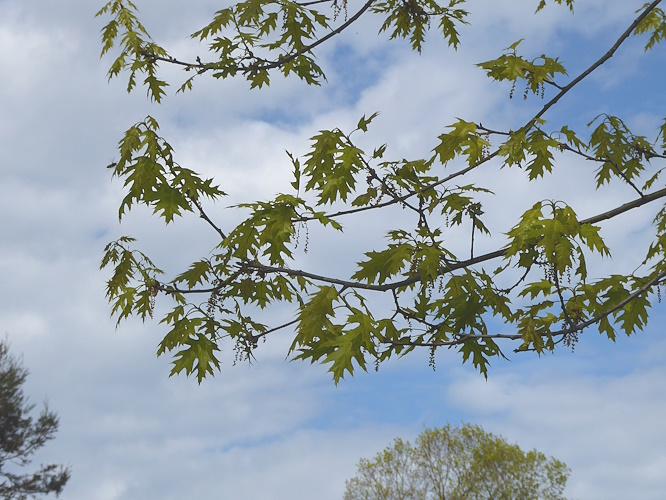
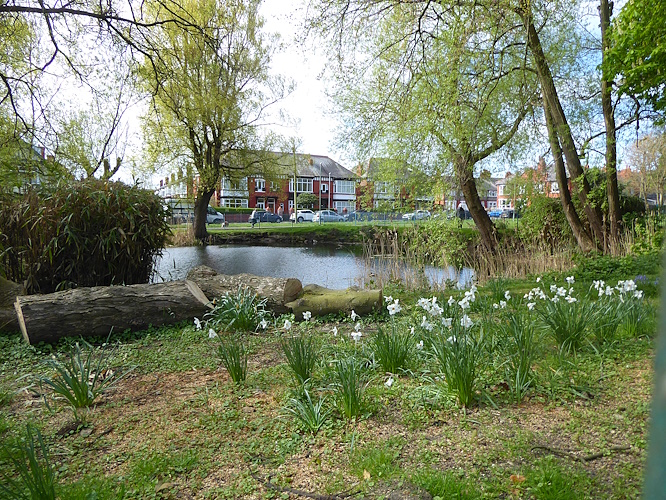
We go to Birkenhead Park a lot, but there is always something worth looking at. Today, although the trees were mostly still bare, here and there buds were breaking and a pale green flush of life was gradually creeping over the landscape. Daffodils were coming out, and this Periwinkle was peeping out from a hedge.

On the lakeside opposite the Roman Boathouse families with toddlers were indulging in the time-worn ritual of “feeding the ducks”, using great slabs of supermarket white bread. Their customers were a few Mallards and a large group of noisy Canada Geese, who were pushing, shoving and honking to get at the food on offer. Just along from there is a special tree on the wide bank, carefully protected in a cage, with a sign saying it was planted as part of the Queen’s Green Canopy project in 2022, her Platinum Jubilee year, after seventy years on the throne.  We have never identified its species, but today we went through a fisherman’s gate and got up close to it. Although its buds were just breaking, with interesting-looking contents, its identity is still a mystery. (Added later. Thanks to Margaret who found this article from the Birkenhead News, suggesting the tree is a Rowan, with a fascinating history.)

In the trees around the main lake were the usual Magpies, Wood Pigeons and Crows, Robins, Blue Tits, Great Tits and a Long-tailed Tit. Both Nuthatches and Greenfinches were calling. On the water were Mallards, more Canada Geese, Coots and Moorhens. There were a dozen or more adult Lesser Black-backed gulls and 20-30 adult Herring Gulls, all looking very smart and aloof, but lowering themselves to bicker with the pigeons for bread.

Near the rockery there were a couple of fenced-off beds on the lake bank with what looked like young Azaleas in them. They will look great when they are established, but clearly need protection from the birds at this early stage. Nearby is another Queen’s Platinum Jubilee tree, a Holm Oak planted in April 2022 by the Friends of the park.

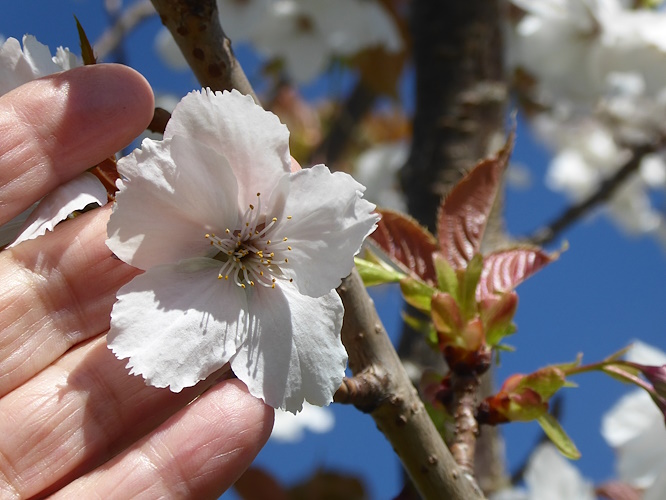
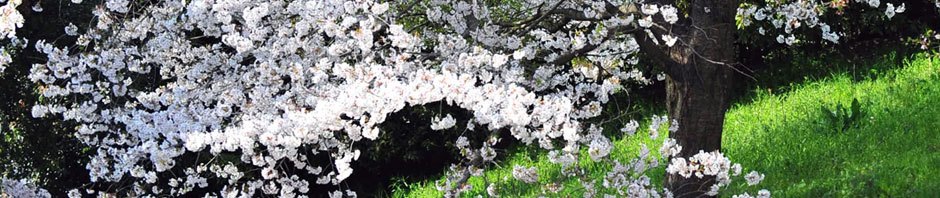
On the way back to the Visitor’ Centre we spotted the remains of the old Mulberry tree which had come down in the winter storms. A pile of its cut-up logs had been left to rot about a hundred yards away to the east, but identifiable as the Mulberry by their distinctive knobbly bark. Why so far away from its original site? After lunch we crossed over to the Upper Park and spotted a tree in early blossom opposite the Victorian post box. It might be some sort of Crab Apple, or is it a Callery Pear, which is often early to bloom and is commonly planted as a small street tree?

On the upper lake were the usual birds, but the gulls were mostly juveniles, there were a few Tufted Duck and a single juvenile Mute Swan. In a quiet corner a Little Grebe was diving. It doesn’t have the reddish head of an adult in breeding plumage, so perhaps it’s one of last year’s youngsters.

We heard a Woodpecker drumming, and though we knew where it must be, but couldn’t see it until it flew off. Always the way!  A lovely Weeping Willow was turning yellow-green with new leaves, and a lady was sketching it.

We headed back to the station through the ornamental Alfred Holt Garden. Some Horse Chestnut buds were just breaking, and we admired the Flowering Currant, Hellebores and Forsythia.

Public transport details: Train from Central at 10.20, arriving Birkenhead Park station at 10.29. Returned from same station on the 13.36 train, arriving Liverpool at 13.50
Next week we plan to go to Stanley Park, meeting Queen Square at 10am.

Posted in Sunday Group | Comments Off on Birkenhead Park, 16th March 2025

Landican cemetery, 9th March 2025

It was a mild, sunny, springlike day, and by lunchtime we were taking off layers of jackets and fleeces. But they say it won’t last. We entered Landican by the farmer’s path at the northern edge. The leaves of Cow Parsley were coming up well, and there were patches of Coltsfoot.

We were hoping for Hares today, and we have had brief glimpses of them here before. Perhaps they live in the surrounding fields? We walked the cemetery perimeter, looking through gaps in the hedges, but there were no Hares in the fields at all. The only sign of mammals were the molehills amongst the gravestones.

Could we also claim that we saw some Meerkats?

The Alder trees were out, all the way through Wirral from the bus and throughout the cemetery. This is the best time of year to identify them, when their copious catkins are out, punctuated by the little black dots of last year’s cones. Even the young trees are distinctive. The female flowers are less well-known, but they are these little groups of reddish structures just behind the catkins. They will be the Alder cones of later in the year.  We forget how many of our street and park trees are Alders until they make themselves obvious at this time of year.

Female flowers of Alder
Young Alder tree showing catkins and cones

We spotted a couple of big bumble bees, probably Buff-tailed. I haven’t seen any Red-tailed yet. There were plenty of little birds around: Robin, Blackbird, Blue Tits, Great Tits, Long-tailed Tits, Goldfinch and Greenfinch. There was a Buzzard over the park opposite. We were also looking for Green Woodpeckers, reported by locals as nesting in Arrowe Park and feeding in Landican, where there are said to be anthills on the lawns. We don’t think we have ever heard their distinctive “yaflle” call in either the cemetery or the park, and we saw no sign of the birds today, or indeed of any suitable anthills. Our best bird was Jay, on the ground just over the fence into the south-west corner field. It was on the ground with its wings out, making convulsive grooming movements. Its crown feathers were up and its beak was open. Was it basking in the sun and getting too warm? Or was it “anting”, allowing ants to crawl over it. Nobody knows why they do this, but one theory suggests they are using the ants’ formic acid to stimulate their skin and remove mites. This one looked quite stimulated to me!

After a minute or so It hopped up onto the fence then flew off. Although its beak was open, it didn’t make a sound.

Apart from the Alders, many other trees were starting up. A pair of Cherry Plum trees had their tiny white blossom out.

We also saw our first “Pussy Willow” catkins on a small ornamental weeping tree.

Blossom buds included these pink ones that look like Callery Pear, and red ones of some sort of Cherry.

Public transport details: We expected to get the 471 or 472 from Sir Thomas Street, but none appeared, so we took the 423 Seacombe bus at 10.30, arriving Woodchurch Road / Arrowe Park Road at 10.58. Returned on bus 471 from Arrowe Park Road / opp Landican at 1.53, arriving Liverpool 2.29.

Posted in Sunday Group | Comments Off on Landican cemetery, 9th March 2025

Sefton Park, 2nd March 2025

We were on a bit of a twitch, hoping to see a Mandarin Duck and a Gadwall, both having been seen here recently. The southern end of the main lake had Canada Geese, Mallard, Coots, Moorhens, several Tufted Duck and a pair of Mute Swans. Missing were the great flocks of Black-headed Gulls which usually dominate the scene. Had they all returned to their breeding grounds already?

As we made our way northwards, Ring-necked Parakeets were squawking everywhere. It is said that they have mostly driven out the resident Stock Doves from their tree-hole nests. What will they crowd out next? Woodpeckers?  In the little waterway east of the William Rathbone statue, we found the Mandarin duck, exactly where he was supposed to be. A Mandarin has been seen here at this season for several years, and it’s hard to avoid the feeling that it is the same individual.

Various little birds were about, Robin, Blue Tit, Great Tit, Long-tailed Tit. In the grove of Scots Pines between the Palm House and the Fairy Glen we found some less-common birds. Several fast-moving Goldcrests were among the pine branches, and we spotted the Nuthatch we had heard calling earlier.

Down the bank here is the Persian Ironwood tree, whose flowers were just going over.

We lunched in our usual spot near the old aviary, then went along the Obelisk path to see the crocus display. They are at their best now, so don’t miss them.

There was a Coot on a nest below the eastern side of the bandstand.

I spotted a big slow-moving Bumblebee heading towards some yellow crocuses, but when I went nearer to try to identify it, I couldn’t find it again. It was probably a Buff-tailed Bumblebee, which are known to emerge around now.  Something not emerging at the right time, but 4-6 weeks early, were the flowers of a Norway Maple tree at the path junction about 100 yards south of the bandstand. Every other Norway Maple I have seen (and they are common street trees) blooms in April or even May, but this one tree is always way ahead.

There was no sign of the Gadwall in the backwaters where it had previously been seen. However, there were lots of people about in the park, and many of their dogs went splashing through the water, so the Gadwall may have gone to hide somewhere. There was a single Little Grebe on the lake and some Black-headed Gulls had eventually appeared at the southern end, accompanied by a few Herring Gulls and Lesser Black-backed Gulls.

Public transport details: Bus 82 from Eliot Street at 10.03, arriving Aigburth Road opposite Ashbourne Road at 10.20. Returned on bus 82 at 2.10 from Aigburth Road / Jericho Lane, arriving Liverpool at 2.25.
Next week we plan to go to Landican Cemetery, hoping for Brown Hares (meet 10 am Sir Thomas Street) and the week after to Birkenhead Park (meet Central Station 10 am).

Posted in Sunday Group | Comments Off on Sefton Park, 2nd March 2025

Rice Lane City Farm, 23rd February 2025

After two warm days that felt like spring, we are back to cold wind and blustery showers. Rice Lane City Farm is on the site of the old Walton Park Cemetery, so little brown Ryelands sheep graze amongst the old gravestones.

Every time we go there, they seem to have switched around the gates and signs, so this time we were not permitted to walk down the long path heading south from the chapel and went northwards instead. There were lots of twittering birds, including Robin and Blackbird. A party of about 12-20 fast-moving small birds went through the bare trees, high up against the light. They may have been Siskins but it was hard to be sure.

There were Snowdrops everywhere, some Daffodils coming out, and in the woods near the Prison the ground was carpeted with shoots of Bluebells rising up through the Bramble. A couple of coppiced Hazel trees bore catkins that were just going over, although they are the first I’ve seen this year.

By the Dutch graves they have been planting young orchard trees, Cherry, Damson and Quince. The farm itself is under Bird Flu restrictions, so at the farmyard gate there is a pad to disinfect boots, and all the poultry is penned up. They have chickens and ducks, geese and turkeys, the aforementioned sheep, some goats, one or two cows, a couple of donkeys and a pony.

We were amazed to see a small coop with about half a dozen Quails. I don’t think I have ever seen a Quail before. One of the staff said they are all females, and they hope they will lay when the weather is warmer, giving them Quail eggs to sell.

On our way back to the bus we stopped in the little park on the corner of Evered Avenue, at the western end of Rice Lane Recreation Ground. There were some female Chaffinches foraging on the ground, perfectly camouflaged amongst the fallen leaves. There was also a small tree just coming into bloom. It’s the first blossom tree of the year, Cherry Plum Prunus cerasifera. Keep an eye out for it, it will be blooming on streets and in parks in the next week or two. Don’t mistake it for Blackthorn, which is usually a couple of weeks later. Cherry Plum is a small tree rather than a hedgerow shrub, it has no thorns and its flowers have short stalks. (Blackthorn flowers appear to come straight out of the wood.)

Just to add that I spotted a Herring Gull outside the Playhouse early on Sunday morning, feeding on a recently-deceased Pigeon. Although it may just have been scavenging an already-dead bird, I have heard that some Herring Gulls actually catch and kill their prey. Who needs the Serengeti!

Public transport details: Bus 20 from Queen Square at 10.20, arriving Rice Lane / Rawcliffe Road at 10.40. Returned on the 21 bus from Rice Lane / Fazakerley Road at 1.45. arriving city centre at 2.10.  Next week we plan to go to Sefton Park, meeting at Elliot Street at 10am.

Posted in Sunday Group | Comments Off on Rice Lane City Farm, 23rd February 2025

Anglican Cathedral, 16th February 2025

Next to the Anglican Cathedral is a low-level cemetery, formed from the old quarry. We entered it at the south end. It was pretty bleak in February, populated by the usual Wood Pigeons, Crows and Magpies, with a single Wren on a gravestone. Someone had been leaving flowers at the grave of Kitty Wilkinson, who has been remembered as the “Saint of the Slums” for pioneering washhouses and public baths for the poor.

The lawns and verges were full of snowdrops, in great carpets in some places.

New young trees with nursery labels were dotted about. A labelled one at the south end was Prunus domestica, a plum, so perhaps the other unlabelled ones nearby were similar fruit and blossom trees.  A labelled one at the north end was far more exciting – Paulownia tomentosa, a Foxglove tree! (left foreground) It was quite a tall young tree, too. We need to visit that one again in a more interesting season.

There was no sign of the Peregrine Falcons which used to nest on the Cathedral tower. According to local news reports, the Cathedral fitted anti-bird netting to their preferred nesting site in spring 2022. What a shame. Then we went into the Cathedral to see the Exhibition “Threads through the Bible”. It consists of 44 huge panels of embroidery depicting Creation, the life of Jesus, and Revelation. They are by the artists Jacqui Parkinson.

She is quite good on animals and birds. See the “Expulsion from the Garden of Eden” above. It seems to have a parade of animals like some kind of Noah’s ark. The lamb is lovely and there is an incongruous US bird, the Roadrunner, below the giraffe. She has also included occasional little side panels with shellfish, caterpillars, tree seeds and the like, amongst which I spotted this British rarity, the Ladybird Spider.

Public transport details: Bus 82 from Elliot Street at 10.15, arriving only 5 minutes later at St James’ Place / Upper Hill Street. Returned on foot as it was all downhill, via Rodney Street and Bold Street.
Next week we plan to go to Walton City Farm and woodland. Meet 10 am Queen Square.

Posted in Sunday Group | Comments Off on Anglican Cathedral, 16th February 2025

Southport, 9th February 2025

We weren’t looking for wildlife today – we went on a Bear Hunt! Southport Business Improvement District (BID) have commissioned ten fibreglass bear models, asked artists to decorate them, and scattered them around the town. They are mainly aimed at younger kids, so the prize is a family trip to Legoland. The aim, of course, is to attract visitors to the town and boost the struggling local businesses. It attracted us (that worked) but we didn’t spend any money at all!  There are ten of them, seven close to the town centre and three further out. We only looked for the easy seven, and here is the best – “Luna and the Moon” by Marnie Maurri, outside the Prince of Wales hotel.

When we got near the Marine Lake we spotted some real wildlife – the usual Swans, Geese and  Mallards but also a smart pair of Gadwall.

Hanging out on its own was this very odd duck, some sort of hybrid I think. At first glance, swimming towards us, it said “Mallard” by its shape and by its green head and yellow beak, but its light-coloured sides looked wrong. We came away convinced we had seen a hybrid of a Mallard and a Tufted Duck. Now I look at the picture, I am perplexed by the bird’s red head. It looked green in life. Is there a Pochard in the mix somewhere?

I have just looked up all three possible parents, and the Pochard and Tufted Duck are in the same genus, Aythaya, while the Mallard is more distantly related, in the genus Anas. So Pochard / Tuftie is the more likely pairing. The “Bird Hybrids” blog says Pochard / Tuftie is the commonest duck hybrid in the UK, so that is what it must be.

Public transport details: Bus 47 from Queen Square at 10.15, arriving Lord Street / Duke Street, outside Morrison’s, at 11.30. Returned on the Merseyrail train from Southport at 1.36, due into Liverpool at about 2.20.

Posted in Sunday Group | Comments Off on Southport, 9th February 2025

Crosby, 2nd February 2025

Crosby Marine Lake doesn’t quite count towards World Wetland Day, but we bagged a pretty good bird list of 21 species, not bad for us. We got off the bus outside Potter’s Barn, a run-down small park just off the main road, Crosby Road South. Our first birds were sitting on a rooftop railing there, a Wood Pigeon and a Collared Dove.

There is a House Sparrow colony in the bushes by the big warehouse mural, and Carrion Crows and Magpies loitered around the car park. We didn’t go into the little nature reserve there because the wooden boardwalks were very slippery, so we went around the side to look at the bay next to the sailing club. Last year we saw some exciting birds here, but today there were only Black-headed Gulls sitting on the mooring posts. A Pied Wagtail pottered on the muddy edge but we looked in vain for the rare Smew which had visited here last week, and there weren’t even any Little Grebes.  Our luck turned as we headed northwards along the path next to the children’s playground. A Little Egret appeared to be skulking in the boulders which edge the lake and I thought it was ill, but it had just found a spot sheltered from the wind, with its feet in the water.

Then it roused itself and started moving amongst the boulders. It was right by the path, within a few feet of passers-by and apparently not wary of people at all.  What a lovely bird it is, with its gorgeous white plumes, black beak, yellow feet and black claws. It was finding food, too, right there at the lake edge.

On the smaller Boating Lake there was the usual crowd of birds. The local people come here with their toddlers to “feed the birds”, so it is a good place for juvenile Herring Gulls and Lesser Black-backed Gulls to spend their first winter.

Young Swans come here, too and there are lots of Canada Geese, Mallards and Coots. But there must be plenty of shellfish in the bottom, because diving ducks do well here, even rarities sometimes. There was a small flotilla of Tufted Ducks.

On the far bank a single Oystercatcher was resting up and there were several Turnstones on the edge. (They are the little brown and white birds, dwarfed by the Gulls). I haven’t seen those here before. Are their numbers increasing?

We lunched in Marine Gardens. Someone had just scattered bird food in a regular spot, and lots of little birds came to it, just a few feet from us. A Wood Pigeon was trying to monopolise it, and seeing off an interloper, so the little birds took their chances to sneak in. We had Robin, Dunnock, a female Blackbird, several House Sparrows, and a Blue Tit in a tree nearby.

Then we walked northwards through all four seafront gardens, with more Oystercatchers flying and  peeping overhead. The Snowdrops were out, but the Daffodils were just starting to show buds.

The winter-flowering evergreen shrub Laurustinus was blooming, and the Flowering Currant buds were breaking. Daisies were open on the path edges and the deep red flowers of Japanese Quince were popping out.

A few years ago The Friends of Waterloo Seafront Gardens replaced a Toposcope, which local residents fondly remembered from their childhoods.  It looks like a sundial, but it shows the directions and distances to points of interest. Blackpool 22 miles, Snowdon 52 miles and so on. Perhaps before the dunes and treees grew so high these points were visible, but not now. The plate also indicates distances to other places called Waterloo, in Belgium, Sierra Leone and Australia!

Public transport details: Bus 47 from Queen Square at 10.17, arriving Crosby Road South opp. Durham Road at 10.45. I could walk home from there but the others got the 53 bus back to Liverpool at 2.00 from Oxford Road / Courtenay Road.

Posted in Sunday Group | Comments Off on Crosby, 2nd February 2025

Sefton and Princes Parks, 26th January 2025

On our first walk of 2025 we planned to join the Friends of Princes Park for a Big Garden Birdwatch event, but that wasn’t on until after lunch, so we went to Sefton Park first, walking from the Dingle corner via Ullet Road and Linnet Lane. There was a bitingly cold wind, with rain forecast for later.  In the park there were branches and twigs down everywhere, the after-effects of last week’s storm Éowyn. Near the old bowling greens, high in a bare tree, we noted a cluster of leaves and branches. Was this a Squirrel drey? We thought it was about 1 to 2 feet (30-60cm) across, and it was the wrong shape for a Magpie nest. Squirrel dreys are said to be leafy, and very high up, so it probably was.

There was a party of Long-tailed Tits high up by café, and the usual Crows and Magpies. We thought we heard Ring-necked Parakeets and spotted one high in a tree. I was hoping for some signs of spring, perhaps snowdrops or hazel catkins, but neither of those were on display.  However, the Witch Hazel near the Eros statue was in bloom.

We lunched by the old aviary, sheltered from the wind. We scattered bird food on the edge of the shrubbery and were rewarded by a Robin and a couple of Magpies. As a light rain started we headed back northwards by the obelisk path. Later in the year this path is lined with a magnificent display of Crocuses, and we were surprised to see some very early ones peeking out.

Into Princes Park via Windermere Terrace. In the backwaters of the lake were Mallards and Coots, and on the grassy opposite bank was a great crowd of Pigeons and Gulls, mostly Black-headed.  One of us spotted a Cormorant sidling away around a bend in the lake bank. As we rounded a quiet corner we came upon about eight Moorhens grazing. As soon as they saw us they headed back into the reeds. We knew they often came out of the water to graze grassy banks, but had never seen so many all together like that.

We went along by the tennis courts to look at their group of six Great White Cherries. They are still only small young trees but I hope they will bloom this year. I’d like to learn what they look like so I can identify others.

Across the fields is a modern sculpture, The Henge, made of wood and put up about ten years ago. It has a platform in the middle (currently under repair) which faces the sunrise at the summer solstice. It is a focal point for large and small celebrations and meetings, including Eid, weddings, solstices, yoga groups and simply for picnics.

We eventually found the Friends group who had been doing some gardening. They had decided it was too cold to go ahead with the Birdwatch. We were relieved, to be honest. As we headed out we saw a Jay crossing from treetop to treetop above our path.

Opposite our bus stop at the southern end of Park Road is a very old building, The Ancient Chapel of Toxteth, Grade I listed. It was built in about 1615 and continues to be used as a Unitarian Chapel to this day.  Of interest to my American friends is that one of its first preachers was a young man called Richard Mather. At that time he and the chapel were nominally Anglican (Episcopalian), but Richard Mather was a Puritan, as were most of his parishioners, and so he was suspended from his ministry in 1633 and 1634. The following year he emigrated to Massachusetts Bay Colony. He became father to Increase Mather and grandfather to Cotton Mather, celebrated Boston theologians, who played a central role in the Salem Witch Trials of 1692-3. The chapel stands incongruously on a busy corner in the south of the city and is much visited by American tourists.

Public transport details: Bus 82 from Elliot Street at 10.10, arriving Aigburth Road / Ullet Road at 10.25. Returned on bus 82 from Park Road / Gredington Street at 1.25, arriving Liverpool ONE at 1.40.
Next week we will meet 10 am Queen Square and might go to Crosby to look for the Smew, if it is still being reported.

Posted in Sunday Group | Comments Off on Sefton and Princes Parks, 26th January 2025

Port Sunlight, 22nd December 2024

On our last walk of the year we had planned to go to Eastham Woods, but high winds of 50-60 mph meant it wasn’t safe. So we went to Port Sunlight instead. As well as the strong winds, there were bouts of squally rain. There wasn’t even a civic Christmas tree to brighten the day, just this slightly wonky “Post Box Topper” of the Nativity opposite the war memorial.

This was no fun at all so we headed for the Lady Lever Art Gallery and sat in their nice warm café, sipping tea. The only “wildlife” we noticed was on the way back to Port Sunlight station, where some roses were still flowering in the Rose Garden.

A couple of weeks ago a MNA member called Janet found a very unusual pine or fir cone in Calderstones Park and posted a picture of it on the MNA WhatsApp group. She identified it as the cone of a Santa Lucia Fir Abies bracteata, but couldn’t find the tree itself.  This is quite a rare tree. My Mitchell’s tree book says of it “Infrequent, in large gardens mainly in SW England. Cones seen rarely in the biggest trees only, extraordinary for long bristly protruding bracts”.

Janet’s cone

The tree in Calderstones is known to the Tree Register of Great Britain and Ireland, which lists it as the height and girth Champion of Lancashire – 17 m (56 ft) tall, 86 cm (34 in) girth. It also gives a grid reference and pictures of the tree itself. Last Thursday I went to Calderstones and found it.

For anyone else wanting to look at it, walk south from the Compton’s Lane car park. On the left, immediately after the end of the car park, is a group of conifers. The Santa Lucia Fir is the tree with three narrow whitish trunks springing from the ground, next to the hedge, and I have marked what I think are its three tall pointy crowns on this map.

There are still plenty of cones on the tree, growing right at the top. They don’t look fresh, so maybe they emerged some time in early 2024.

Janet was in touch with someone from Hergest Croft Gardens in Kington, Herefordshire, who were amazed when their Santa Lucia Fir “coned” (produced cones) for the first time in early 2024. It featured in several Welsh newspapers and magazines. The last recorded time that one of their older specimens of this tree had produced a cone was in the early 1960s. So it looks like our tree in Calderstones coned at around the same time as theirs. Something about the climate?

Public transport details: Bus 1 from Sir Thomas Street at 10.14, arriving New Chester Road / Shore Drive at 10.40.  Returned on the train from Port Sunlight Station at 12.24, arriving Liverpool Central at 12.50.
No Sunday walks now until 26th January 2025, meeting Queen Square, and we will decide on the day where to go.

Posted in Sunday Group | Comments Off on Port Sunlight, 22nd December 2024

Eric Hardy Nature Reserve, 15th December 2024

The Eric Hardy Local Nature Reserve was formed from a tract of Clarke Gardens, and dedicated in April 2002 to honour the founder of the MNA, Eric Hardy. He was then 90 years old and died later that year. Eric had written a weekly “Countryside” column in the local paper, the Liverpool Daily Post, for 70 years from 1929 to 1999, and was once in the Guinness Book of Records for the world’s longest-running journalists’ column. He also broadcast weekly on Radio Merseyside and was a founding member of the Mersey Estuary Conservation Group and the Lancashire Wildlife Trust.  Many current MNA members remember going on walks he led, but I joined too late to meet him.

The reserve is an area of rough grass and woodland extending southwards from Allerton Towers to Springwood Crematorium, set in the leafy southern suburbs of Liverpool, close to the childhood home of John Lennon. We entered it through the gap in the railings at the junction of Menlove Avenue, Woolton Road and Hillfoot Road and crossed the open area of young trees and bramble patches into the Oak and Beech woodland. Very few birds were making themselves known, except for the screeching of Ring-necked Parakeets. Jays are known to live here, but we didn’t see any today. Although the woods appear to be wild, there was evidence of management. This old Lime tree with its bushy epicormic growth at the base appears to have been trimmed.

Daffodil shoots were popping up.

The woods are fairly wet, and the map shows a section of a stream running through it. We have had a dry week, though, so all we had to contend with were occasional muddy patches, with one particularly boggy bit called Deadman’s Valley.

We emerged from the woods at the northern edge of Allerton Cemetery. It was looking neat and landscaped after the wildness of the woods. Two Monkey Puzzle trees near the north chapel caught my eye, perhaps now looking as the designers had imagined.

A big Beech tree had come down in Storm Darragh, cleverly missing all the surrounding trees and a hedge, and not touching a single gravestone.

Nearby was the stump of a previously cut-down tree, which was hollow. We peeked inside and spotted a couple of bracket fungi growing from the inside surface, an unusual sight.

We lunched in Springwood. They have decorative gardens for the scattering of loved ones’ remains, and there are plenty of benches for contemplation and remembrance. The lawns have some splendid old Cherry trees. I wonder about their age. The gardens at Springwood are only about 50 years old (1975), but these old Cherries look at least as old as the ones in Sefton Park – about 150 years old (1872).

In the sheltered shrubberies some Rhododendrons were coming into bloom.  We scattered some bird food, and got Great Tits, Coal Tits and a Grey Squirrel. More distant were a Blackbird, Wood Pigeons, Magpies, and our best bird, a Stock Dove. Around the northern perimeter a row of three conifers (Cypresses?) had come down.

We headed north on the path along the west side of the nature reserve, emerging by the south entrance to Allerton Towers on Woolton Road. Since one of us had arrived by car, we had a lift to Hunts Cross Station.

Public transport details: Bus 76 from Queen Square at 10.02, arriving Menlove Avenue / Cheddar Close at 10.30. Returned on Merseyrail train from Hunt’s Cross at 2.06, arriving Central at 2.25
Next week, our last walk of the year, we plan to go to Eastham Woods, meeting at 10.00 at Sir Thomas Street.

Posted in Sunday Group | Comments Off on Eric Hardy Nature Reserve, 15th December 2024