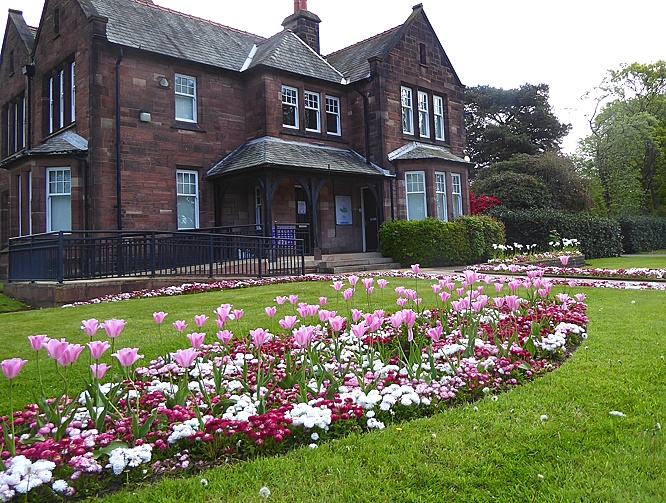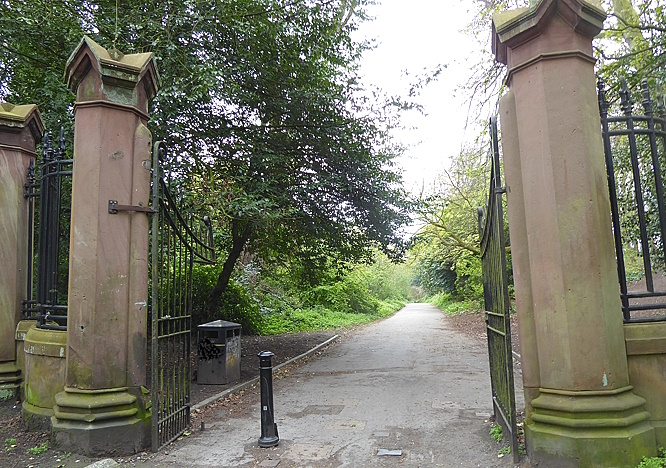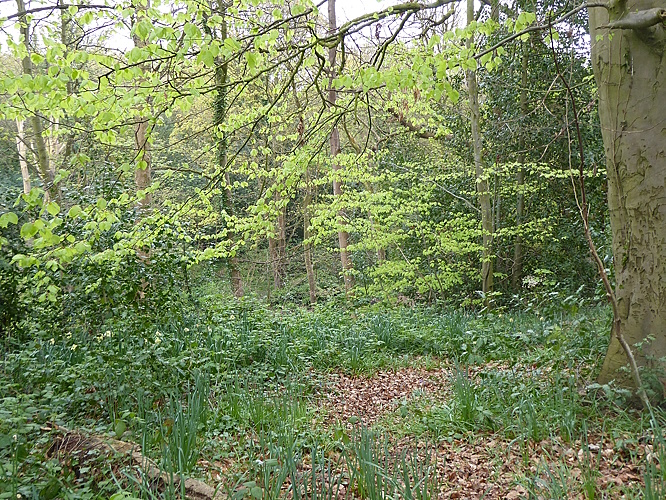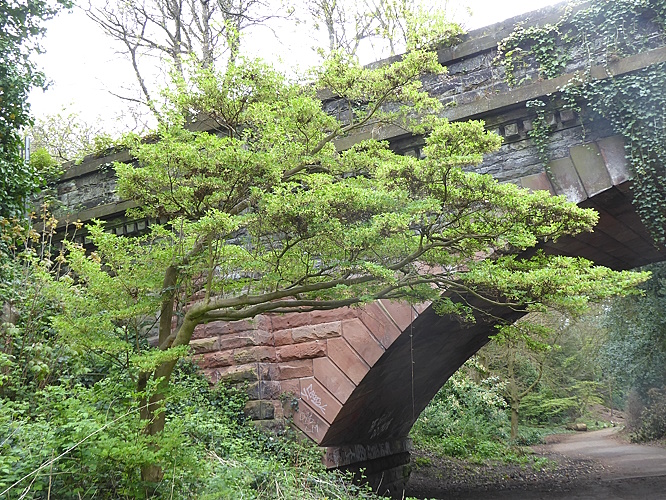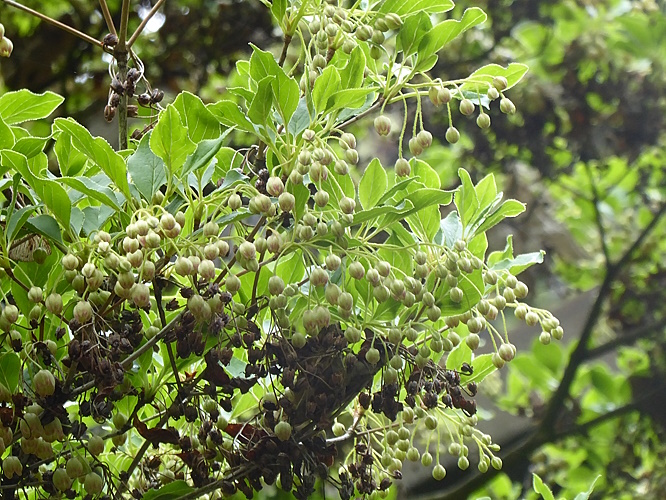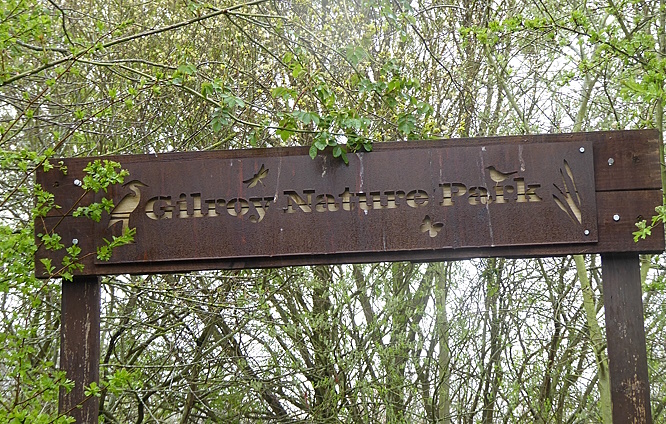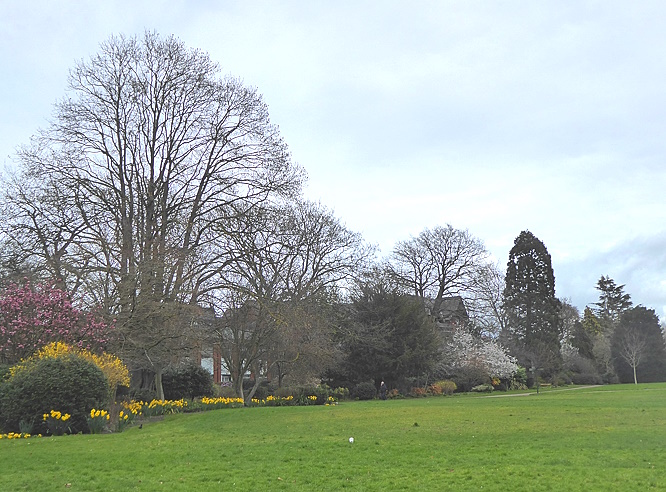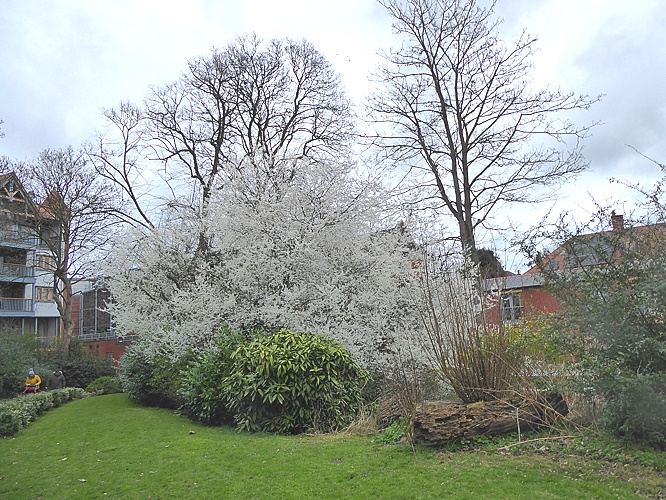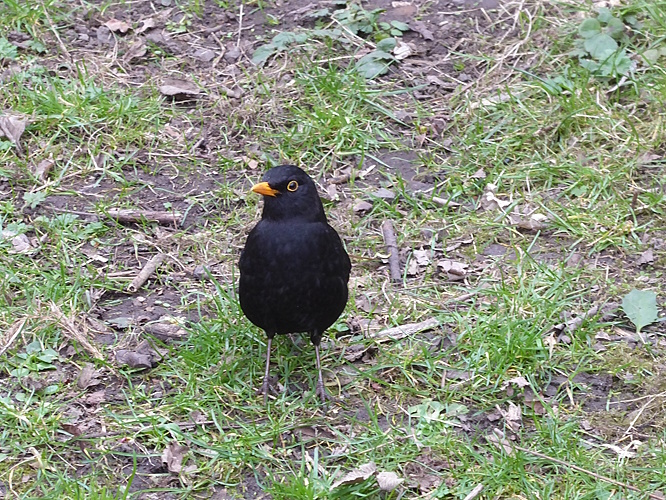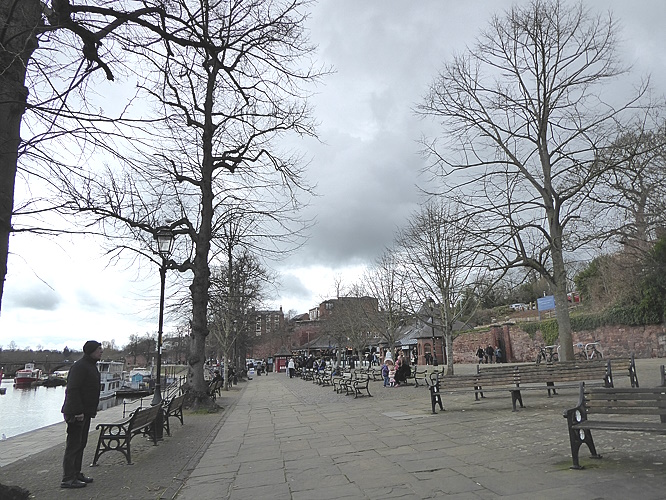
Gilroy Nature Park, West Kirby, 16th April 2023

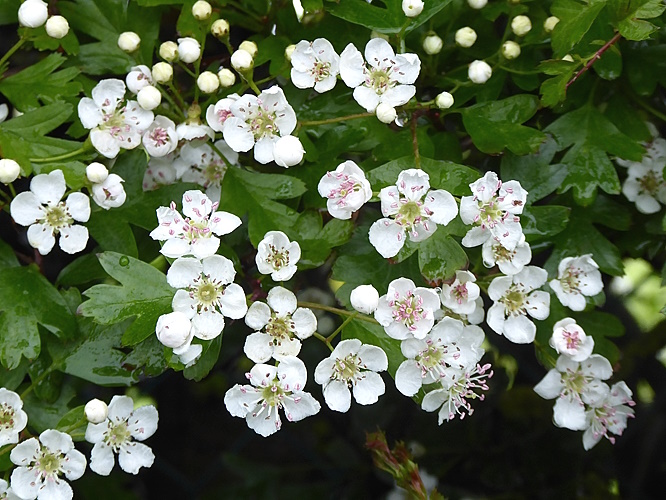
It was grey and damp as I set out, and it settled into a persistently dismal drizzle all day. Our plan was to walk across the fields from Hoylake to Gilroy Nature Park, near West Kirby.  Along New Hall Lane there were plenty of wayside “weeds” doing well at the edge of the pavement – Shepherd’s Purse, Green Alkanet, Goose Grass, Mallow, Scarlet Pimpernel, many of them not in  flower yet, but there was a gorgeous crimson Crab Apple tree blooming near the entrance to New Hall Farm.
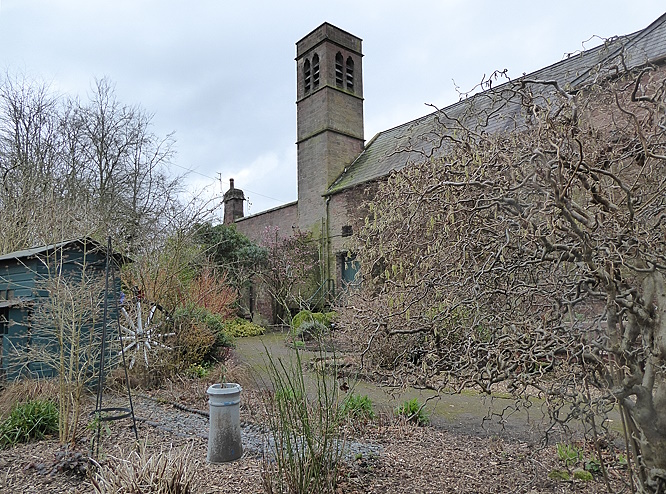
We passed Whitegate Animal Sanctuary and stopped to gawk at the pigs and poultry. Then along the path between the fields, the route we had attempted on 18 December last year, but had been defeated by the ice.

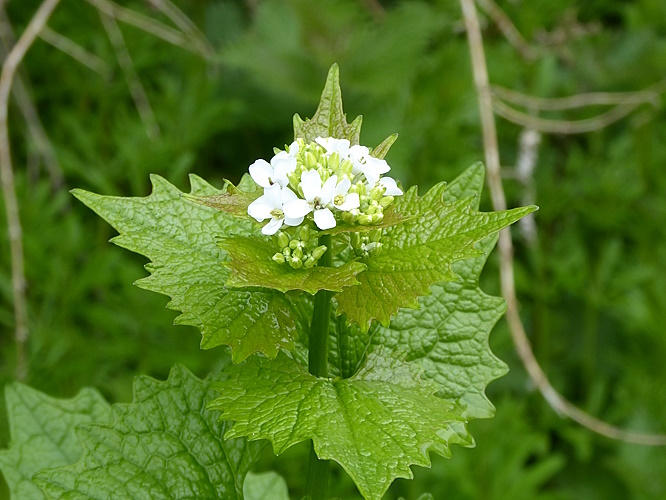
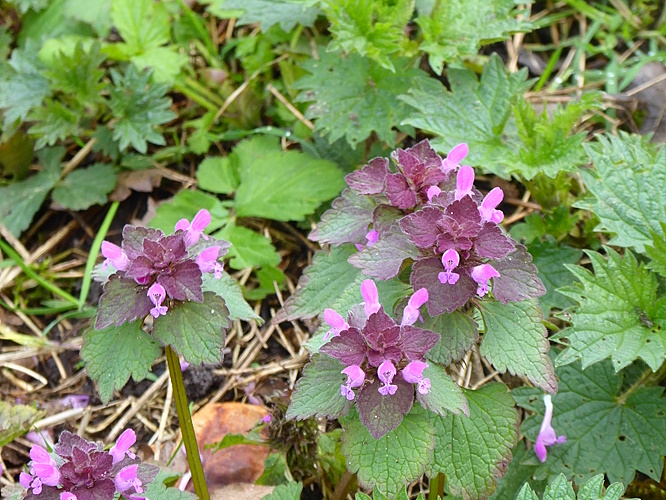
A Wren dived out of sight into a ditch as we approached and seven or eight Shelduck flew over in a tight flock, heading south. All the Dandelion flowers were closed up tight in the cold rain, but there were large patches of Red Dead-nettle, the Elder flower buds were well formed, and the earliest flowers of Garlic Mustard were just showing.

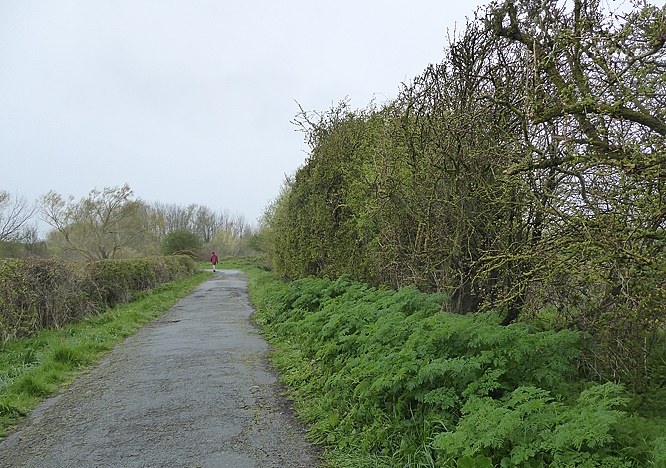
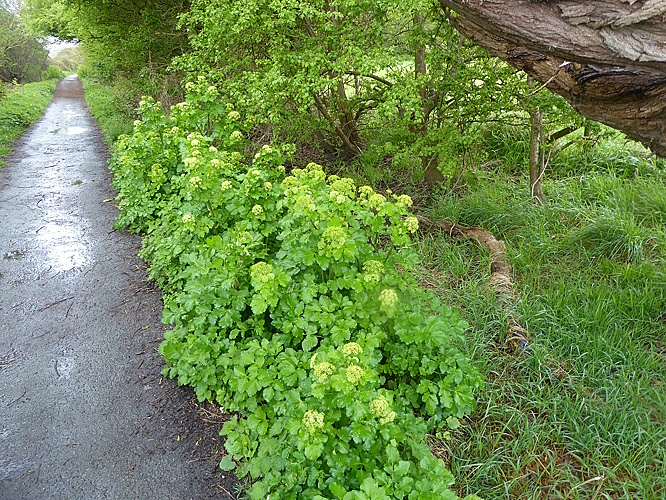
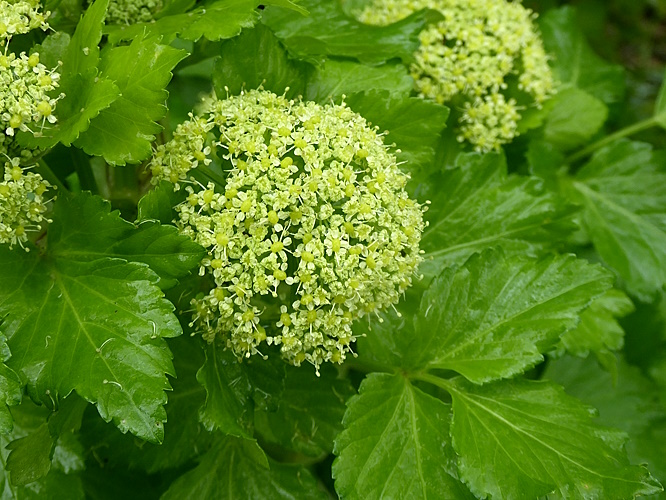
It had been cold and bleak between the open fields, but as we approached Gilroy we were at last sheltered by overhanging trees and the path was lined with the coastal plant known as Alexanders.

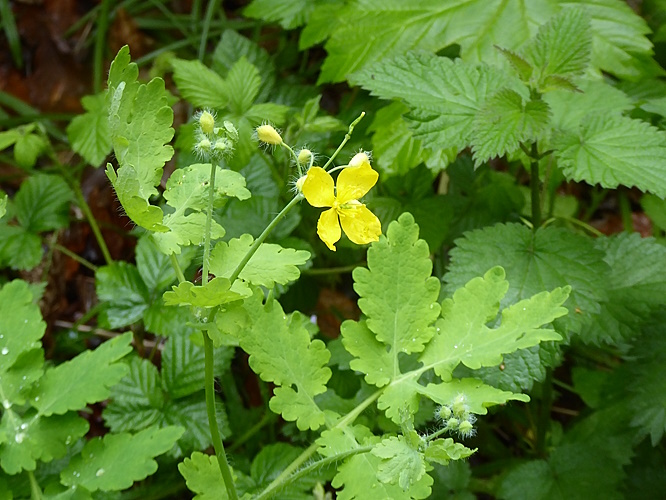
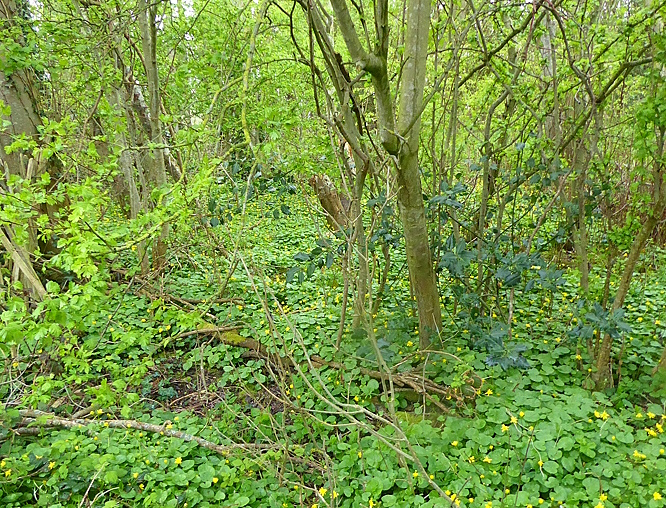
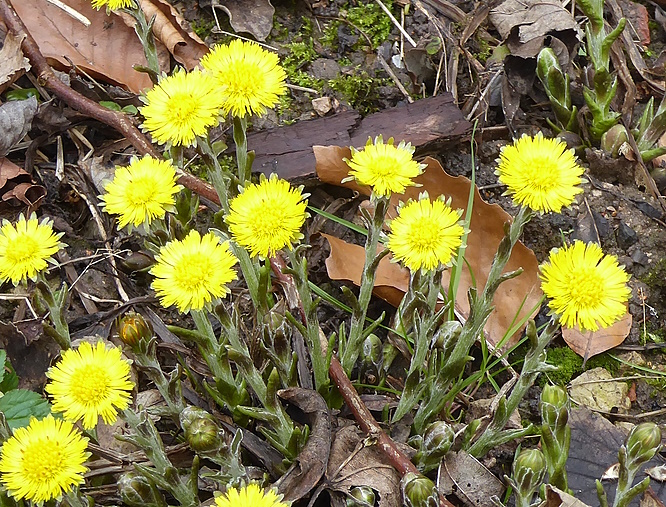
A huge carpet of Lesser Celandine stretched right back into the woods.

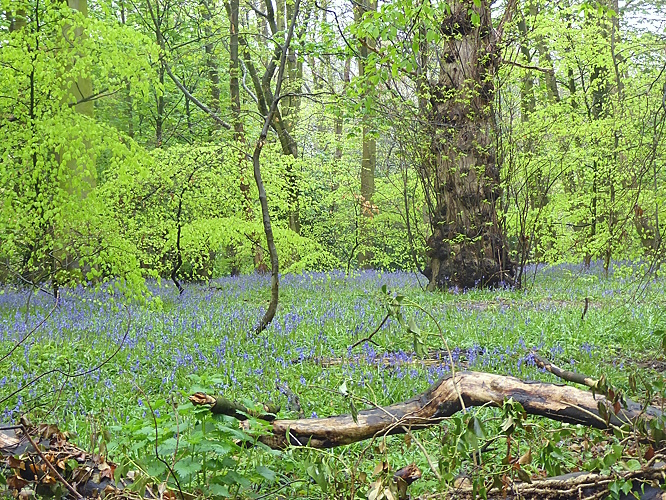
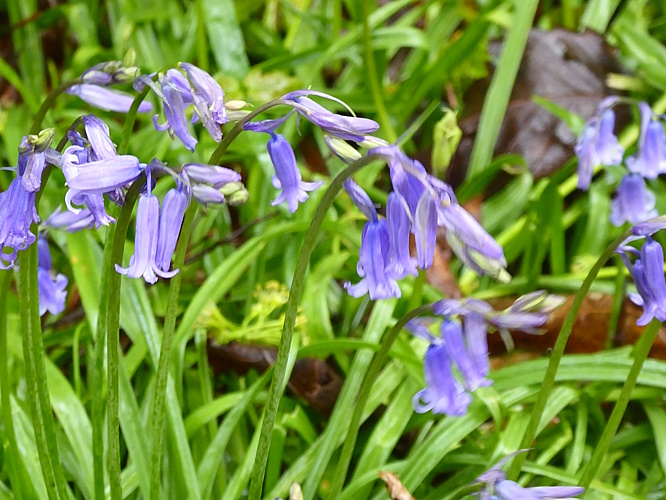
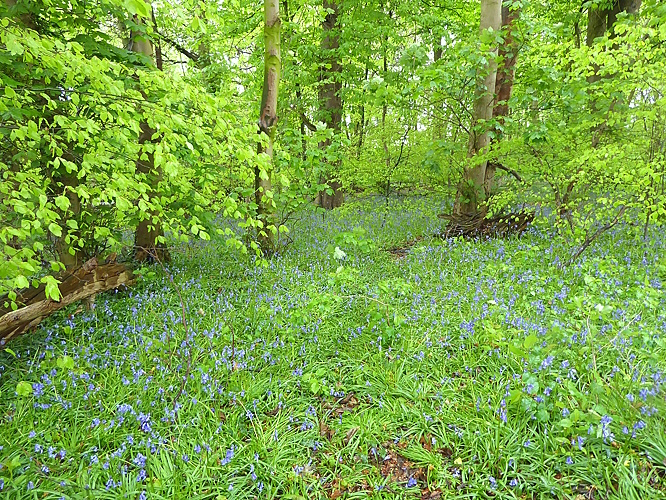
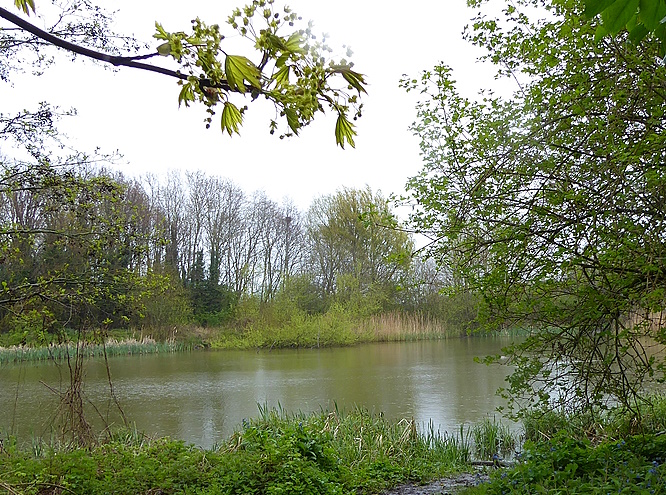
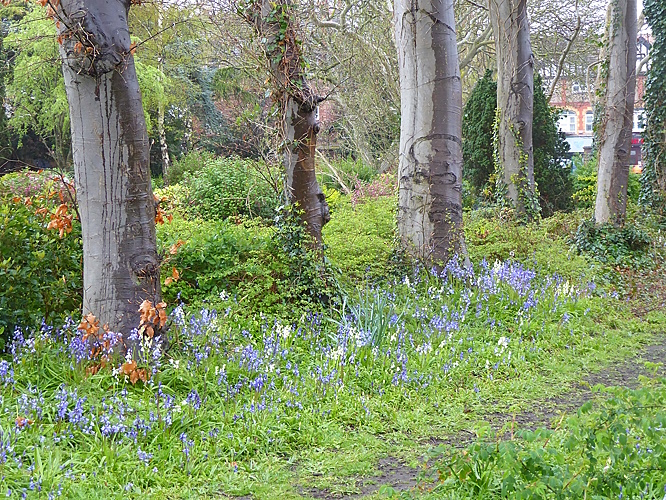
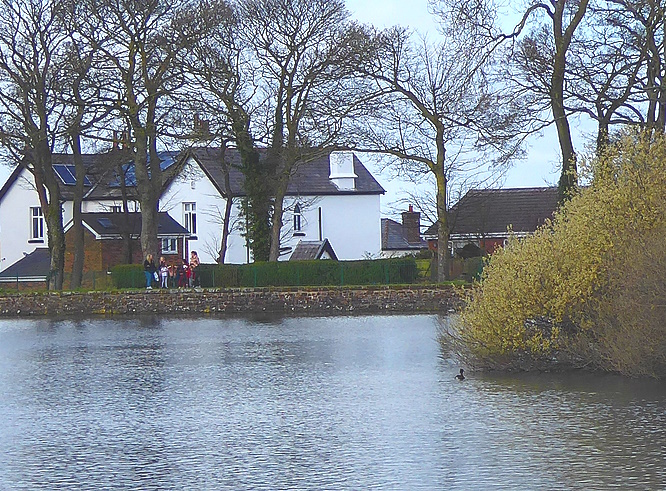
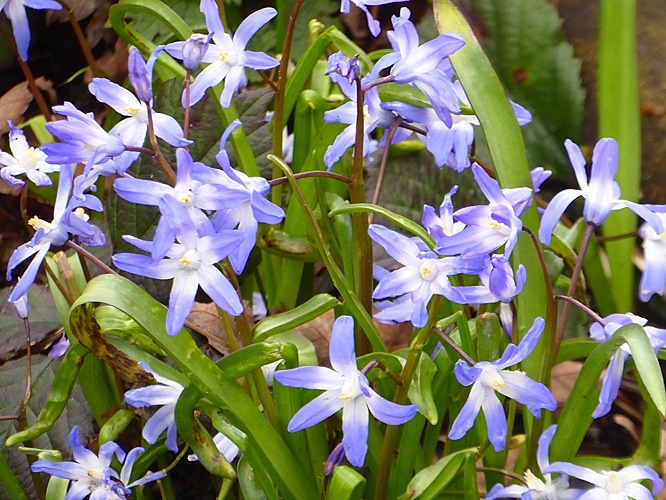
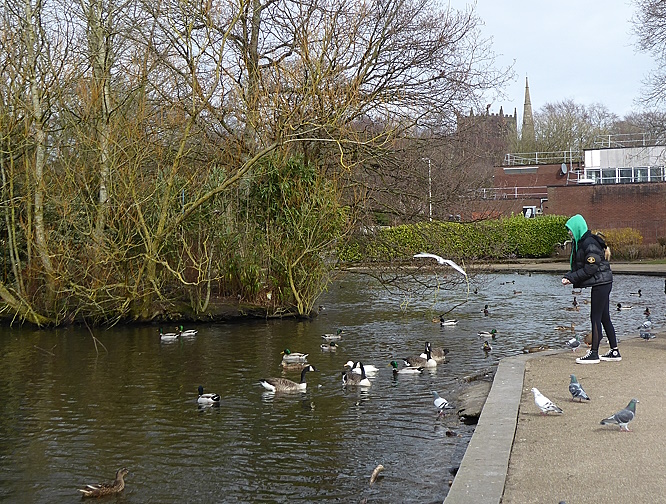
Inside the Nature Park bluebells were coming out under the trees. A Chiffchaff called, and there were a few Mallards out on Gilroy Pool, but then we spotted a fast-moving bird – a Swallow over the water.  But the rain was dripping down our necks, so we knew that one Swallow definitely doesn’t make a summer! (It was too fast to be in this picture, in case you are squinting.)

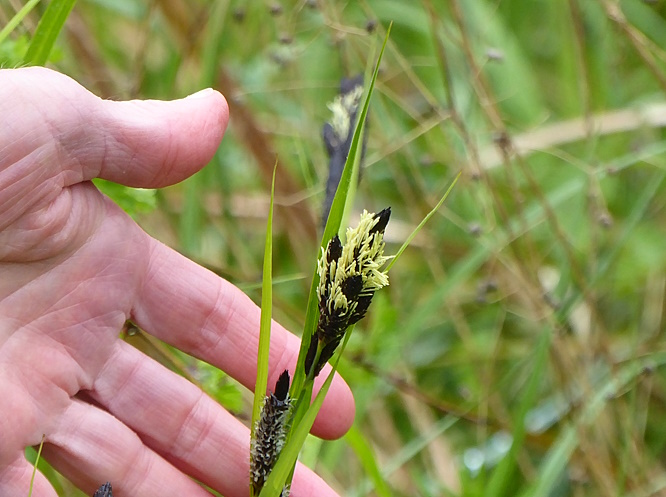
Around the edges of the pool were clumps of a grass-like tussocky plant, with black flower buds opening to yellow. It appears to be Black Bog-Rush Schoenus nigricans, a native plant. It is said to be common in Scotland and East Anglia, but the NBN Atlas doesn’t show any records of it between Formby and North Wales.  The Freshwater Habitats Trust says “Black Bog-rush is not a rush but a sedge! This beautiful species can be recognised for its almost 1m in height and its dense tufts with dark fruiting heads. Black Bog-rush flowers from April to June, and it is the host plant for various moths and flies, and food for mammals such as rabbits.”

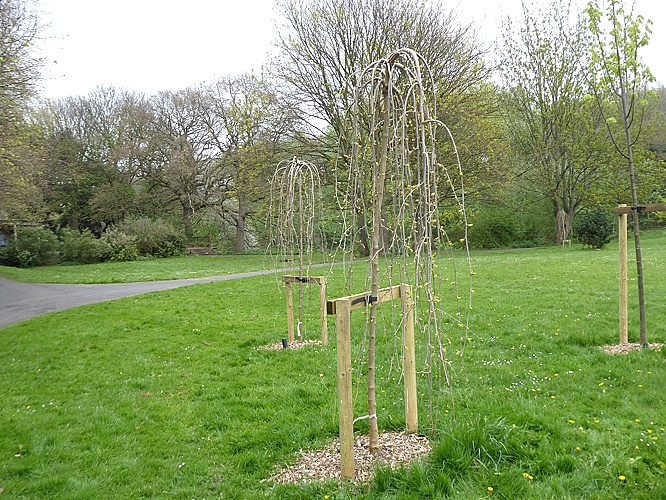
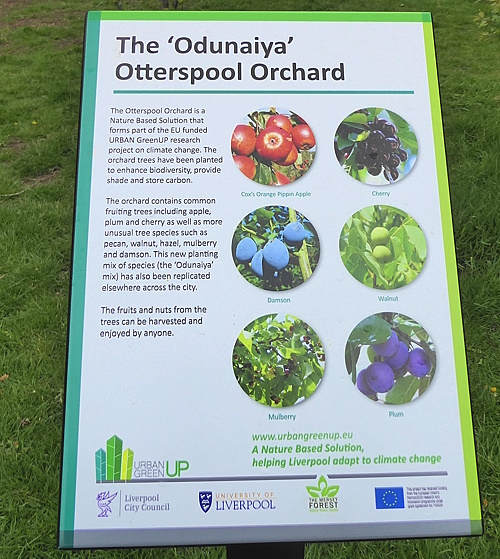
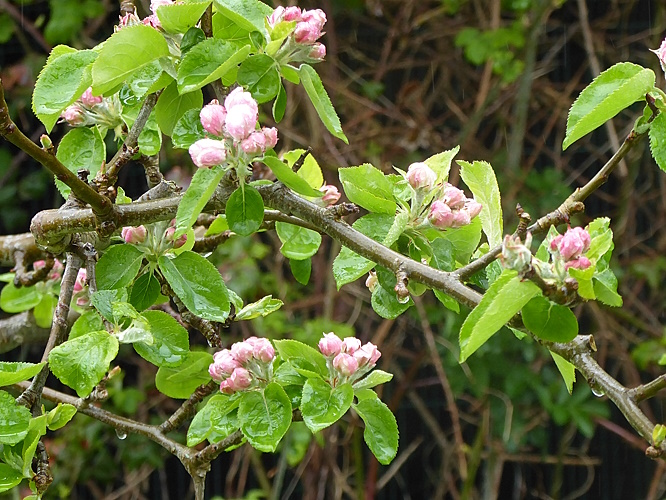
The last section of the path to West Kirby runs next to some allotments, and is bordered by an avenue of newly-planted Apple trees of many varieties, some with legible labels. We could read the ones for Egremont Russet and Laxton Fortune. They were all starting to blossom.

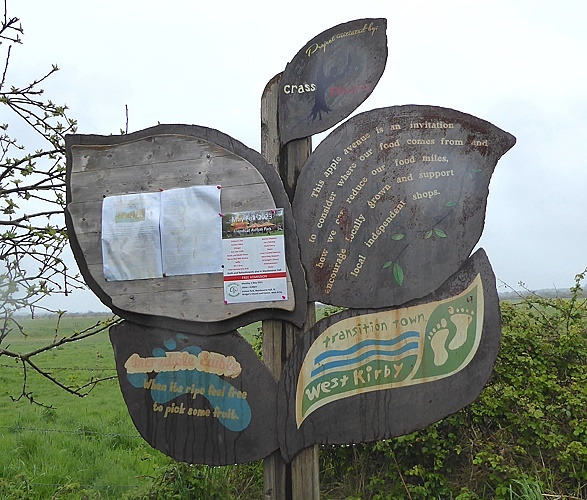
A sign for “Incredible Edibles” says “When it’s ripe, feel free to pick some fruit” and adds “This apple avenue is an invitation to consider where our food comes from”.

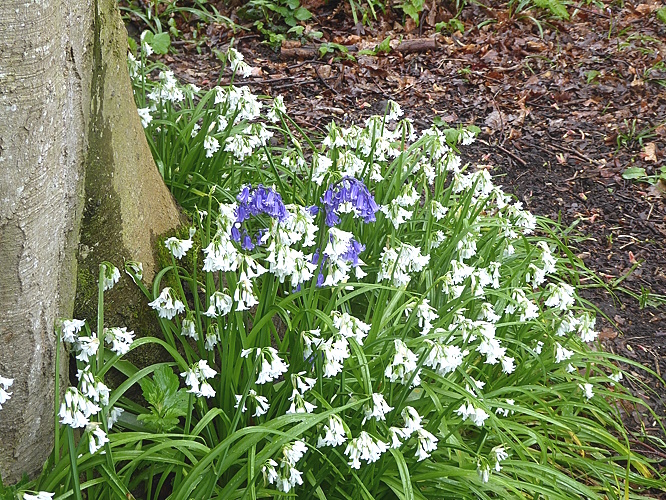
By then it was nearly noon, but with no shelter in sight we got the bus a few stops into West Kirby, dropped into Morrison’s for the loos, then had a late lunch in the shelters in the ornamental gardens at the corner of Victoria Drive.  It was still raining, and we were getting cold and bedraggled, so it was time to go home. We had time to look into Sandlea Park on the way to the station.  It’s only a tiny park, but pretty. There were more Bluebells coming out, a mix of blue and white, and they looked lovely, especially against some old beech leaves.

A pink tree was just coming into leaf, probably an otherwise-ordinary Sycamore, but of the variety  ‘Brilliantissimum’, in which the green chlorophyll is late to develop.

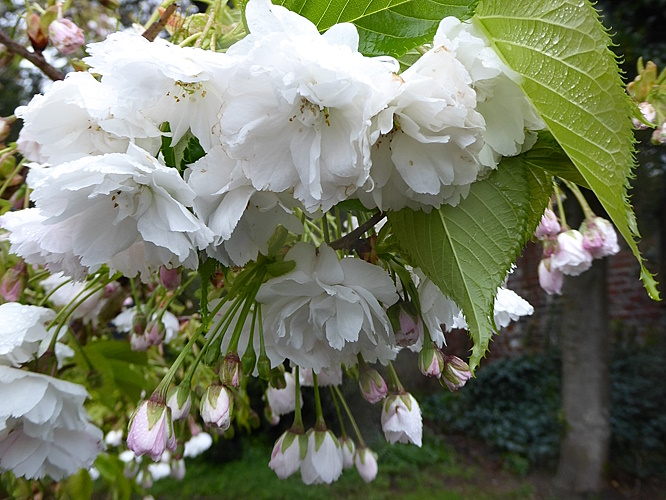
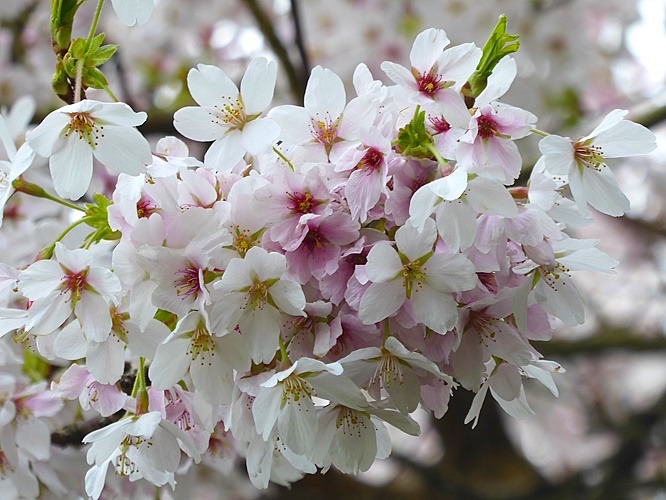
Finally, a lovely white Cherry with its characteristic hanging blossom.

Public transport details: Train from Central towards West Kirby at 10.05, arriving Hoylake 10.30. Returned on the train from West Kirby at 2.30, arriving Liverpool at 3.10.

Posted in Sunday Group | Comments Off on Gilroy Nature Park, West Kirby, 16th April 2023

Taylor Park St Helens, 2nd April 2023

Our intention today was to go to Carr Mill Dam, hoping we weren’t too late to see dancing Great Crested Grebes, but we had to change our minds quickly at St Helens bus station. We found the half-hourly bus we though we would get (the 352) had been reduced to hourly and we would have had to wait for 40 minutes. Blow that! So we hopped on the next 10A and went to Taylor Park.

Taylor Park is on land formerly part of the Eccleston Estate. In 1892 the landowner gave 47 acres to St Helens Town Council for use as a public park. It was never manicured “parkland”, with exotic foreign plantings, but its woods appear to be made up of mostly native trees, with only the shrubberies holding alien plants like Rhododendron and Cherry Laurel. Most mature trees were still bare, but the Daffodil displays were looking lovely.

The moles seem to be active at this time of year, and there were plenty of molehills on the grass, mostly flattened by the gardeners. Twice we came upon mounds of earth with small holes or tunnel entrances next to them. Have the moles been poking their heads out to check the lie of the land?

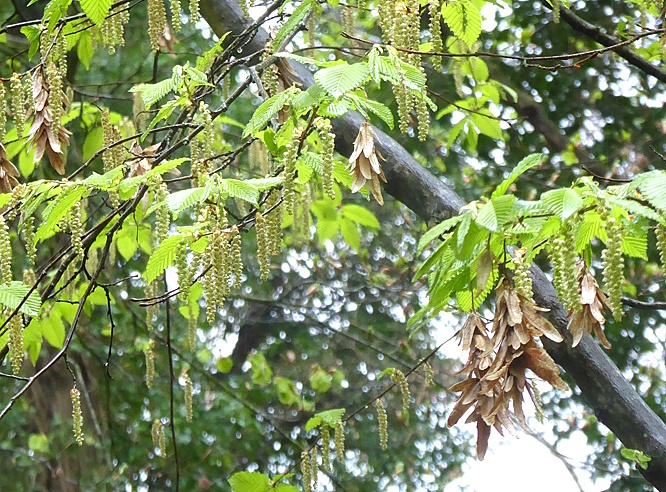
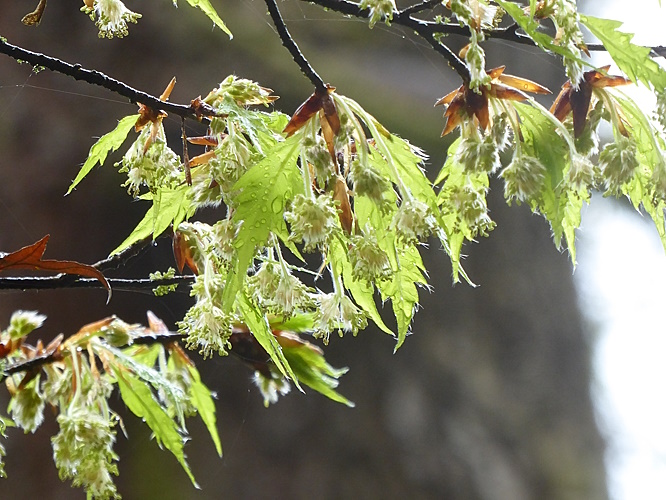
There were masses of Sycamore seedlings under the shrubs, throwing up their strap-like first leaves. Along the woodland paths we noted Elder and Hawthorn well in leaf, young Hornbeams  and Horse Chestnuts breaking their buds, but no sign yet of Beech or Oak. We heard or saw plenty of woodland birds – a Chaffinch singing, two Treecreepers, Robins, Great Tits and a fast-moving Goldcrest heading for a Scots Pine. A Nuthatch was calling its loud wheep! wheep!  Later, near the Visitors’ Centre, we heard our first Chiffchaff, but couldn’t see it. Around the lake a Willow had some past-their-best catkins of the pussy willow type, but it‘s hard to say if they were from Grey Willow Salix cinerea or Goat Willow Salix caprea.

The only “wild flowers” apart from the Dandelions, was this patch of Red Dead-nettle.

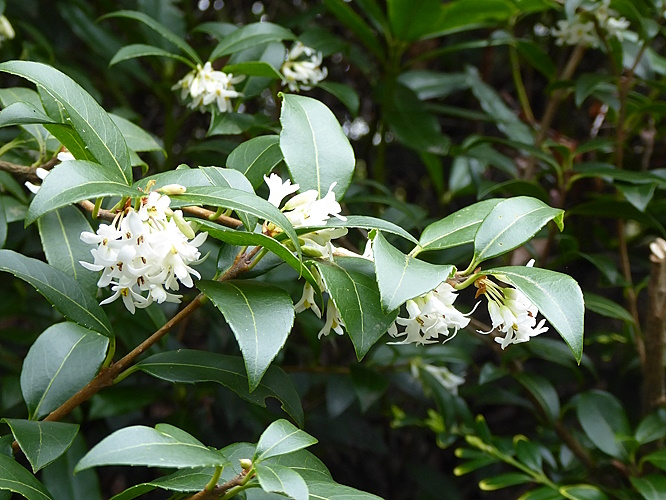
It was still grey and overcast by lunchtime, although the forecast had promised sunshine. We wanted to sit in the Quarry Garden, but it was closed, so we found seats up some steps, opposite a massive Cherry Laurel. A Blackbird came to crumbs. Many of the passing dogs were of the type we call sandwich sniffers, and we had to be on our guard.  Behind us was an evergreen shrub with white flowers emitting a lovely scent. It looked similar to Sweet Box, but this one’s flowers were bigger and wider, and Sweet Box is definitely a winter flowering plant – January and February only. So I don’t know what this was, but it was lovely.

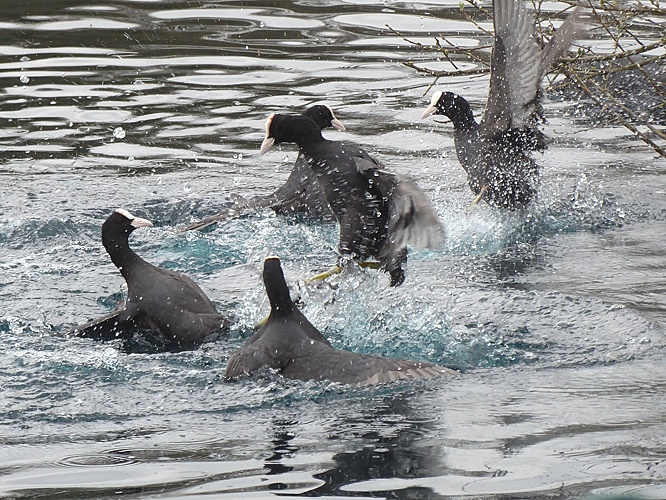
There weren’t many birds on the lake. The Black-headed Gulls all seem to have gone away to their breeding grounds but there were plenty of Canada Geese and Mallards, two or three pairs of Tufted Ducks and gangs of fighting Coots.

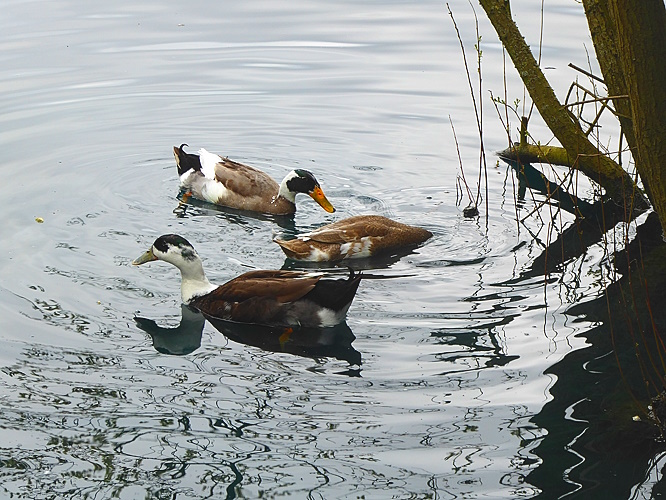
In a quiet corner were these three oddly-marked patchwork Mallards, probably brothers and sisters from the same brood. These groups of distinctive ducks often stay together for all their lives, and we will look out for them again.

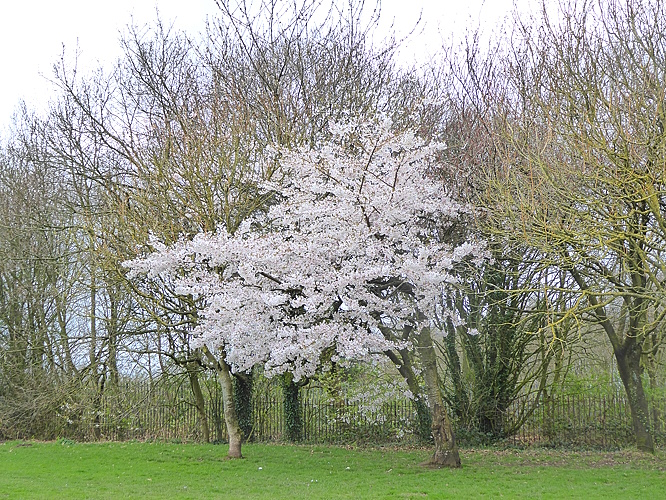
We struck off the path across the big field to see a magnificent white Cherry in blossom on the boundary with the golf course. The flowers were so dense they almost obscured the branches beneath. It’s some sort of cultivated early variety, I think.

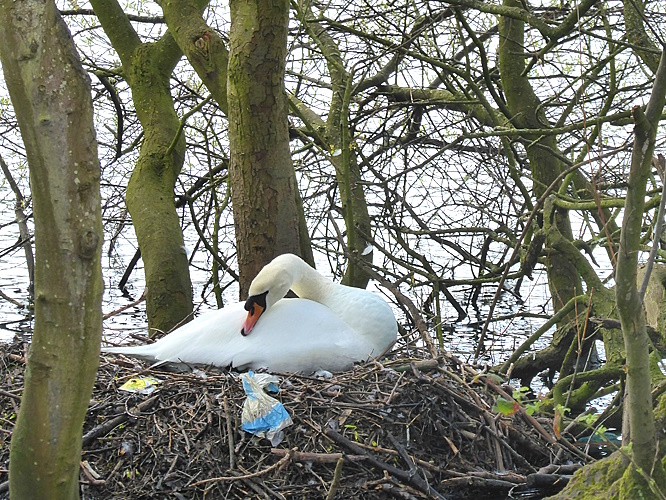
There was one Mute Swan on the lake, hanging around by some bushes. As we came around the back of them we spotted the other Swan, probably the female, sitting on a nest. It’s a pity about the rubbish and litter they have collected, but it probably does them no harm.

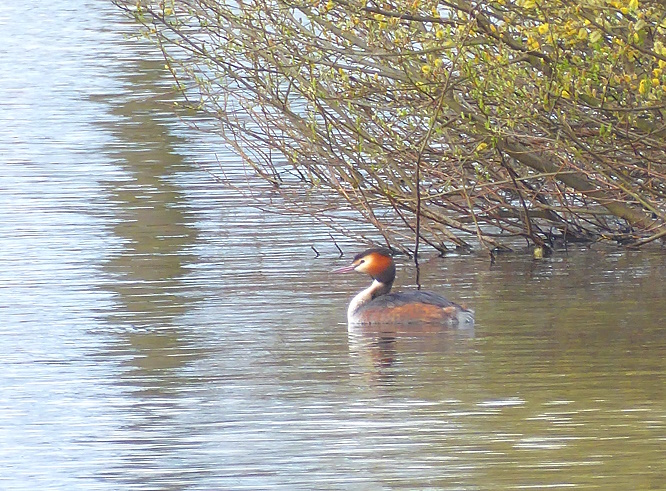
Also loitering by some different overhanging bushes was a single Great Crested Grebe. It’s very likely his mate was sitting on a nest, well-hidden and further back.

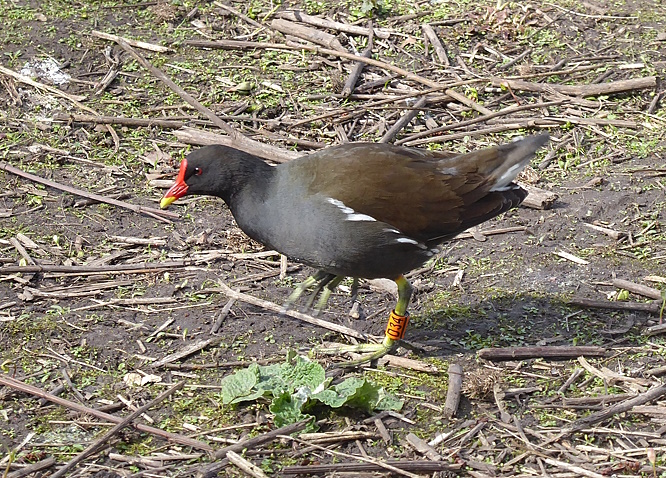
Near the Visitors’ Centre, on the fenced-off bank, were several Moorhens, and two of them bore orangey-red rings on their legs. They were D33 and D34, probably ringed at the same time. I reported them, but the website didn’t return a report, perhaps because this is a new study, with only 47 birds ringed so far.

Public transport details: Train from Lime Street station (towards Blackpool) at 10.17, arriving St Helens Central at 10.45. Then bus 10A at 11.00, arriving Prescot Road / Toll Bar at 11.10. Returned on the 10A from Prescot Road / Toll Bar at 2.20, arriving Liverpool 3.17.

Posted in Sunday Group | Comments Off on Taylor Park St Helens, 2nd April 2023

Mayer Park and Port Sunlight, 26th March 2023

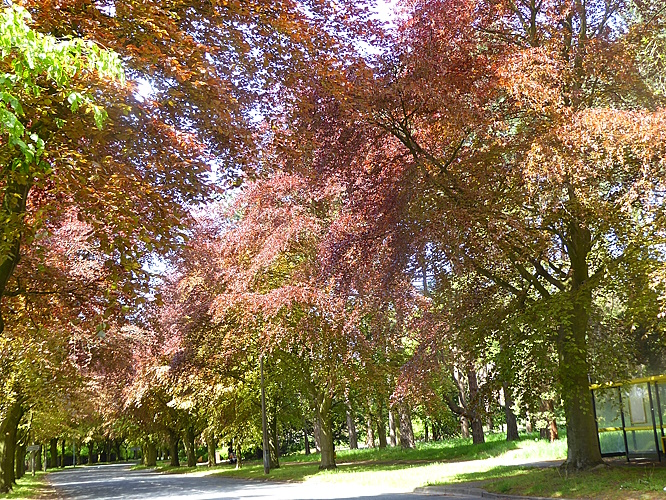
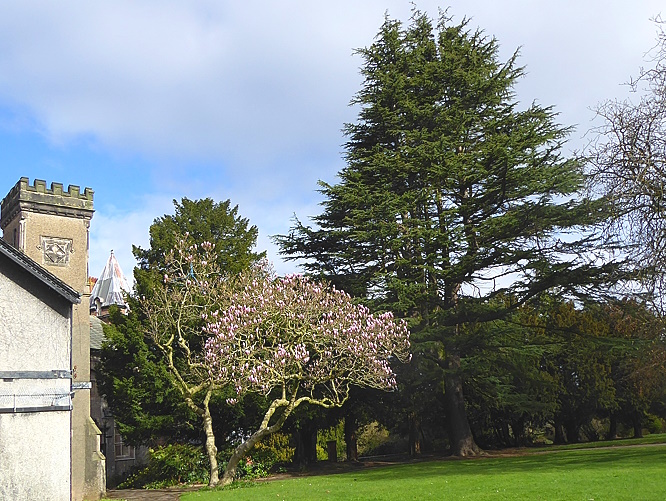
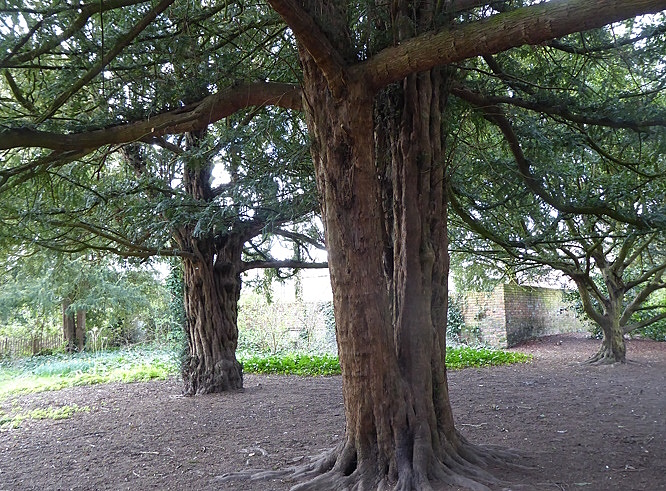
On a sunny morning, when we had all successfully managed to change our clocks, we took a bus across the Wirral.  The gardens on the way were showing off their Forsythia, Camellia, early Cherries and their just-breaking buds of Magnolia. It’s over ten years since we went to Mayer Park. It was once owned by Joseph Mayer of Liverpool, silversmith, antiquary and philanthropist. He lived in Bebington, and in 1869 bought the building next door, with five acres of land, and transformed them into a library and public park for all the people of the area. I imagine some of the older trees may be Mayer’s originals, perhaps now 150 years old. We didn’t examine the Cedar in the top photo, but it might be a now-rare Cedar of Lebanon, while a couple of Yews with gnarly trunks might also be that age.

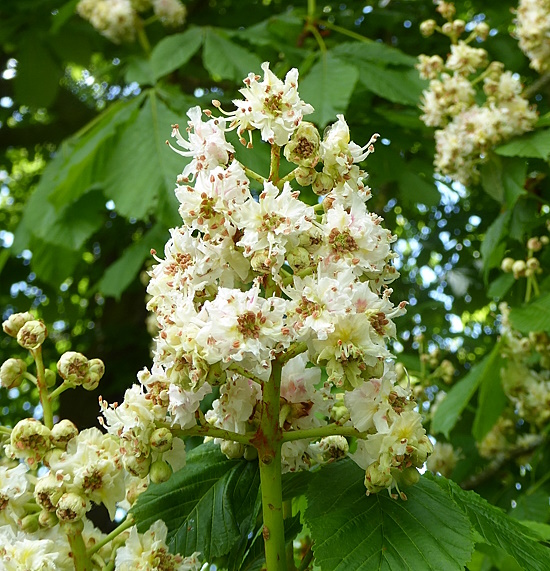
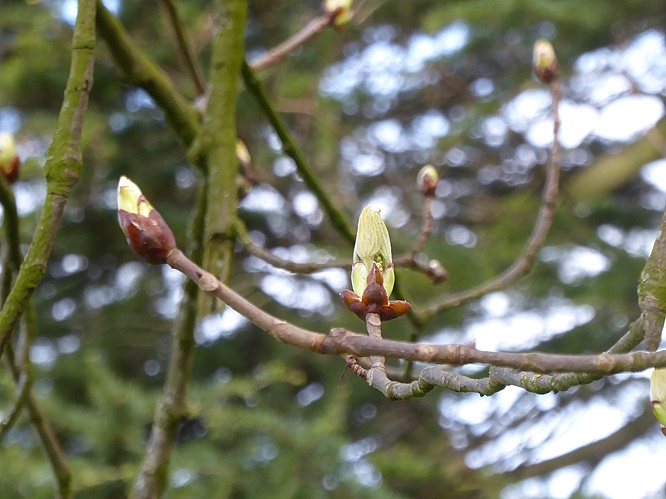
Grey squirrels were scampering up and down the trees. The only birds about were Blackbirds, Magpies and Wood Pigeons. Daisies and the first Dandelions were in flower on the lawns and we spotted a big Bumble Bee quartering the ground beneath shrubbery, looking for a hole to start her nest. The “sticky-buds” of the Horse Chestnut were just breaking.

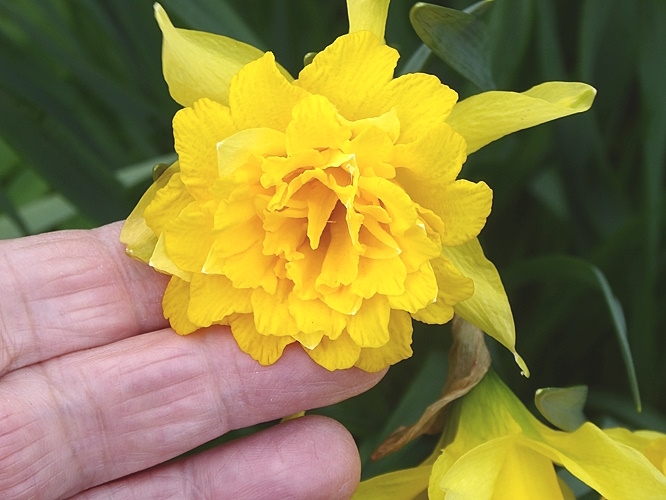
We poked about in the woodland area on the eastern edge, which may once have been allotments. In amongst the overgrown bramble and scrub were some remnants of cultivated flowers, such as these double Daffodils.

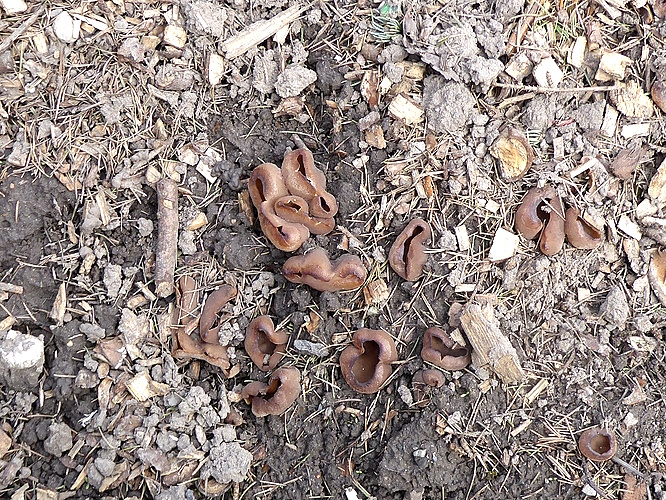
In the bare flower beds around the paved circle near the southern end we spotted Jelly Ear fungus emerging right out of cleared soil. They normally grow on dead Elder branches. The fungi weren’t attached to any underground roots, so we guessed they had grown from the woodchip mulch. (Added later: Sabena commented “…you have a pic of what you thought were Jelly Ear fungi … They’re actually Peziza – a saprophytic cup fungi that grow on the ground or woodchips. There are a lot of similar species – you really need a spore test to distinguish between them.”)

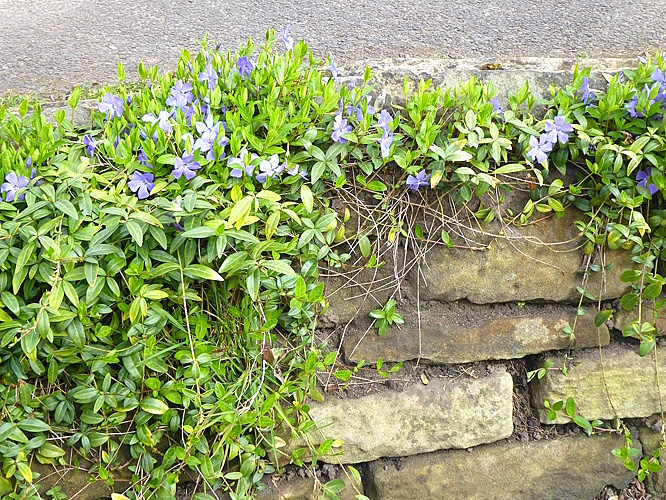
There was Periwinkle growing on a low wall, and flying all around it were bees with ginger thoraxes. Probably Common Carder bees Bombus pascuorum. They must have been queens emerging from hibernation, but were they feeding from the flowers or were they looking for places to nest in chinks in the old wall? They didn’t seem to settle for either purpose, and I never caught one sitting still for a photo.

After lunch we went under the railway tunnel to Port Sunlight and visited the garden centre. Outside there was a lovely shrubby border, and we found wintering snails tucked up in the  Hellebore.

The southern arm of Port Sunlight Rose Garden has recently been re-worked as a memorial garden for the late Queen. They took out the old roses and replaced them with the variety “Queen Elizabeth”, surrounded by low hedges and clipped conifers.

Along the junction of Church Drive and The Causeway there used to be a row of tall Lombardy Poplars. One came down in the storms of December 2021, and most of the others were found to have rotten cores and were felled. But the living cambium layer just under the bark persists in pushing out new shoots.

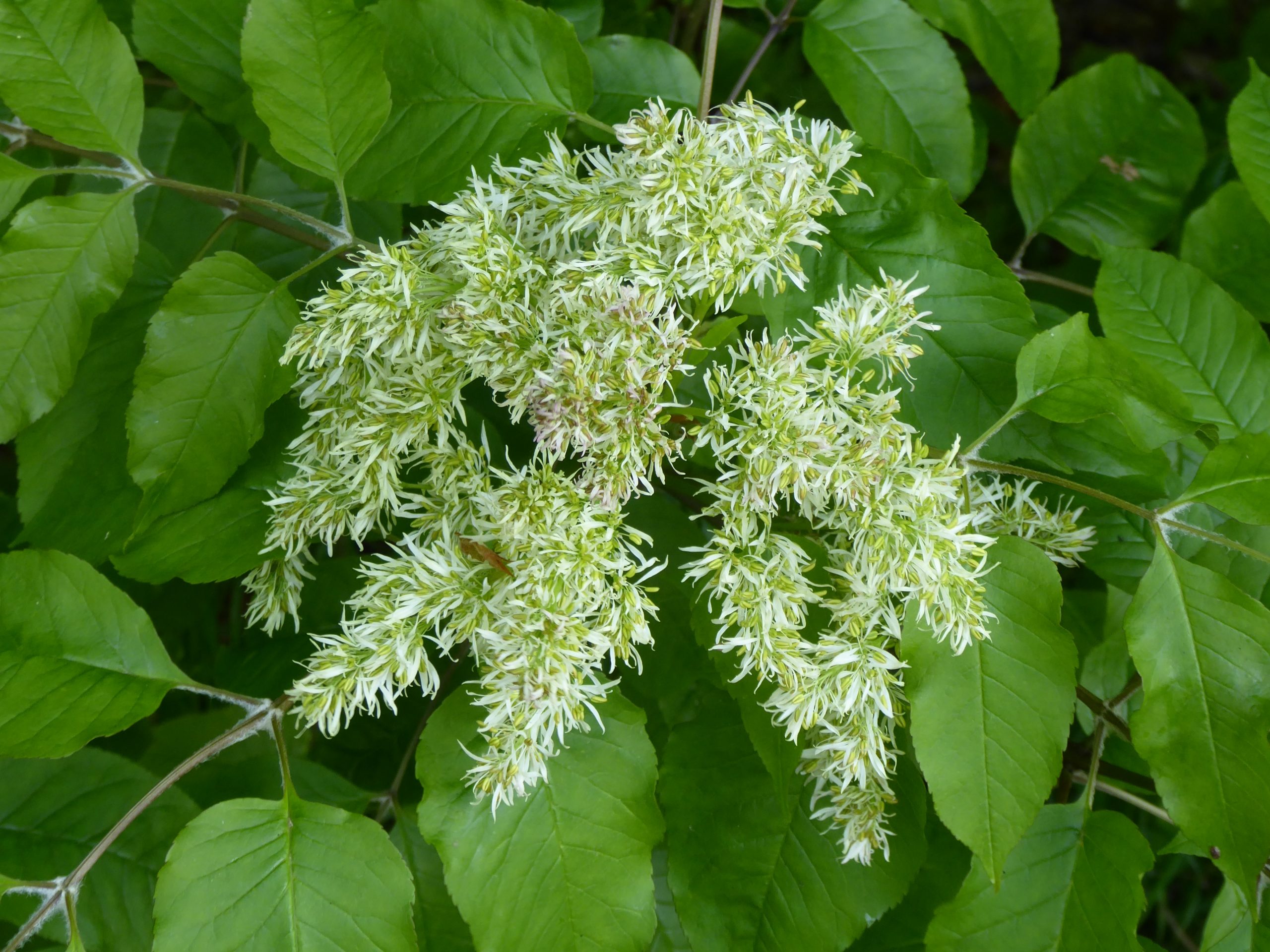
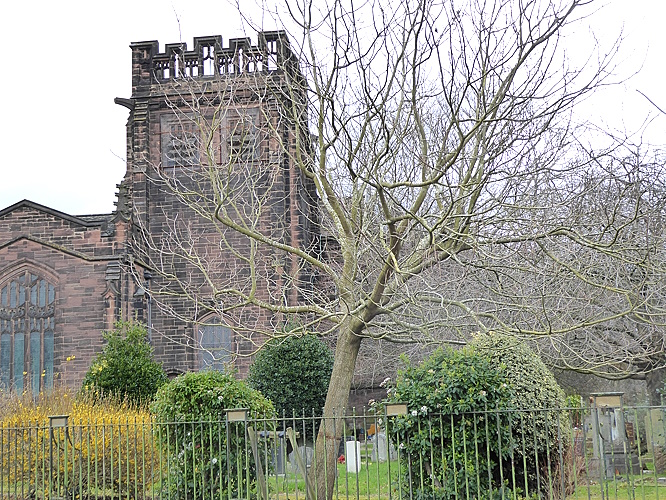
Outside Christ Church is a tree, planted by the WI, which we have variously mis-identified over the years. A Moosebark? A Foxglove tree? Something with huge leaves, anyway. Today we finally nailed it down as an Indian Bean tree, because we saw last autumn’s remaining bean pods.

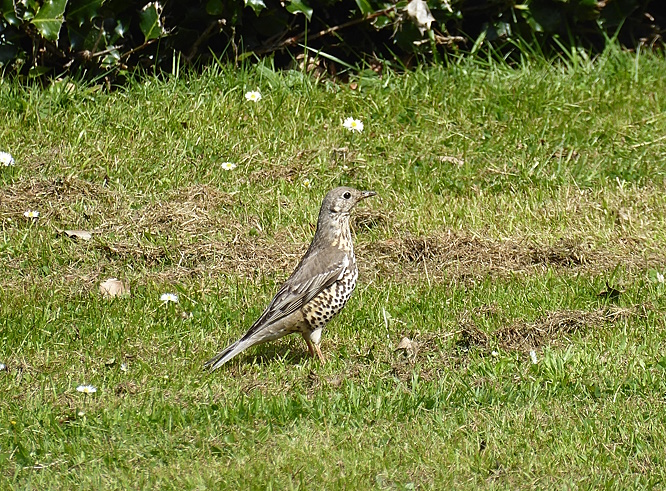
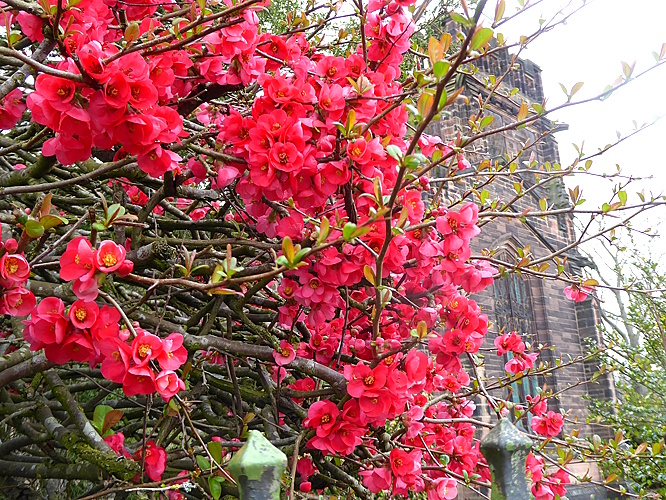
A Mistle Thrush sang from the top of a churchyard tree, a Robin from lower down, and Jackdaws pecked about on the lawn. The Quinces in the hedge are magnificent this year.

It looks like Spring in the Dell.

Public transport details: Bus 487 (the Parkgate bus) from Sir Thomas Street at 10.38 (should have been 10.29), arriving The Village opp Civic Way at 11.04.  Returned on the train from Port Sunlight station at 14.36 (that was late too!), arriving Liverpool 15.00

Posted in Sunday Group | Comments Off on Mayer Park and Port Sunlight, 26th March 2023

Croxteth Park, 19th March 2023

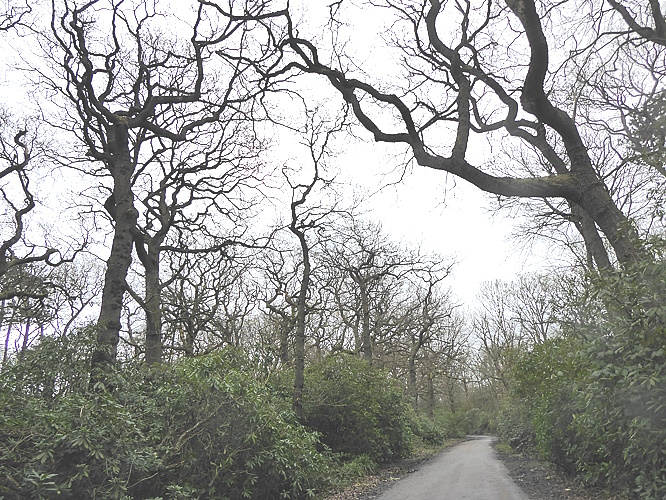
It always seems to rain when we go to Croxteth Country Park, but it wasn’t forecast for today, although it was grey and overcast. Instead of entering from the West Derby end, we took a different bus to the furthest entry point, the Kirkby Drive Gate, which leads to a large woodland area.  A Great Tit was calling and a Robin was singing. The woods were mixed Scots Pine, with tall bare twisty Oaks and a lot of straggly Rhododendrons, some being cleared. John, who used to be a volunteer warden here, said the Rhododendrons were originally planted when it was a shooting estate, to give cover to the baby pheasants.

The pale green Hawthorn leaves were coming out. We noticed several tall Lime trees next to the main path, with twiggy untrimmed (“epicormic”) growth around the bases of the trunks. Had this been a Lime avenue once upon a time?

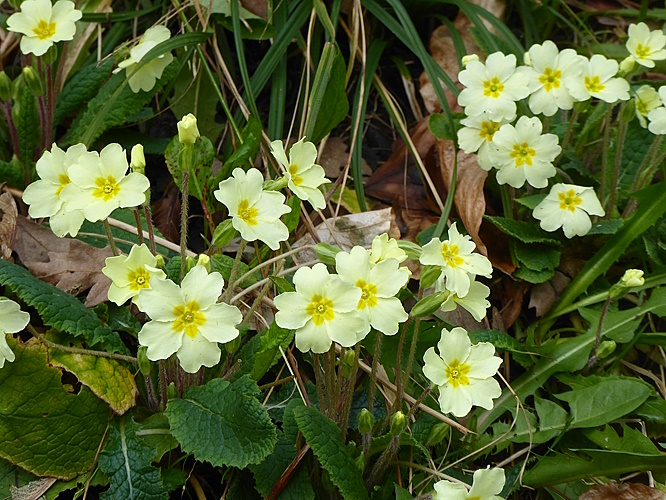
It’s definitely spring now. In the gardens near me, the Magnolias are starting to flower, and also Forsythia and Camellia. In the woods we came cross a patch that had been a bit “gardened” as well, with patches of daffodils, primroses, spent snowdrops and some lovely blue Glory-of-the-Snow.

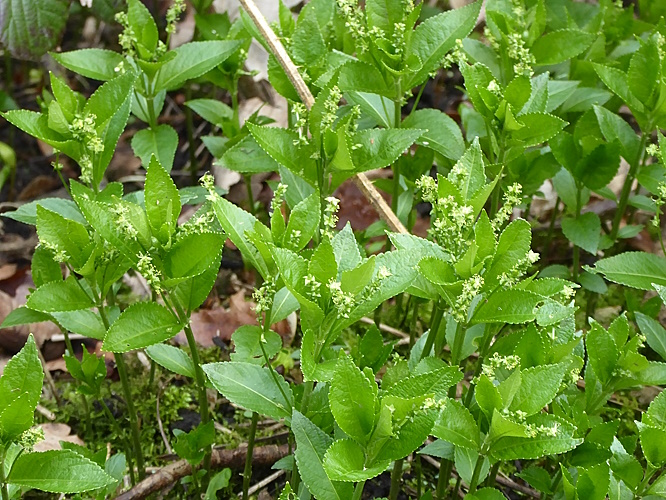
There was Dog’s Mercury at the edges of the paths, but not obviously in the woods themselves.  The Woodland Trust says it is “A poisonous coloniser of ancient woodland, quick to sweep over the wood floor, sometimes outcompeting more delicate ancient woodland species.” I didn’t know until today that there are separate male and female plants, and these are the male flower spikes. I didn’t notice the females.

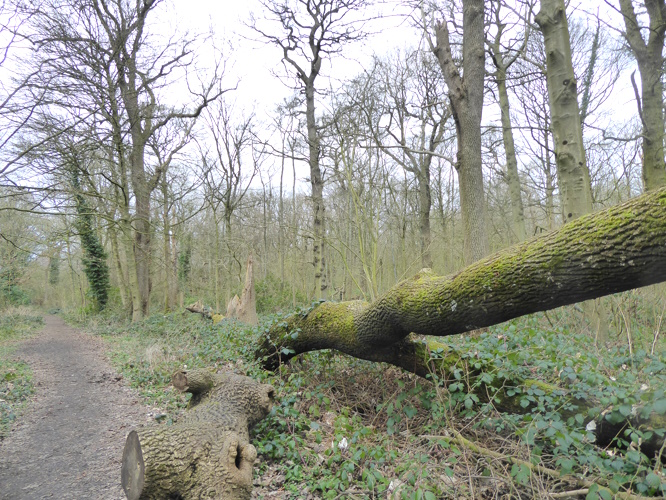
The main tarmacked paths were well-used by dog walkers, but when we headed into the muddy and little-frequented area, we had it to ourselves. It all seemed very silent. Then we heard a woodpecker drumming, quite close. John used a stick on a log to drum back, and it worked. The bird drummed again in answer and came closer, inspected us from behind a tree, then flew off in disgust. No rivals here! There was a Tree Creeper dodging around the trunk of a tall tree and a Buzzard flew over. Evidence of the storms of a couple of years ago was still about, including this snapped and fallen oak.

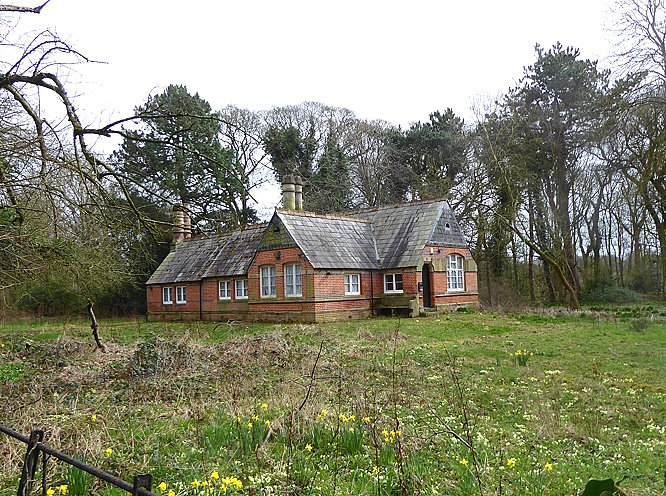
We emerged from the woods opposite the Gamekeeper’s cottage near the old kennels. Daffodils and Primroses were scattered over the grass, making it as pretty as a chocolate box.

After a visit to the loos by the café block, we noticed a Monkey Puzzle tree in the shrubbery. The weak sunshine was catching what appeared to be new female cones at the ends of the branches, and making them look bright yellow. We knew that Monkey Puzzles come as separate male and female trees (dioecious), so we assumed the browner hanging structures further back were older female cones. However, I see on the Wild Flower Finder website that male cones look exactly like that. The website says “occasionally it is possible to find individual trees bearing both types of cone”, so that tree appears to be a special and unusual one.

There were Wild Garlic leaves sprouting by the Long Pond, and also this early Wild Cherry.
Loveliest of trees, the cherry now
Is hung with bloom along the bough,
And stands about the woodland ride
Wearing white for Eastertide.

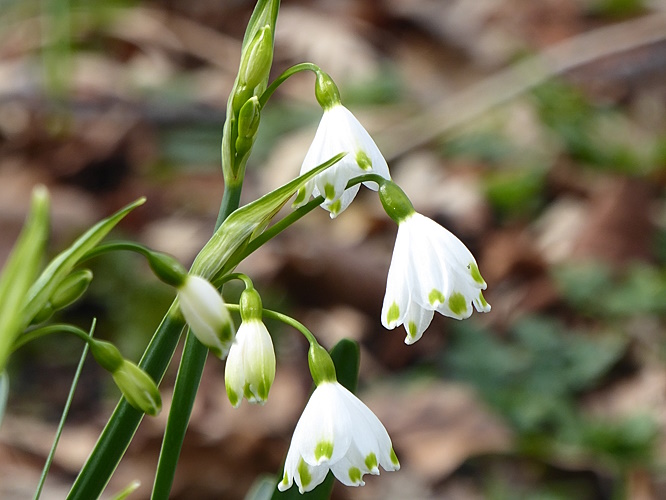
There were Primroses on the bank by the way out to West Derby village, and Summer Snowflake on a corner near the car park.

The Highland cattle have had a productive spring, and we spotted five calves in a field with three adults, so there are probably two sets of twins. One of the calves was very pale-coloured.

The patch of wet grass near the village now looks almost like a proper pond. We looked for frogs or spawn, but no joy.

Public transport details: Bus 18 from Queen Square at 10.12, arriving Oak Lane North / Abbeyfield Drive at 10.35. Returned from Mill Lane / Town Row (West Derby village) on bus 12 at 2.33, arriving Liverpool at 2.55.

Posted in Sunday Group | Comments Off on Croxteth Park, 19th March 2023

Ormskirk, 12th March 2023

What a mild day in comparison to the snow and ice we had in the week! My first (and only) interesting bird of the day was a Common Gull (which aren’t common at all nowadays) on the pavement in Queen Square in the city centre. At first glance it looked like an ordinary Herring Gull, but it was looking around with a bemused air, as if it was wondering how it got there, and then I noticed the dark eye and yellow-green legs. I wonder what made it stop in a bus station? Common Gulls are usually found in the middle of big playing fields or golf courses. Our destination today was Ormskirk, but we hopped on the Kirby train for a couple of stops to Sandhills, so we could ride on one of the fancy new ones, the first time for most of us.

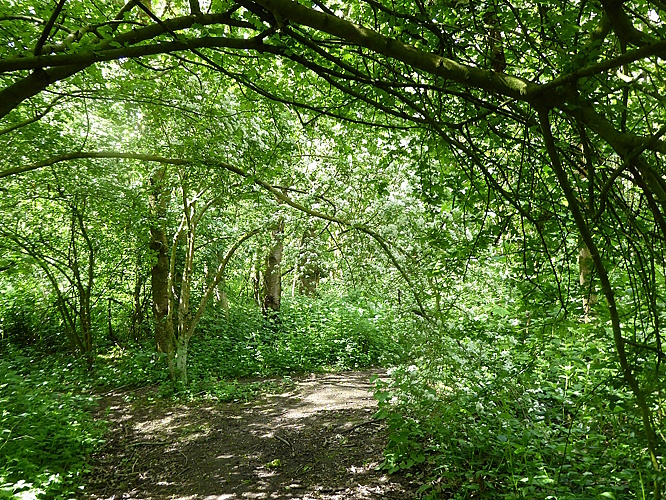
Just outside of Ormskirk station, past the park-and-ride car park, is a triangular wooded area called Station Approach. It’s a 7 acre mixed wood and wildflower area on the footprint of old sidings and the former branch line to Skelmersdale. The trees are mostly tall Birches and young Oaks and in a few weeks they will stand in a carpet of Bluebells, Lesser Celandine and Wild Garlic. The signboard also promises meadow flowers and butterflies in early summer, and also rabbits and weasels. Today we noticed the Hawthorn and Elder leaves breaking out, a few flowers of Lesser Periwinkle and this patch of Coltsfoot.

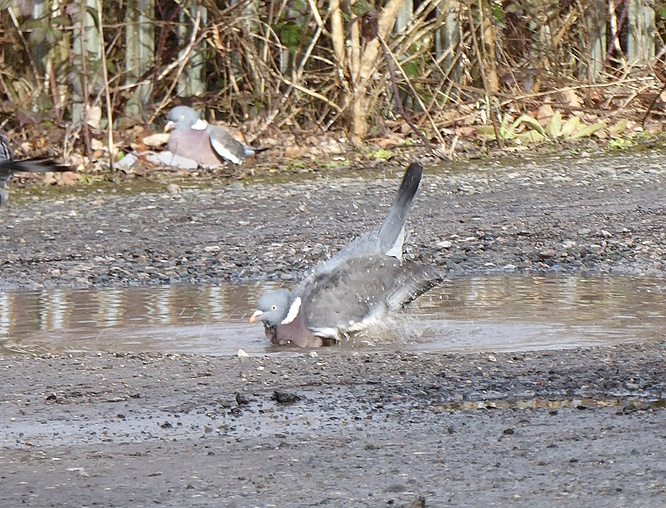
A few woodland birds were moving about – Robin, Goldfinch, Dunnock – and there were Magpies in an adjacent field. In some broken tarmac, Wood Pigeons were bathing in the dirty puddles, possibly the first unfrozen water they have had for several days.

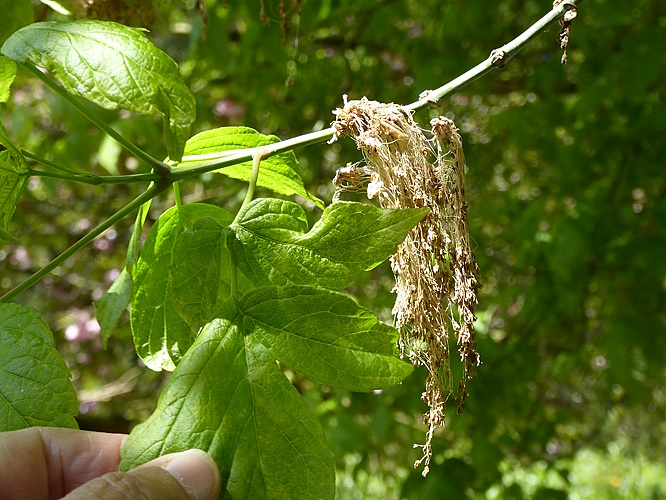
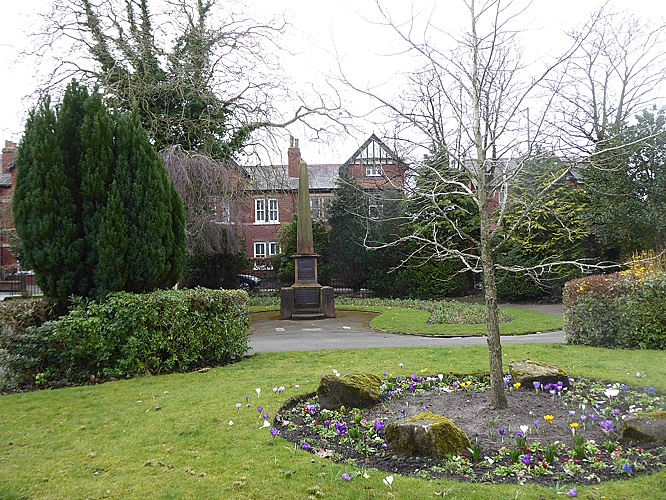
There is a pretty little park at the junction of Ruff Lane and St Helens Road called Victoria Park and Garden. We had our lunch there, spotting a Buzzard high overhead. We hunted for the pair of Ash-leaved Maple / Box Elder trees, hoping to see the bright pink clusters of catkins that the male trees show off at this time of year. We think we found the female tree, but not the male tree we were hoping for. There is a memorial obelisk in the park to Sergeant-Major Nunnerley of the 17th Lancers, a local man who had participated in the Charge of the Light Brigade in 1854, and survived to become an Ormskirk shopkeeper and local celebrity until his death in 1905.

After a pit stop in Morrison’s supermarket we headed into Coronation Park. Families were “feeding the ducks”, and we noted lots of Mallards, some of which were the domesticated white type, Canada Geese, a few Moorhens but no Coots. There were also a couple of Herring Gulls and a few Black-headed Gulls, none with leg rings. A couple of the BHGs still had white heads so late in the season. Are these young ones?

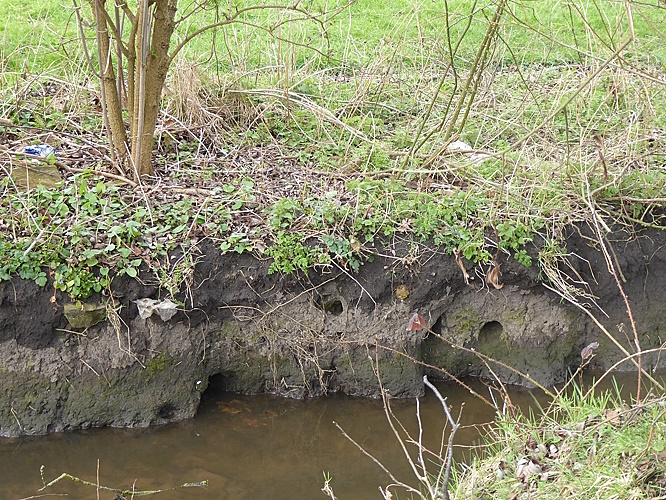
Beyond the park lake is a wetland area, edged with coppiced willow, and which is good for butterflies and wildflowers in summer. The signboard boasts of bats, amphibians and water-loving flowers like Purple Loosestrife, but there was nothing like that today. However, along the recently-cleared watercourse we spotted many holes in the bank. What made those, I wonder? If it was Water Voles, wouldn’t the sign have said so?

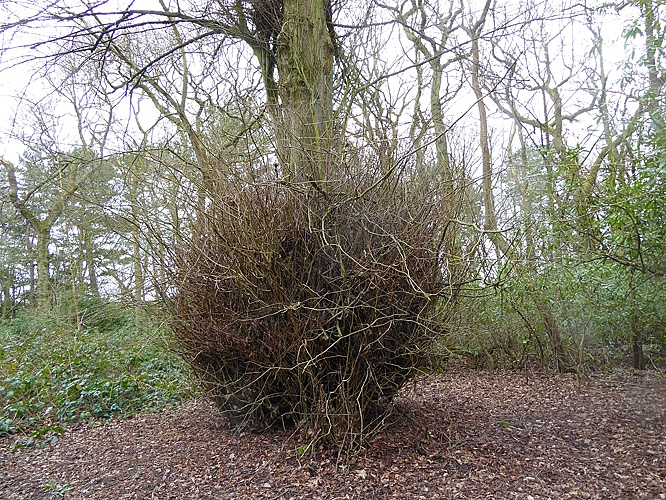
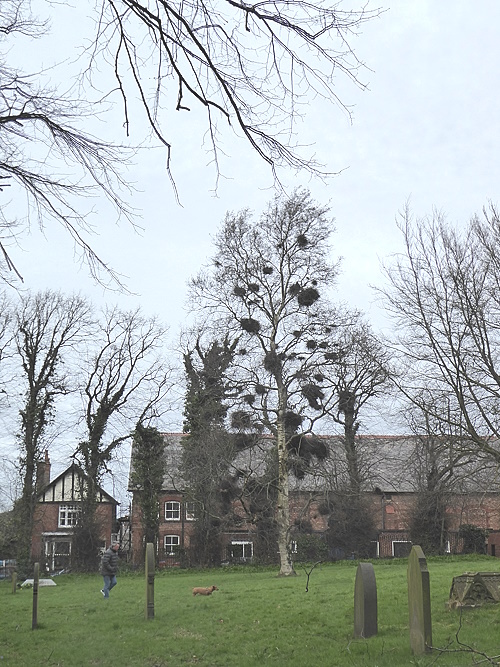
We cut around a fence into the graveyard of Ormskirk Parish Church. There were carpets of Daffodils, Crocuses and gone-over Snowdrops around the old Victorian gravestones. On the far side was a Birch tree covered with Witch’s broom.

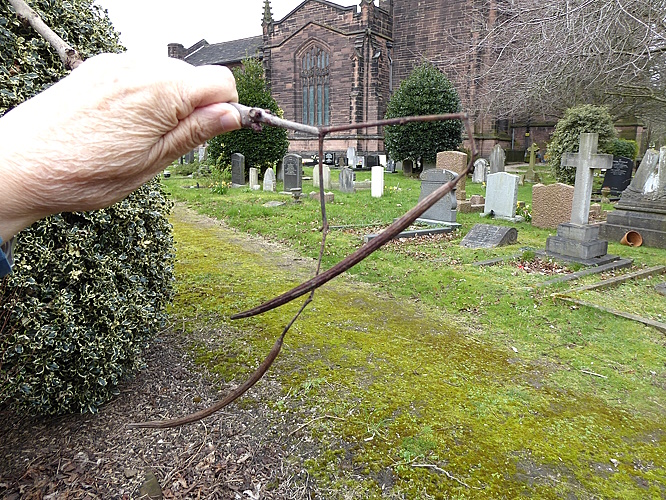
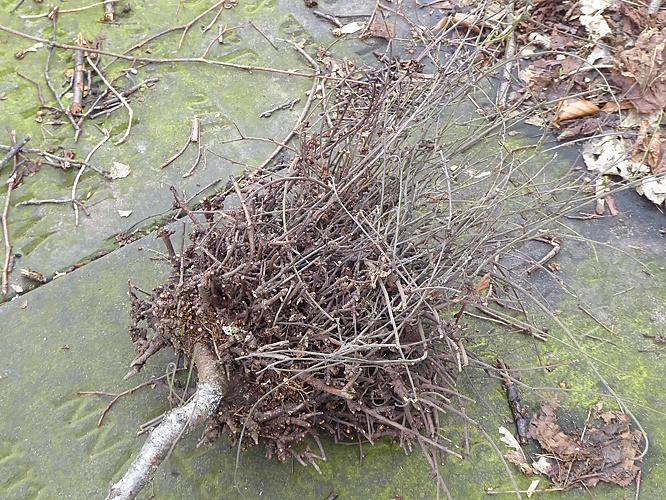
It is thought to be caused by a fungus called Taphrina betulina, which infects the lateral buds that make twigs and side shoots and causes them to lose control and grow multiple stems in a tangled, disorganised manner. It takes many years to make big brooms, and it doesn’t seem to harm the tree. One branch of this one had broken off and we were able to see the broom close-up.

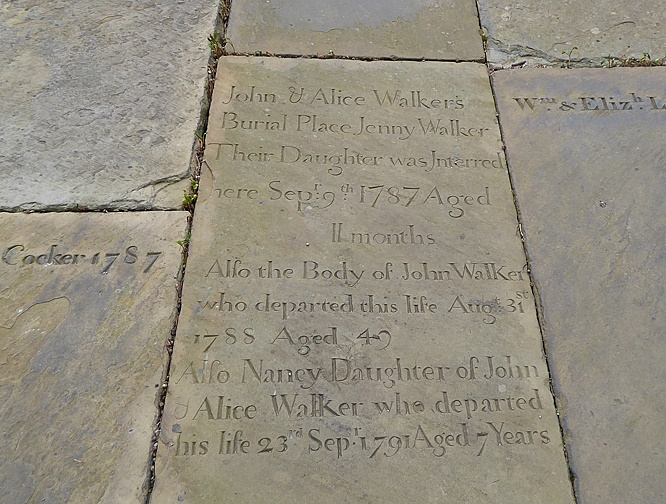
The oldest gravestones have been used to pave the area surrounding the church, and one of the oldest I could find records a baby girl aged 11 months who died in 1787.

Public transport details: Train from Sandhills to Ormskirk at 10.23, arriving 10.50. Train back from Ormskirk at 2.37, arriving Liverpool 3.10.

Posted in Sunday Group | Comments Off on Ormskirk, 12th March 2023

Chester, 5th March 2023

Grosvenor Park was full of early spring blossom, and would have looked magnificent in sunshine, but the day was dull and overcast. The best display was this Cherry-Plum in spectacular flower at the north east corner.

There was a Moorhen and a pair of Mallards on the pond, and elsewhere the usual Black-headed Gulls, Herring Gulls, Wood Pigeons, the odd Blue Tit, and several confiding Blackbirds hoping for a hand-out.

The Magnolias were about to break their buds and there was a lovely Azalea out near the Rose Garden. Two Ravens followed each other overhead, heading northwards. Twice in the past we have seen sculptures made of willow in the park, of WWII planes for the RAF centenary and birds for the RSPB. They are the work of Sarah Gallagher Hayes, a local sculptor. Today we saw another work which must be hers, although there was no sign, a head of the late Queen, put up for the Platinum Jubilee. More pictures of her work are at her Twigtwisters website.

We headed down Little St John’s Lane to The Groves next to the River Dee. A Dylan sound-alike was singing Mr Tambourine Man.

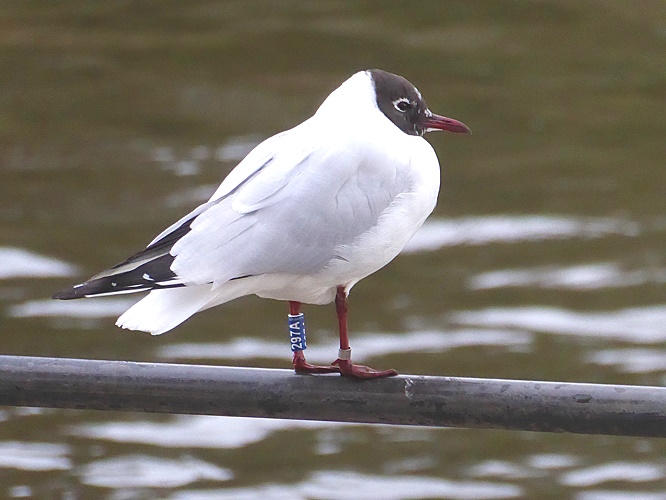
There were several young Herring Gulls there, and dozens of Black-headed Gulls. We were looking for legrings. One ringed bird flew off before we could make out its code, but this one sat still for us, number 297A.

Later in the day I reported it on the new Waterbird Colour-marking Group website.  Their report said it was ringed at Chester in November 2021 as an adult and re-sighted there about 20 times since then, two or three times a month. However, there was an interesting gap last spring, between 12 Mar 2022 and 27 July 2022. For four months last year it was absent from Chester, and had probably gone back to its breeding grounds, wherever they are. I imagine it’s about to go off to breed again. We have already seen BHGs at Chester that breed in Norway and Poland, and the website has an interesting map of all the places that BHGs ringed in north west England go to breed – all over Europe.

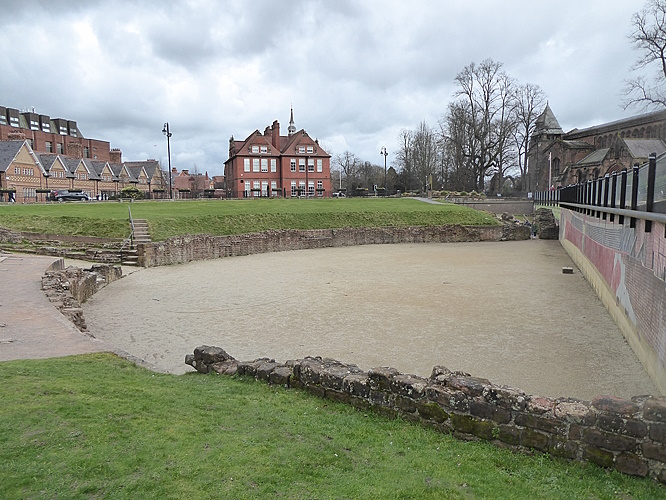
We strolled back through the re-created Roman garden and past the remains of the Roman Amphitheatre.

Roman Garden
Roman amphitheatre

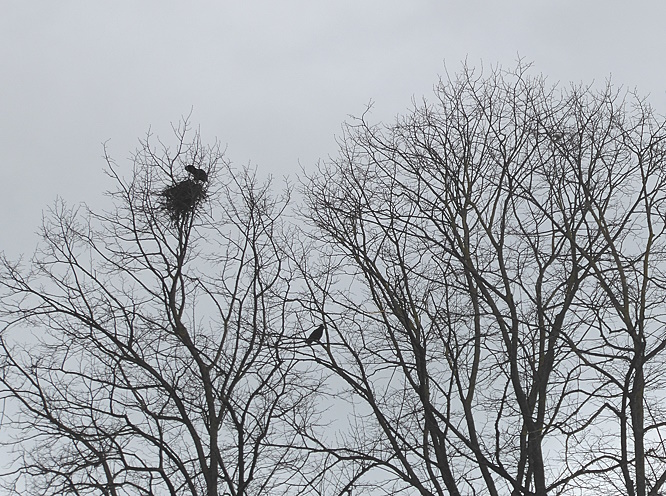
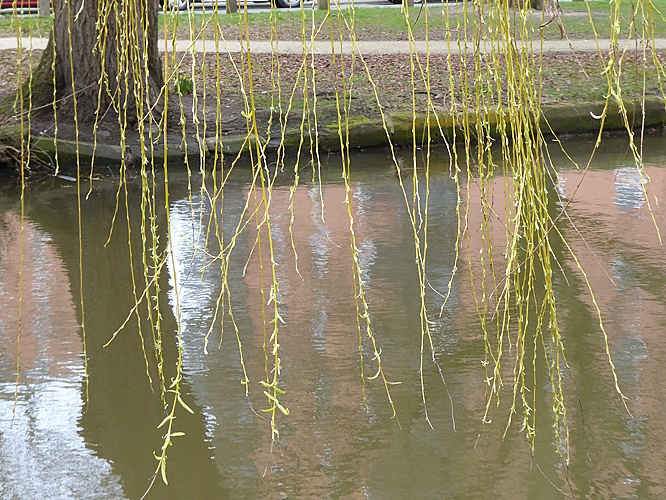
Rooks were nesting above the Cathedral and, along the canal, the Weeping Willow was just breaking into leaf.

Public transport details: Chester train from Central Station at 10.15, arriving 10.55.  Returned on 2.30 train, arriving Liverpool Central at 3.15.

Posted in Sunday Group | Comments Off on Chester, 5th March 2023

Royden Park, 26th February 2023

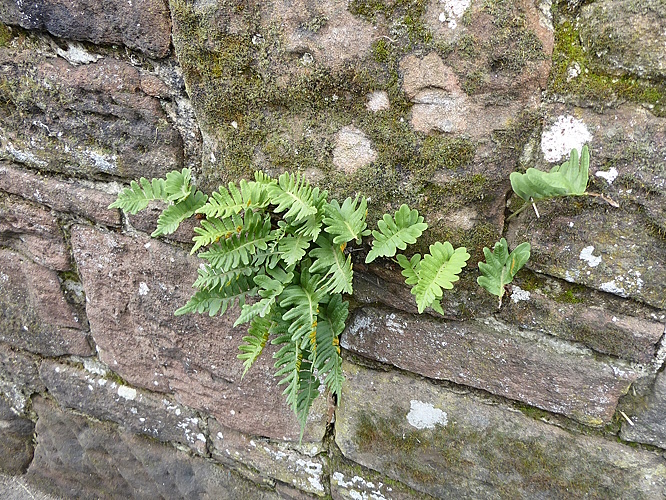
It was a good day for mystery trees, but our first corker was immediately identifiable, a yellow-flowering Mimosa seen from the bus, growing next to the Esso garage in Greasby. How did that get there? We took the bridleway west of Frankby Cemetery, sheltered from the chilly wind. Two horses and riders came past us. In the adjacent open field were Redwings, and a few busy Goldfinches. There is an old sandstone wall along Montgomery Hill, and we stopped to look at this fern emerging from it. Something unusual? No, I think it’s Common Polypody Polypodium vulgare.

Happily, Royden Park’s walled garden is open again now that they have repaired the damage caused by 2022’s winter storms (see my blog of June 2022). There were plenty of little birds flitting about – Robin, Dunnock and various tits, and it is ready for spring.

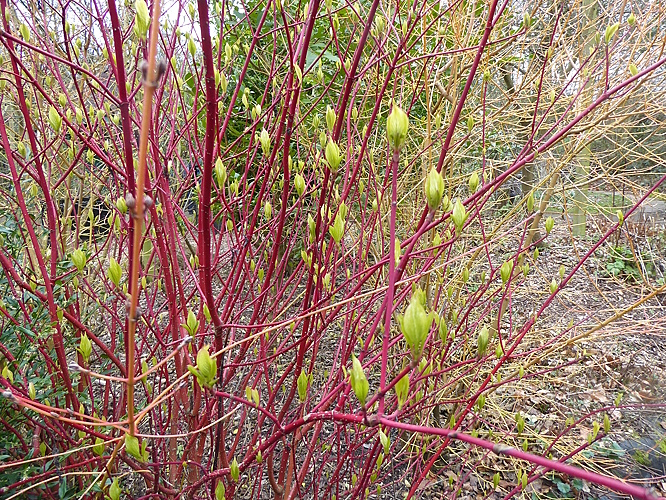
The shrubs are starting to sprout, including Forsythia, catkins on the Contorted Hazel and this red Dogwood.

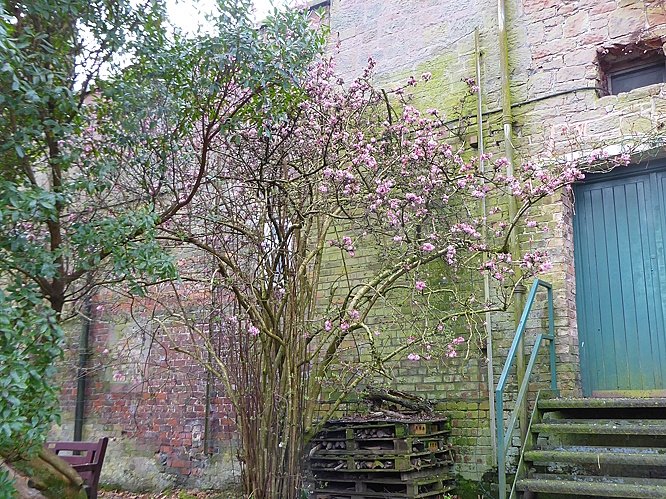
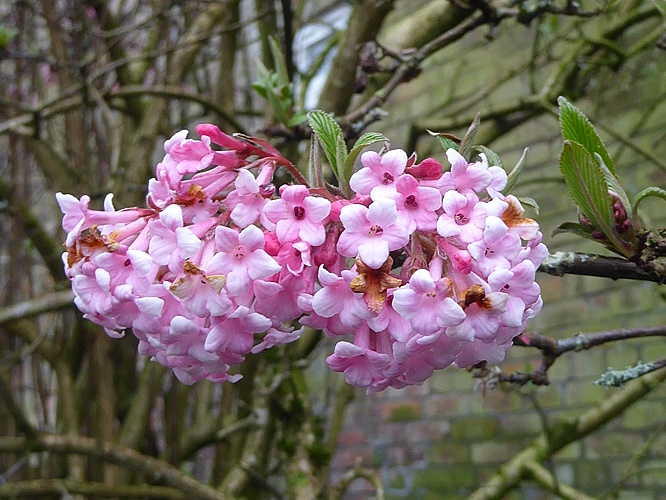
Next to some old metal steps and doorway was a small tree breaking into blossom, looking rather Japanese. It’s the hybrid Viburnum bodnantense, one of the loveliest examples I have seen.

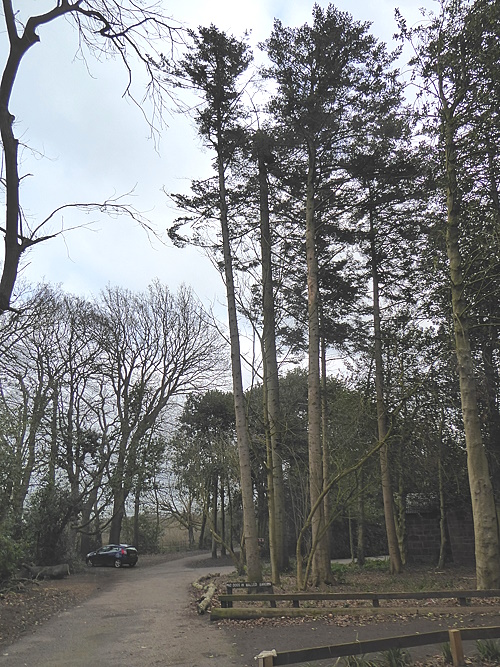
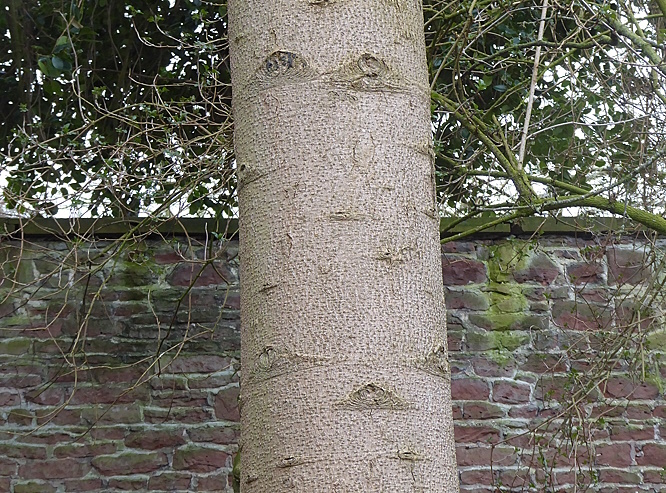
Just outside the gate are several very tall trees, which are some sort of conifer. The bark looked rather “primitive”.  The foliage was so high up we had to use binoculars, and it turned out to look a bit like Yew. Not that of course. Some sort of Redwood? After consulting books at home I am leaning towards them being one of the Silver Firs, genus Abies, which are known to grow straight to that sort of height. Perhaps Grand Fir because of the flattened Yew-like foliage. (Added later: more likely to be the European Silver Fir Abies alba, which has that white bark.)

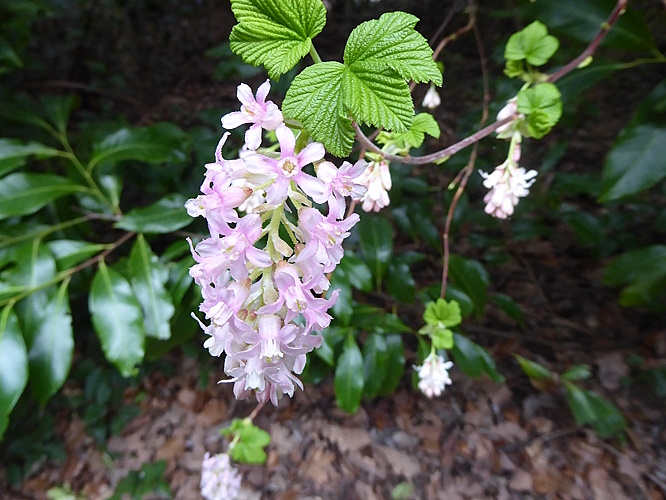
On Roodee Mere were the usual Mallards, Coots, Canada Geese and Moorhen, one Common Gull and a Black-headed Gull with no dark head plumage at all.  A former park ranger of our acquaintance is said to have been on the radio last week, opining that the ones with black heads are the males! (In reality they all have the same plumage, they just change at different times, probably depending on their age.). A Buzzard called overhead. The park managers have been busy felling old trees and clearing Rhododendron, with patches of new tree planting. They have been clearing shrubbery in Frankby Cemetery, too, although we spotted a very pale shoot of Flowering Currant emerging from Laurel shrubbery.

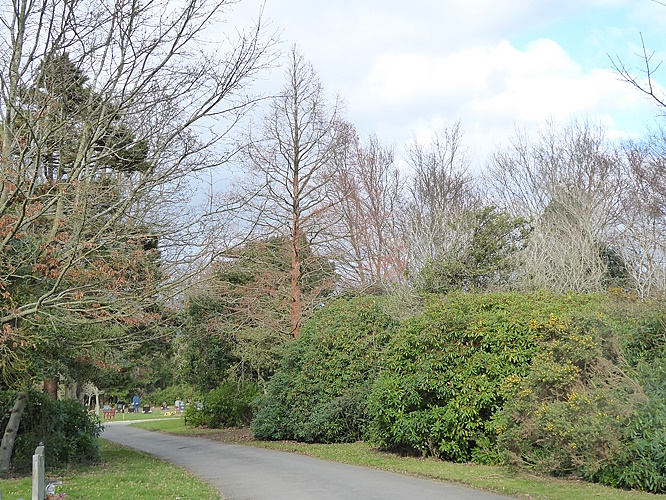
The Cemetery lake had Moorhen, Coot and Mallard. This pond also had signs up warning passers-by not to feed the birds because of bird flu. We noticed that the Mallards had an early reflex to head towards us, but stopped very soon, and didn’t approach the bank, so it looks like people are complying. On the way out we saw a very odd tree. It’s the bare upright conical one with reddish bark, emerging from the shrubbery.

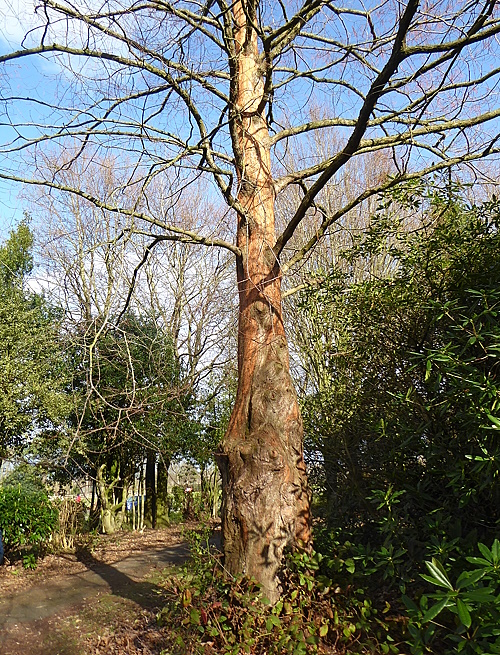
Closer up the bark looked even more orangey, and it was fairly soft. The trunk was wide and lumpy at the bottom. Oddest of all was the display of pink buds or catkins at the top, just on the sunny southern side. What on earth is that?  I wonder if it is a Dawn Redwood?  The shape is right, and soft orangey bark is right. As for the pink stuff, Mitchell says their shoots are “pinkish-green or pale purple”, so maybe this is an effect only seen fleetingly, perhaps just for a day or two. As always, we need to look at this tree again in a different season.

Public transport details: Bus 437 (West Kirby) from Sir Thomas Street at 10.04, arriving Frankby Road opp. Frankby Stiles at 10.45.  Returned on 437 at 2.29 from Frankby Road opp. Frankby Green, arriving city centre at 3.05.

Posted in Sunday Group | Comments Off on Royden Park, 26th February 2023

Sefton Park, 23rd February 2023

This was an MNA midweek short walk, starting at the café at the south end of the lake at 11.00. There were 15 of us, including some newer members, although some had to leave early. It was a bright, brilliantly sunny day, and even the chilly northern breeze didn’t penetrate far into the park.

Birds on the lake included Mallard, Coot, Canada Geese, Black-headed Gulls (a few with fully-“black” heads), immature Herring Gulls, Mute Swans, a few Moorhen, one or two Little Grebes, a Tufted Duck and the single male Gadwall, who has been there since early November.

Black-headed Gull with fully “black” head

Around the park we saw Blackbirds, Goldfinch, a Greenfinch, a Ring-necked Parakeet, and a Great Spotted Woodpecker near the Fairy Glen, after we heard it drumming. The Kingfishers are said to be back, but although we looked, we saw no flashes of blue. There were also reports of even more exciting birds. Jenny had heard that a Water Rail had been seen recently somewhere in the park, and somone else had heard that one Monk Parakeet had joined the Ring-necks. It is similar, with green plumage, red beak and a long tail, but it has no neck ring and it has a barred front. We didn’t see it, but keep a lookout!

A few trees strut their stuff at this time of year and become easily recognisable. The Hazel has catkins, as do the Common and Italian Alders.

Italian Alder catkins and last years’s cones

The male Yew trees have their tiny clusters of poilen sacs, and shed clouds of pollen when shaken. There is a Winter-flowering Cherry by the Gothic Fountain. The Persian Ironwood on the bank by the Fairy Glen had its flowers just going over.

The biggest tree surprise was a very early Norway Maple, which had burst into flower in a south-facing corner by the path junction below the Palm House.

If you are interested in the wildlife of the north-west of England and would like to join the walks and coach trips run by the Merseyside Naturalists’ Association, see the main MNA website for details of our programme and how to join us.

Posted in MNA reports | Comments Off on Sefton Park, 23rd February 2023

Walton Park Cemetery and Rice Lane City Farm, 19th February 2023

It’s been nearly eight years since we were last here, not sure why.  The land that is now Walton Park Cemetery was once the Liverpool Parochial Cemetery, then became the burial place of the poor who died in Liverpool and Walton Workhouse hospitals. It is consecrated ground, not available for development, so part of it is the city farm and the rest is recreational woodland.  Some old graves still line the two main paths.

The small birds were getting busy, including Blackbird, Mistle Thrush, Greenfinch, Long-tailed Tits, a Coal Tit and some Chaffinches feeding on the ground. Robins were singing and a Wren flashed across the path. Magpies flew between the distant trees and a Sparrowhawk cruised overhead. The woodland is mostly Oak and Ash with an understory of coppiced Hazel, Holly and Ivy. Bluebell leaves were pushing up everywhere and there were large patches of Snowdrops.

There was a row of very old gravestones laid flat next to the woodland path. The oldest commemorated “Henery son of Henery Tyrer died September ye 18th 1746”. The parents and another sister and brother are recorded as dying in 1758, 1766 and 1767.

The most famous grave is that of the socialist author Robert Tressell, who wrote The Ragged-Trousered Philanthropists. He died of TB in 1911 and was buried in an unmarked pauper’s grave along with 12 others.  The location of his grave was re-discovered in the 1970s and is now marked with a large stone under an overhanging Hazel. Flowers and tubs of plants are still being left in his memory.

His grave is near to the back entrance gate on Hornby Road, opposite Liverpool prison, with the old Walton Gaol buildings standing like a castle keep beyond the modern prison walls.

Scattered in amongst the Victorian graves are some of the simple markers of fallen WWI soldiers put up by the Commonwealth War Graves Commission. Unusually, there are also about a dozen Dutch War Graves from WWII, clustered in a neatly-mown area next to the farm pastures. They seem to have been naval labourers originating from the Far East (Indonesians?), and appear to have had only one name. A Commonwealth grave is there too, to a “fireman and trimmer” (= stoker) called Ali Mohamed, whose stone bears wonderful Arabic calligraphy.

Dutch war graves
CWGC gravestone, Muslim and Arabic.

There is a newly-planted orchard, and the labels on the saplings promise Pear, Apple, Cherry and Damson. When the sun came out around lunchtime we spotted a Red Admiral butterfly on the wing, which must have been tempted out of hibernation by the spell of warm weather. The rare-breed Ryeland sheep are all expecting lambs in April.

After lunch we went into the farmyard, observing their boot-disinfection measures to protect against bird flu. The poultry are all enclosed, as they were at Tam O’Shanter last week. They have some chickens, doves and Guinea Fowl as well as the sheep, pigs, a pony and a donkey. The two Saanen goats (sisters called Iris and Daffodil) have been given some old children’s playground equipment to climb on, and I wondered if this one was going to slide!

We left the farm and took the short footpath along the railway line to the residential street also called Walton Park, crossed Rice Lane and went into the little park on the corner of Evered Avenue by the old Library. A tree there was just bursting into flower. This must be Cherry Plum Prunus cerasifera, which has the first white blossom of spring, blooming a couple of weeks before Blackthorn. Cherry Plum flowers have stalks (as these do) while Blackthorn flowers don’t, apparently. I have never inspected Blackthorn closely enough and I ought to do.

I heard last week that pundits think this will be an excellent spring for all types of blossom, as the weather conditions have been just right. The Quince bush in my front garden seems to be living up to those expectations.

Public transport details: Bus 21 (to Northwood) from Queen Square at 10.05, arriving Rice Lane / Rawcliffe Road at 10.25. We all returned on different buses from Rice Lane / Fazakerley Road at about 2.20

Posted in Sunday Group | Comments Off on Walton Park Cemetery and Rice Lane City Farm, 19th February 2023

Flaybrick / Tam O’Shanter, 12th February 2023

There’s not a lot to see at Flaybrick at this time of year, although we visited the Tibetan Cherry and stroked its lovely ruby-red shining bark.

Last February we spotted some newly-planted Holly trees, with oddly symmetrical leaves, and thought they were the variety ‘Nelly Stevens’, which is said to have lots of red fruit without the need for pollination. They appear to have lived up to expectations, with plenty of berries set in the first autumn since planting.

We went over to Tam O’Shanter Urban Farm for lunch. They seem to have had an infusion of new life, funding and enthusiasm. There was a new kids playground, new fences, new little huts being built, new walkways, fences and gates, more picnic tables, and many more families visiting. One area had marked-out vegetable plots with the names of local primary schools, and they have even cleaned out the pond, possibly for pond-dipping sessions.

There were half a dozen Redwings in the Alpaca field.

The first Hawthorn leaves were breaking.

A member of staff and three young volunteers were cutting Ivy in the enclosure of the Kunekune pigs. It wasn’t for the fat little pigs, but they eagerly snaffled any of the fallen bits.

The Ivy was a treat for the Alpine goats, Norma and Noel. It made me think of the old nonsense song “Mersey Doats” and the line “a kiddlea tyviettoo”

All the domestic birds were enclosed, and there were bowls of disinfectant dip for everyone’s boots, measures against the spread of bird flu.  They have ducks, chickens and Guinea Fowl and the ducks had a couple of tiny paddling pools to mate in. There was a sign up about it, for the benefit of the kids.

Public transport details: Bus 437 (West Kirby) from Sir Thomas Street at 10.04, arriving Upton Road / Boundary Road at 10.30. Returned from the opposite stop on the 437 at 1.45, arriving city centre at 2.05.

Posted in Sunday Group | Comments Off on Flaybrick / Tam O’Shanter, 12th February 2023