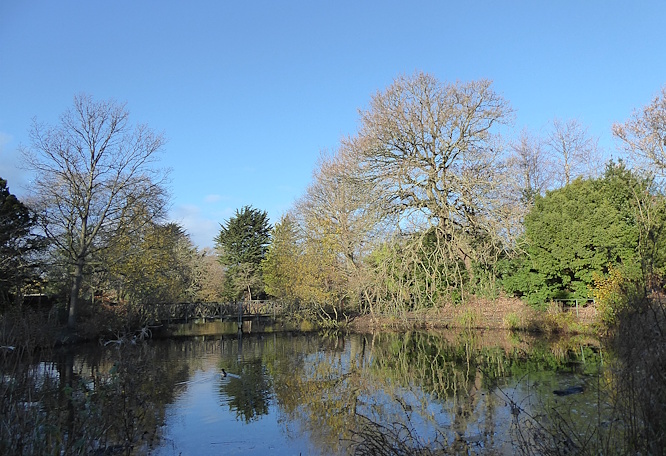
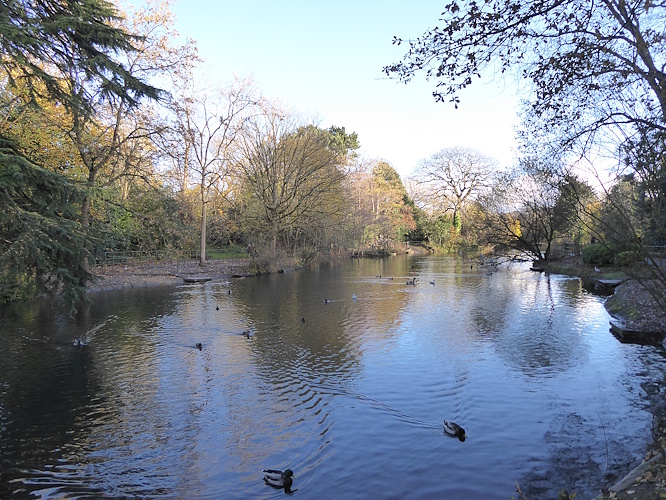
What a beautiful day for a change! It was mild and still, with a low sun catching the late autumn trees in a golden light. The park’s Grey Squirrels were very bold and numerous. Were they especially hungry after a week of bad weather and no visitors to feed them? The parkland birds like Robins and Great Tits seemed tamer as well, approaching us hopefully. Otherwise we saw the usual Magpie, Crows and just one Wood Pigeon. A Great Spotted Woodpecker was calling from a distance, but we didn’t see it. On the Lower Lake were Mallards, Canadas, Coots, Moorhens, a few Herring Gulls, three Tufties and two Cormorants in a secluded bay.
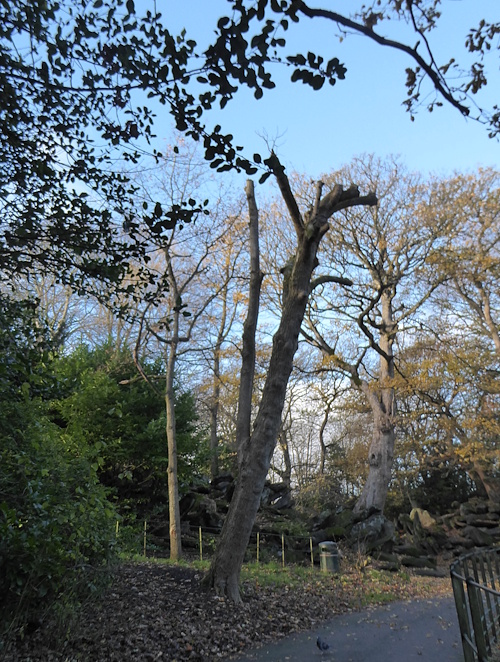
One of the park’s rarer trees, the Cucumber tree Magnolia accuminata, at the top of the lower lake near the rockery, has been comprehensively pollarded. What a shock! It used to lean out over the path, so perhaps the overhanging branches have been deemed unsafe.
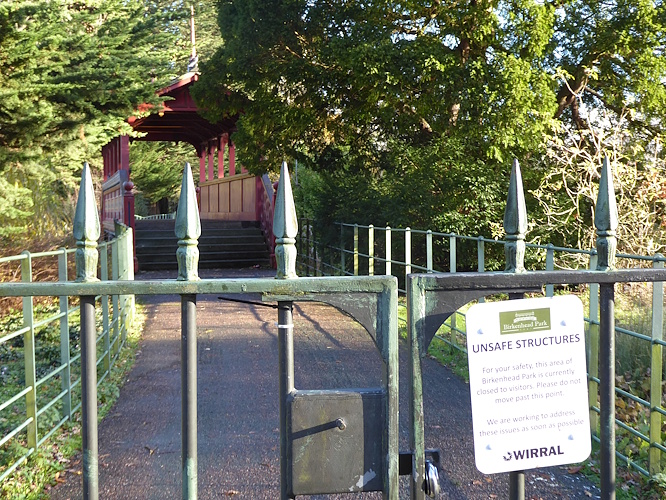
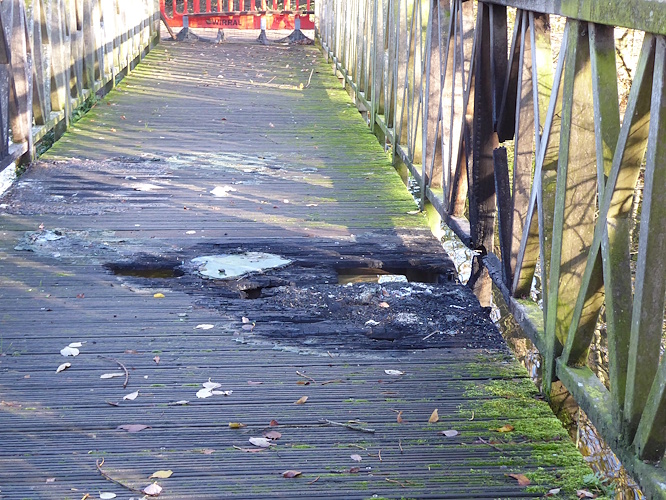
There has also been an outbreak of vandalism. The Swiss Bridge was closed, although we couldn’t see any damage. We spoke to a passer-by who said kids had kicked out something. The supports? They looked OK side on. Some windows had been broken on the visitors’ centre and “The Footbridge” (not the “Swiss” or the “Rustic” bridge) had been damaged by fire.
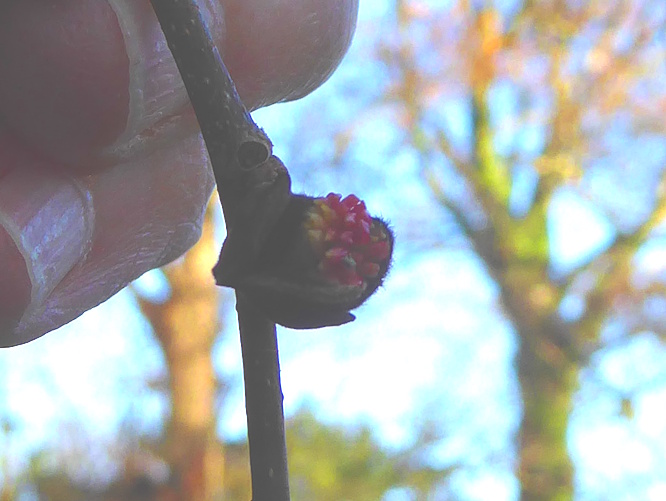
We had a look at their small Persian Ironwood Parrotia persica, wondering if its winter flowers were developing. We usually see the shocking pink blooms in January on the tree in Sefton Park. Do they start in late November? Yes, one flower was just breaking out.
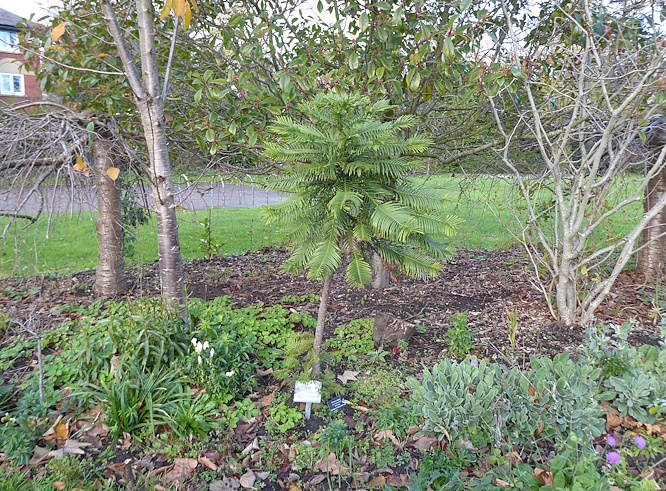
We lunched near the visitors’ centre, where we caught the only rain shower of the day, and made a discovery in one of the flower beds on the left (west) side. A Wollemi Pine! It is one of the world’s oldest and rarest plants, dating back to the time of the dinosaurs. It was discovered in Australia in 1994 hanging on in a stand of fewer than 100 adult trees. The Wollemi Pine Wollemia nobilis is now the focus of extensive propagation to safeguard its survival, with young trees planted all over the world. This one brings the number on Merseyside that I know of up to four. The others are in Princes Park, Ness Gardens and Speke Hall. The sign said it was also known as the Lazarus tree (back from the dead?), but that’s the first time I have heard that nickname.
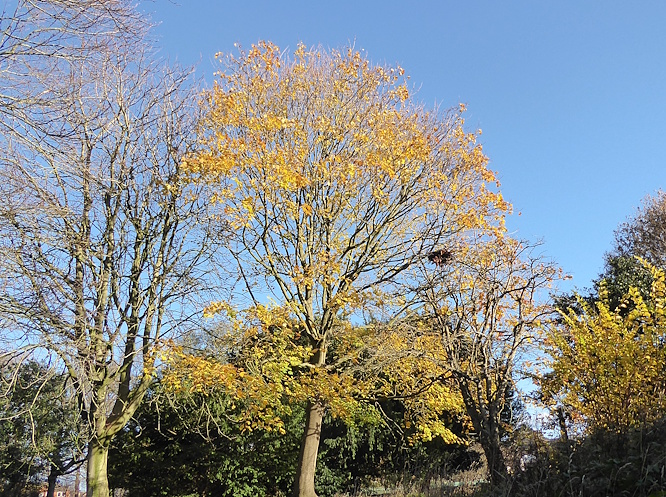
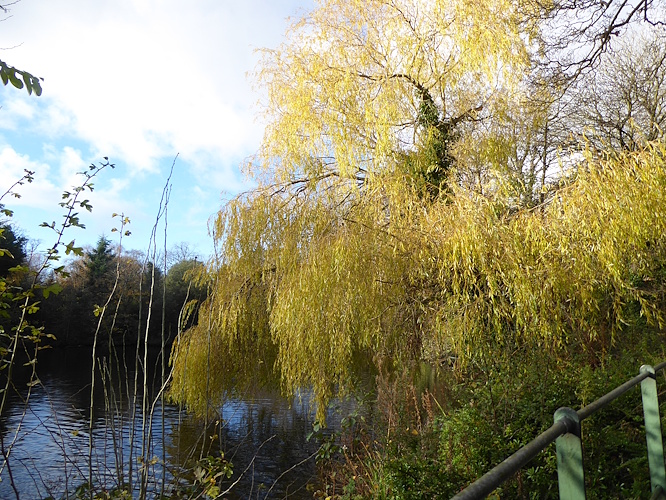
A Norway Maple was catching the bright sunshine, and its yellow leaves were golden in the bright light. A Weeping Willow in the Upper Park was doing the same trick.
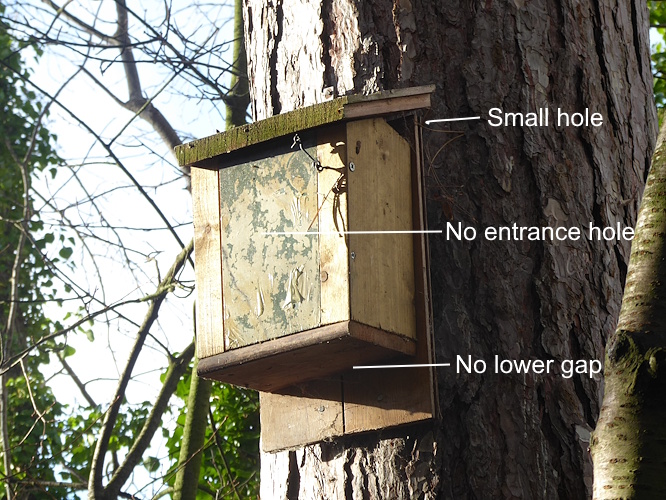
There was a very odd bird or bat box on a tree by the upper lake. There was no hole at front for small birds, nor an opening at the bottom for bats, just a little triangular hole at the side. Does anyone know what creature it’s for?
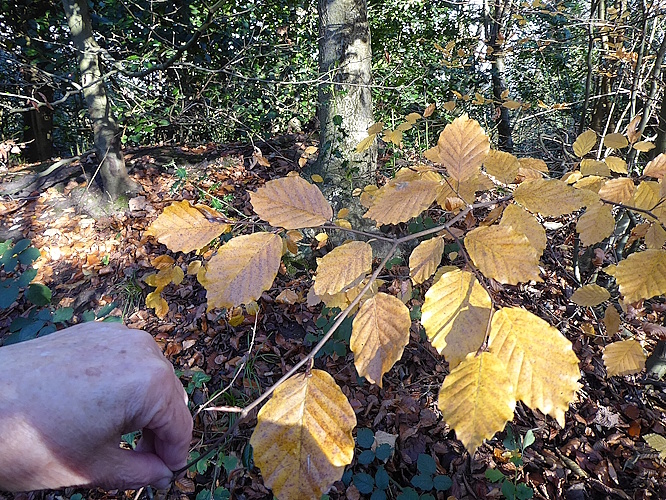
The third golden tree was this Beech, whose leaves were much lighter than the usual copper colour. I see there’s a variety called ‘Dawyck Gold’ with yellow leaves in the autumn, but that is said to be fastigiate (growing very upward-pointing) and this tree wasn’t shaped like that. Perhaps it’s just natural variation.
On the way out we went to look at the clump of Hybrid Strawberry trees Arbutus x andrachnoides at the junction of Park Road North and Ashville Road. We were surprised to see that the middle three (of five) had been felled, although the stumps were sprouting vigorously. They are rare trees, and prized by the park, but despite their rarity they must have failed a safety inspection and been deemed top-heavy and likely to fall or shed a branch, to the danger of the public. Like the Cucumber tree, at least they haven’t been removed, but carefully cut back to grow another day.
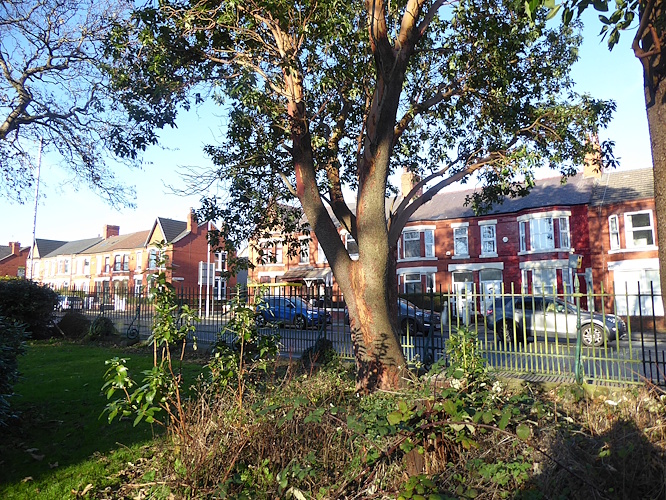
and more just to the right of the background tree trunk.
Public transport details: Train from Central at 10.05, arriving Birkenhead Park station at 10.15. Returned from Birkenhead Park Station at 13.36, arriving Central 13.55.
Next week we are going to Ormskirk. Meet 10.00 at Central Station.